How to Sell a Car With a Salvage Certificate Before Inspection in Los Angeles
You don't necessarily need to rebuild or inspect a salvage car before selling it in Los Angeles. Learn how to transfer ownership using a California Salvage Certificate, disclose vehicle damage, handle outstanding liens, and sell an unrepaired vehicle without completing revived-salvage inspections.
A car can be too damaged to drive and still be worth selling. For example, your insurer may have declared it a total loss after a collision on the 405, paid the claim, and allowed you to keep the wreck. The California DMV then issued a Salvage Certificate, but you never repaired the car because replacing the airbags, straightening the body, fixing the suspension, and going through another round of inspections would cost more than you wanted to spend. Now the damaged vehicle is sitting in your driveway or accumulating storage somewhere, and a buyer wants it exactly as it is. That is usually when the owner starts wondering:
“Do I have to rebuild and inspect this thing before I am even allowed to sell it?”
In most cases, no. The important distinction is between transferring ownership of a salvage vehicle and getting that vehicle approved for normal road use again. A California Salvage Certificate is an ownership document. It allows the salvage vehicle to be transferred. The revived-salvage inspections become important later if somebody repairs the vehicle and wants to register it for highway use. That means you do not necessarily have to replace the airbags, repair every damaged panel, complete a safety inspection, obtain new plates, and turn the wreck back into a road-ready car simply to hand ownership to somebody who wants to rebuild it themselves.
But this does not mean the sale is as simple as signing whatever document you have and letting the buyer tow the car away. The Salvage Certificate has to identify the correct vehicle and owner. Any lender still involved has to be dealt with. The condition needs to be described honestly. Old DMV charges can affect what the buyer is willing to pay. And because the vehicle is not yet revived for road use, you need to think about how it will physically leave the property. So the first question is not really:
“Has the car passed inspection?”
It is:
“What exactly am I selling today: an unrepaired salvage vehicle with valid ownership paperwork, or a vehicle whose paperwork is still incomplete?”
The Salvage Certificate Lets You Sell the Car Without Pretending It Is Ready to Drive
Imagine a sedan in Van Nuys whose front end was crushed in an accident. Both airbags deployed, the radiator is broken, and the suspension is damaged badly enough that driving the car would be unsafe. The insurer declared it a total loss, you kept the wreck, and California issued a Salvage Certificate. A private buyer looks at the car and says:
“I rebuild these. I’ll buy it exactly like this.”
You do not have to repair the airbags and suspension first simply because the buyer eventually wants to put the car back on the road. That future rebuilding project belongs to the buyer once the ownership transfer is completed. But the Salvage Certificate is already the document showing who owns the vehicle in its current status. The inspections answer a different question:
Can this vehicle be registered for highway use again after it has been repaired?
That question matters later. For example, the buyer may take the car home, spend six months rebuilding it, gather receipts for major replacement parts, and then begin California’s revived- salvage process. The buyer simply needs to understand that they are not buying a road-ready vehicle. They are buying an unrepaired salvage vehicle with an ownership document that allows them to become the next owner.
Read the Salvage Certificate Before You Start Advertising the Car
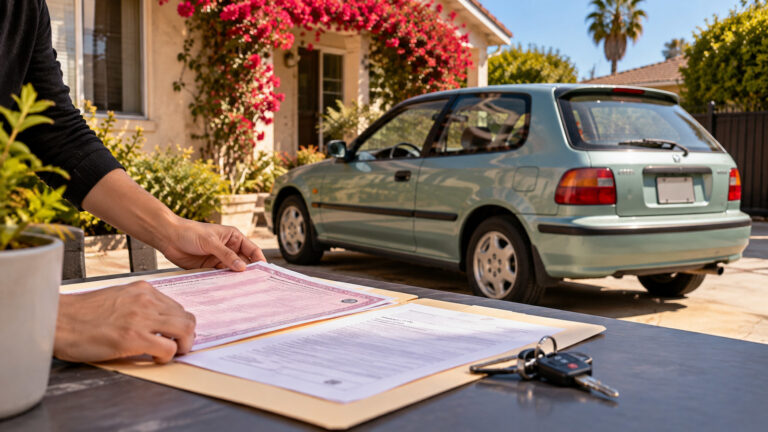
A California Salvage Certificate is not just an ordinary pink slip with the word “salvage” stamped across it. It is its own ownership document, commonly identified as REG 489. Before showing the car to buyers, take the certificate out and compare it with the vehicle. Check the VIN. Check the year and make. Check the owner information. Look at any lienholder information, restrictions, or ownership assignments that have already been completed. You want the paperwork to tell the same story as the car sitting in front of you.
For example, if your name appears correctly as the owner and the VIN on the certificate matches the VIN on the windshield and vehicle labels, you have a much cleaner starting point. Now imagine the certificate contains somebody else’s name with an incomplete assignment between that person and you. A salvage certificate can contain assignment sections documenting changes in ownership. If one of those transfers was never completed properly, the buyer may question whether you actually have the authority to transfer the vehicle today. Resolve that before accepting final payment.
Then look carefully at where you are supposed to sign. Do not assume the assignment area is identical to an ordinary California title and start following a generic pink-slip diagram from the internet. Read the labels on the actual Salvage Certificate and complete the seller or transferor section that applies to your transaction. And prepare a bill of sale as well.
The Bill of Sale Should Describe the Car the Buyer Is Actually Getting
Suppose the certificate shows valid ownership, but the vehicle itself has deployed airbags, a broken radiator, a bent front rail, and two flat tires. The bill of sale should not make the transaction sound like an ordinary used-car sale. California’s REG 135 can document the buyer, seller, VIN, sale date, and purchase price, but an additional written condition statement can make the transaction much clearer. For example, explain that the car is being sold in unrepaired
salvage condition, has not completed the inspections required for revived registration, and is not represented as roadworthy. If the airbags are deployed, say that. If the vehicle does not run, say that. If the frame or suspension is visibly damaged, say what you know. If important parts are missing, mention them. The objective is to make sure the buyer cannot reasonably say later:
“I thought I was buying a rebuilt car that only needed registration.”
If an odometer disclosure is still required for that model year and transaction, handle it through the proper accepted document. REG 262 can become relevant in certain situations, but it is a secure form with several functions and should not be treated as a universal form you print whenever any transfer gets complicated. And if the Salvage Certificate itself is missing, you now have a different problem to solve before the buyer should hand over the money.
Losing the Salvage Certificate Is Not the Same as Losing an Ordinary Pink Slip
Suppose the insurer completed the total-loss process, you received the Salvage Certificate, and then somewhere between moving house and storing the damaged car, the certificate disappeared. But a missing Salvage Certificate is not necessarily handled the same way as an ordinary lost title. California uses REG 488C, Application for Salvage Certificate or Nonrepairable Vehicle Certificate, for the applicable duplicate-salvage process, together with REG 256 explaining whether the original certificate was lost, stolen, or destroyed.
The DMV process can depend on who originally applied for that Salvage Certificate. For example, if you were the owner-retainer who applied for the certificate after the insurance settlement, the replacement path may be relatively straightforward. Now imagine you bought the wreck from somebody else but never received the original certificate. You should not simply sign a duplicate request pretending you were the original applicant if the DMV record says otherwise. This is why the phrase:
“I don’t have the salvage title”
is not enough to tell you what paperwork you need. The real question is whether the document was issued to you and later lost, or whether the ownership chain was never completed properly in the first place. And while checking the certificate, make sure it really is a Salvage Certificate, because a Nonrepairable Vehicle Certificate creates a completely different future for the car.
Salvage and Nonrepairable Do Not Mean the Same Thing
Two badly wrecked cars can look almost identical in a storage yard. One may carry a California Salvage Certificate. The other may carry a Nonrepairable Vehicle Certificate. Those documents do not give the buyer the same options. A salvage vehicle can potentially be rebuilt and returned to California highway use after it is repaired and satisfies the applicable revived- salvage requirements. A nonrepairable vehicle cannot simply be rebuilt, inspected, and turned
back into a normal road car. It is intended for parts or material recovery. This difference can have a major effect on price.
For example, a hobbyist may pay more for a salvage pickup because they believe the chassis, drivetrain, and remaining body justify rebuilding the truck. The same buyer may have much less interest in an otherwise similar nonrepairable vehicle because the future use is fundamentally different. So do not advertise:
“Salvage, easy rebuild”
until you have actually looked at the certificate. Cash Cash Cars discusses a related ownership problem in its article about salvage versus an Export Only title. Once you establish that the vehicle genuinely has a transferable Salvage Certificate, the next practical problem is getting it to the buyer. That should normally happen without pretending the car is already legally revived.
The Buyer Can Own the Salvage Car Before the Car Is Allowed Back on the Road
Suppose the buyer signs the agreement, gives you the money, and receives the properly endorsed Salvage Certificate. They now own the vehicle. That does not mean they should jump in, start the engine, and drive it across Los Angeles. Ownership and legal highway use are separate. For an unrepaired salvage vehicle, a flatbed or suitable car trailer is usually the easiest solution because the car does not need to operate under its own registration. That is particularly important when airbags have deployed, lights are broken, steering components are damaged, the suspension is bent, or the tires are unsafe. Even if the car physically moves, road use can still be illegal or dangerous.
California has a one-day Vehicle Moving Permit, REG 172, for certain qualifying movements. But it is not a general permit saying every salvage buyer gets one free day to drive an unsafe wreck anywhere they want. The underlying vehicle status and purpose of the movement matter. So if you know the car needs a flatbed, make that part of the sale from the beginning.
The buyer should also know the loading condition. Does the car roll? Does the steering move? Are all four wheels present? Is the parking brake stuck? Is the vehicle in an underground garage where a full-size flatbed cannot enter? A buyer who arrives expecting to winch a rolling car and finds a wheel-less shell on blocks may change the offer simply because the pickup has become a different job. Which leads to the next issue: how much is the unrepaired salvage car actually worth?
The Salvage Certificate Does Not Create One Standard Discount
There is no useful rule saying:
“Salvage cars are always worth 40 percent of clean value.”
The vehicle has to be valued as the actual damaged car sitting in front of the buyer. For example, imagine two clean-title vehicles would each be worth $20,000 in normal condition. The first salvage vehicle has cosmetic front-end damage, no structural damage, intact airbags, and readily available parts. The second has frame damage, deployed airbags, damaged wiring, missing lights, and a broken suspension. They should not be valued with the same salvage percentage simply because both carry the same type of ownership certificate.
Different buyers also look at the numbers differently. A private project-car buyer may begin with what they think the vehicle will be worth after repair and then subtract the work they expect to do. A professional rebuilder may also subtract labor, parts, inspections, registration costs, transportation, and the profit margin needed to justify the project. A dismantling-oriented buyer may focus much more heavily on the engine, transmission, catalytic converter, wheels, body panels, electronics, and metal value. Uncertainty lowers offers because the buyer cannot know exactly what will be found once the damaged areas are taken apart.
Airbag deployment is particularly important. Replacing airbags correctly can involve more than simply buying a used steering-wheel module. Sensors, pretensioners, control modules, wiring, seat components, dashboard pieces, and other restraint-system parts can all become involved. This is why you should describe the condition accurately when requesting an offer. Do not say:
“Minor front damage”
when both airbags deployed and the wheel is pushed backward. For context, Cash Cash Cars discusses how damaged and unwanted vehicles are approached in its guide to how much a junk car can sell for. And that calculation should include old DMV fees as well.
A Salvage Certificate Does Not Automatically Wipe the DMV Record Clean
Suppose the wreck sat for two years after the insurance settlement because you kept telling yourself you might rebuild it. A buyer may also care about what is sitting on the DMV record. California distinguishes ownership of a salvage vehicle from registration of a rebuilt vehicle for highway use, but that does not mean every old registration fee or penalty automatically disappears when the Salvage Certificate is issued. This is why you should check the record before telling the buyer:
“Don’t worry about any old fees. Salvage clears everything.”
That can be wrong. If the vehicle had properly maintained Planned Nonoperation or another qualifying nonoperation status, the balance may be very different from a car whose owner simply stopped paying registration. Certain penalties, and in more limited circumstances other fees, can be treated differently for qualifying buyers under California law. That still does not create a universal rule that every person buying salvage receives a complete fee waiver.
For example, a rebuilder may be willing to pay $4,000 for the vehicle assuming the DMV side is relatively clean. If they later discover significant charges that affect the revival process, that cost may come straight out of what they were willing to pay you. So check the VIN record and understand what exists before negotiating the final number. A salvage certificate does not cancel debt either.
The Insurance Company Calling the Car a Total Loss Does Not Make the Auto Loan Disappear
Imagine the vehicle was financed when it crashed. The insurer declared it a total loss, but you still retained the vehicle and a Salvage Certificate was issued. Now you want to sell the wreck. If a lender still has an ownership or lien interest, you cannot simply ignore it because the car is no longer roadworthy. The salvage certificate describes the vehicle’s ownership status after the loss. The lien says somebody else still has a financial claim against that ownership.
Ask the lender for the current payoff. Find out whether it physically holds the Salvage Certificate or another title document connected with the total-loss process. If the lender participates electronically, ask what release procedure applies.
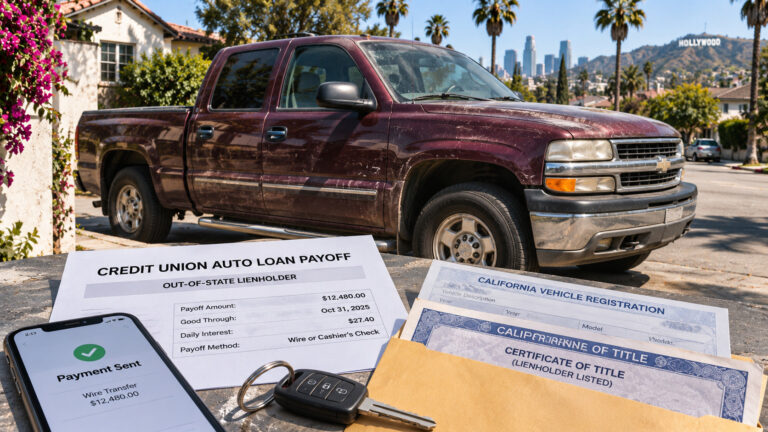
Suppose the salvage vehicle is worth $7,000, but the remaining loan payoff is $10,000. The buyer can pay the full $7,000 market value and the lender is still short $3,000. You have negative equity even though the car has already been totaled. The shortage needs to be resolved through money you contribute or another arrangement the lender agrees to before clean ownership can move. REG 166 can help document certain lien releases, but it is not a universal paper solution for every lender or electronic lien. Cash Cash Cars’ guide to selling a car with a lien explains that payoff side separately. Once the ownership document and lien are clear, the buyer can take over the part of the process that many sellers mistakenly think they have to complete themselves: the revived-salvage inspections.
The Buyer Can Rebuild the Car and Deal With the Inspections After the Sale
Suppose the buyer’s entire reason for purchasing the vehicle is to rebuild it. They deal with any structural, steering, braking, lighting, tire, electrical, and restraint-system work needed to prepare the vehicle for inspection.
Once the car is actually ready, California’s revived-salvage process begins. That can involve REG 343, acceptable ownership evidence, the applicable DMV charges, and identification verification. Depending on the vehicle and its history, the identification portion may be handled by an authorized DMV employee or may require referral to the California Highway Patrol. California also now uses the Vehicle Safety Systems Inspection administered through the Bureau of Automotive Repair. This process replaced the older separate brake-and-lamp certificates and looks more broadly at major safety systems, including structural areas, brakes, lights, steering, suspension, tires, wheels, and passenger-compartment safety equipment.
Applicable diagnostic checks and open safety recalls can also become part of that process. A smog inspection may be required depending on the vehicle.
You are not selling a revived salvage vehicle. You are selling a salvage vehicle that has not yet been revived. The buyer should understand what that means and should never be promised:
“It just needs inspection.”
You do not know that. The buyer may discover additional frame damage, electrical problems, missing parts, or other defects once repair work starts. And California places different obligations on businesses that rebuild and resell revived salvage vehicles than on an ordinary registered owner selling their own unrepaired vehicle. This is why describing yourself accurately matters too. The buyer is taking on the future repair and inspection risk. But an as-is sale does not give you permission to hide what you already know.
“As-Is” Means the Buyer Accepts Risk, Not That You Can Invent a Better Car
Suppose the buyer understands the vehicle is salvage and unrepaired. They know the car has front-end damage. They inspect it, sign an as-is agreement, and tow it away. Two weeks later, they remove the damaged panels and discover that the repair is more extensive than they expected. That uncertainty is part of buying an unrepaired salvage vehicle.
But now change the facts. You already knew the frame had been cut. You knew both airbags were missing. You knew the car had severe flood damage in addition to the collision. And you told the buyer:
“No frame damage, airbags intact.”
An as-is clause does not turn those statements into acceptable disclosure. This is why the condition description should be factual. Tell the buyer what you know. If you do not know what is behind a damaged panel, say you do not know. A signed condition statement can help. For example, record that the vehicle is sold in unrepaired salvage condition, that airbags have deployed, that structural or hidden damage may exist, and that the buyer is responsible for future repairs and registration. Let the buyer inspect the car before payment. Keep photographs showing its condition when it left you. Once the buyer has inspected the vehicle and accepts the condition, close the sale so the money, ownership document, and transportation all happen in a controlled order.
The Cleanest Sale Is One Where the Paperwork and the Flatbed Arrive at the Same Time
Before the buyer comes, compare the VIN on the Salvage Certificate with the vehicle one final time. Then complete the correct transferor assignment on the original Salvage Certificate and
give the endorsed document to the buyer as part of the closing. Complete the bill of sale with the real price and date. Describe the vehicle accurately. For example:
“Sold in unrepaired salvage condition. Vehicle has not completed revived-salvage inspections and is not represented as roadworthy.”
If you have agreed that the buyer will handle future inspection, registration, towing, or storage costs, document that understanding. Then let the vehicle leave through the method you agreed upon. If the car is not safe or legal to drive, use proper transport. Do not finish an otherwise careful sale by watching the buyer drive a badly damaged salvage car away on old plates simply because the engine happened to start.
Once possession changes, file the California Notice of Transfer and Release of Liability, commonly called the NRL or REG 138, within five calendar days. Keep the confirmation with a copy of the bill of sale, photographs of the vehicle, and your copy of the certificate. The NRL does not itself transfer ownership. The buyer still has to complete their side. What it does is create a record of when you reported that the salvage vehicle stopped being yours. And at that point, the rebuilding decision finally belongs to somebody else.
You Do Not Have to Finish Somebody Else’s Rebuilding Project Before You Sell
The Salvage Certificate can make the vehicle feel unfinished because it has not yet been approved for road use. But you do not necessarily have to finish that process. If the certificate correctly establishes your ownership, the VIN matches, any lien has been resolved, and the buyer understands that the vehicle is being sold unrepaired, ownership can generally change before the revived-salvage inspections are completed.
Your responsibility is to sell the vehicle you actually have. Not the vehicle it might become after somebody spends thousands of dollars repairing it.
Once those pieces are handled correctly, you can sell the car for what it is today rather than investing more money in turning it back into a car you no longer want.
Cash Cash Cars Can Value the Vehicle Before You Spend Money Rebuilding It
Not every salvage owner wants to find a hobbyist willing to spend weekends rebuilding a wreck. For example, replacing the airbags, front structure, lights, cooling system, suspension, and body panels may cost far more than expected. Cash Cash Cars reviews salvage, total-loss, rebuilt, wrecked, damaged, and non-running vehicles throughout Los Angeles and surrounding areas, including North Hollywood, Burbank, and Santa Clarita. You do not need to complete the revived-salvage inspections simply to ask what the car is worth now.
Provide the year, make, model, mileage, VIN, and Salvage Certificate status. Then describe the damage honestly. Does the car start? Does it roll? Can the steering move? Are all four wheels present? Did the airbags deploy? Is there structural damage? Are important parts missing?
Then explain where the car is located. A damaged vehicle sitting in an open driveway is one pickup. A wheel-less wreck in an underground garage or storage yard is another. Also disclose anything that affects the ownership path. Is the Salvage Certificate missing? Does a lender remain? Is an insurance claim still open? Is there an unusual restriction on the certificate? Those details should be understood before anyone schedules collection.
You can use Cash Cash Cars’ salvage vehicle buying page or contact page to compare an as-is offer with what you would spend repairing, transporting, inspecting, and registering the vehicle yourself. You can also request a cash offer or call 818-822-1863 after sharing the Salvage Certificate, vehicle condition, and pickup details. That comparison is often enough to answer whether the rebuilding project is worth continuing.