How to Sell a Car on PNO or With Suspended Registration in Los Angeles
Selling a car on PNO or with suspended registration in Los Angeles? Learn how fees, smog, title issues, transport, and DMV transfer rules affect the sale.
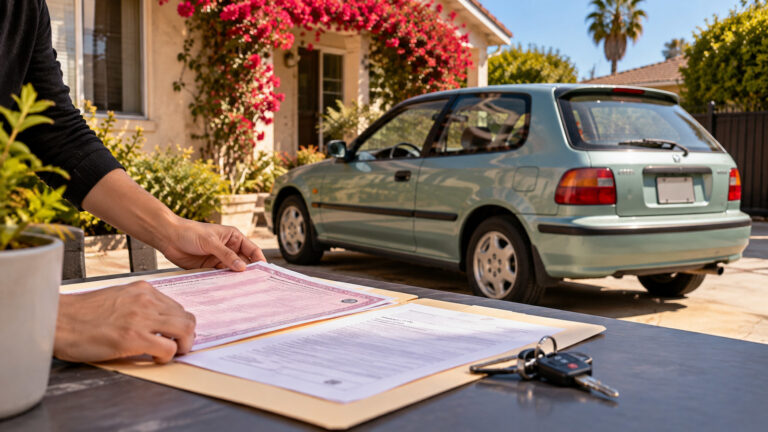
A car can sit in a Los Angeles driveway for months or even years without moving, but the moment you decide to sell it, the old registration suddenly becomes important again. For example, the engine may have failed two years ago, so you filed Planned Non-Operation and stopped spending money on insurance. In another case, you may never have filed PNO at all and simply let the registration expire because the car was not being used. Or perhaps the DMV suspended the registration after the insurance lapsed while the vehicle was sitting. By the time you decide the car is no longer worth repairing, the battery may be dead, the tires may be flat, and the tags may be years out of date, so the last thing you want is to spend another thousand dollars making a vehicle road-ready when your actual goal is to get rid of it.
This is where many sellers make the wrong assumption. They see old tags and immediately think, “I have to register the car again before anybody can buy it.” In many cases, that is not true because California treats ownership of the car and permission to operate it on public roads as two different matters. A vehicle does not stop belonging to you because its registration is inactive, expired, or suspended. What changes is the amount of money sitting on the DMV record, whether the car can legally be driven, what paperwork the transfer needs, and what the new owner will have to do before using it on the street.
The more important point is that PNO, expired registration, and suspended registration may all look the same from the driveway, but they can create very different financial consequences. This means the first step should not be paying the DMV. It should be finding out exactly what the DMV record says.
The Same Expired Tags Can Hide Three Very Different Problems
Imagine three identical sedans sitting in three Los Angeles driveways. None has current registration stickers, and all three have been off the road for roughly two years. The first owner properly filed Planned Non-Operation after the engine failed. The second simply stopped renewing the registration because the car was no longer being driven. The third kept the registration current for a while but later allowed the insurance to lapse, after which the DMV suspended the registration. Looking at the license plates, you might think all three owners have the same problem. They do not.
PNO is specifically intended for a vehicle that will remain off public roads. When the status was properly filed and the car genuinely remained non-operational under the applicable rules, ordinary annual registration charges generally do not continue accumulating in the same way. This is why properly using PNO can save the owner a significant amount of money when a vehicle is going to sit for a long period. Simply allowing the registration to expire does not create the same protection. California does not automatically know that the car spent two years behind your house with a blown transmission. Without PNO or another applicable exception, renewal charges and late penalties can continue building even though you personally never drove the car.
An insurance suspension is different again because the DMV has actively restricted the registration after a compliance problem, commonly involving failure to maintain or report the required liability insurance. The vehicle can even have both expired registration and an insurance-related suspension at the same time. This is why looking at the date on the sticker is not enough to tell you what you actually need to fix.
Before advertising the car, check the notices you received and the current DMV record. An owner can also obtain vehicle-record information and ask for an itemized account of the outstanding charges and restrictions. One seller may discover that the car has clean PNO status and can be transferred relatively simply, while another discovers hundreds or thousands of dollars in delinquent registration fees. Knowing which situation you have prevents you from spending money solving a problem that may not need to be solved before the sale.
A Properly Maintained PNO Vehicle Does Not Need to Become Road-Ready Just to Change Owners
Suppose your SUV developed a transmission problem in North Hollywood two years ago. You knew you were not going to repair it soon, so you filed PNO and left the vehicle on private property. Now you have finally decided the transmission is not worth replacing and want to sell the SUV as it sits. At first, paying for a full year of registration just to hand the vehicle to somebody else may seem unavoidable, but doing that would defeat much of the purpose of placing it on PNO in the first place.
California provides a transfer-only route for qualifying vehicles whose records show PNO and which have remained off public roads in a manner that did not make normal registration charges due. This means ownership can change while the vehicle itself remains non-operational. The buyer can take ownership, move the car to private property through an appropriate method, repair it when convenient, and restore active registration later if they intend to drive it.
Depending on the transaction, the paperwork can involve the normal ownership documents together with REG 256 requesting a transfer only and REG 102 confirming the non-operation status. A bill of sale is also useful because it documents the price and makes clear that the buyer is taking the vehicle in a non-operational condition. The important point is that ownership transfer and road registration are not the same thing. The new owner can legally own the car before the car is legally ready to drive. For example, a buyer may want your non-running SUV as a restoration project. They do not need you to install a transmission, insure it, register it, and make it roadworthy first if the transaction can properly be completed in its current status. They can arrange transport and decide later whether bringing the vehicle back into service makes financial sense. If your PNO car does not run at all, this is also why comparing its current value with the cost of making it road-ready can be more useful than automatically restoring the registration before asking for offers.
Insurance Suspension Sounds Worse, but It Still Does Not Automatically Stop the Sale
Now change the situation. You never filed PNO. The vehicle sat unused, the insurance was canceled, and the DMV eventually suspended the registration. Because the word “suspended” sounds serious, sellers sometimes assume the DMV has effectively frozen the title and the car cannot be transferred until the suspension is cleared.
That is not necessarily the case.
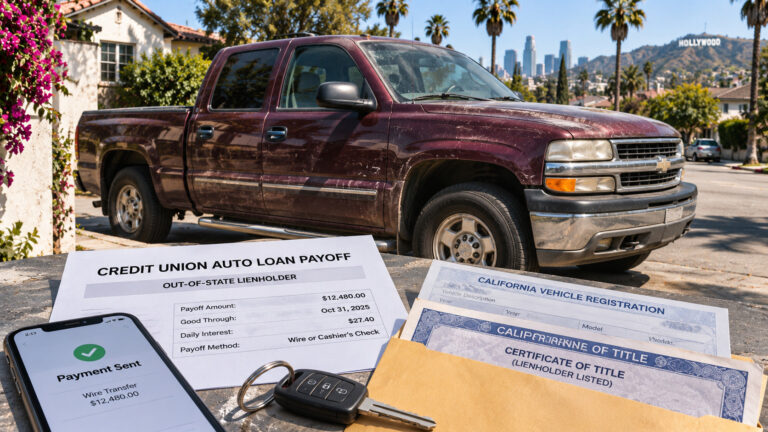
If you intend to keep the car and return it to normal road use yourself, reinstating an insurance-related suspension generally means restoring the required financial responsibility and paying the applicable reinstatement charge, which the source material identifies as $14. But if your intention is to sell the vehicle rather than continue driving it, reinstating your own registration is not automatically required merely to transfer ownership. California treats the registration differently when the vehicle changes hands, and the new owner then becomes responsible for satisfying the requirements that apply before the car returns to normal public-road use.
This difference matters most with low-value cars. For example, imagine a 17-year-old sedan worth perhaps $1,500 in its present condition. The registration is suspended because the insurance lapsed, the engine is weak, and the car has been parked for a year. Buying insurance, reinstating the registration, repairing the engine, and renewing everything simply so you can sell the car as a running vehicle may cost more than the additional sale price you would receive. In that situation, selling the car honestly in its current condition may make far more sense than spending money turning it back into a car you no longer want.
What you should not do is hide the suspension. Tell the buyer why the registration is suspended, whether the normal registration also expired, and whether you know of any other fees or holds. Saying, “The insurance lapsed while the car was stored, and DMV suspended the registration,” gives the buyer something specific to evaluate. Saying, “DMV has some problem with it,” creates unnecessary suspicion and can make the transaction harder than the actual issue deserves.
And once you look at the record closely, you may discover that the suspension itself is not the most expensive problem. The accumulated fees can be. The Amount Owed to the DMV Can Matter More Than the Word “Suspended”
A neglected vehicle often becomes expensive quietly. You stop driving it, forget about the renewal notices, and assume the issue can be handled when somebody finally buys the car. Then a buyer checks the record and discovers a substantial amount of delinquent registration and penalties. At that point, the selling price has to be reconsidered because somebody will eventually have to deal with those charges before the vehicle returns to ordinary registration.
This is another reason a proper PNO vehicle can be much easier to sell than a car whose registration simply expired. A legitimate PNO filing can prevent normal annual registration charges from accumulating in the same way. A vehicle that was merely ignored may carry a much larger balance.
Before setting the price, find out what the DMV is actually showing and separate the different types of charges instead of treating them all as one debt. Registration fees are not the same as late penalties. Parking citations and toll violations are another category again. In an ordinary transfer to an unrelated buyer, certain pre-transfer parking and toll violations may be removed from the vehicle record even though the person responsible for those violations can still owe the underlying money. Some family and trust transfers are treated differently, which is why a seller should not casually promise a buyer that “all the tickets disappear when I sell it.”
For example, saying that “the car owes $1,200” does not really explain anything. Perhaps $900 is delinquent registration the buyer will have to address before active registration. Perhaps $300 consists of parking violations that will be handled differently after a qualifying ownership change. Those numbers affect the transaction in different ways. If the vehicle would normally be worth $4,000 but the buyer can confirm that $1,200 in registration-related charges will have to be paid, it is reasonable for that expense to affect the offer.
The best time to discover that difference is before the buyer is standing beside the car. Once you understand the financial record, you can decide whether paying some of the charges yourself increases the sale price enough to justify doing so or whether it is better to sell the vehicle at a lower price and let the buyer handle the registration side later.
Then another California rule enters the picture, and this one does not disappear simply because the vehicle was on PNO.
PNO Does Not Turn a Smog Problem Into a Registration Problem
A long-stored vehicle can create a confusing situation because the seller may be able to transfer ownership without restoring ordinary registration but still face California’s normal smog rules for the type of sale being made. This is because PNO and Smog Check deal with different things. PNO determines whether the vehicle is being kept off public roads and whether normal registration is being maintained. Smog rules concern emissions compliance and the requirements surrounding certain changes of ownership.
For example, suppose your sedan has been on valid PNO for two years but still starts and runs. The Check Engine light is on, and you know the vehicle will not pass emissions testing in its present condition. The fact that the car was legally stored on PNO does not automatically remove the smog requirement that may apply to an ordinary private-party sale.
Now you have two problems that need to be kept separate. One is that the car is not presently registered for ordinary road use. The second is that it may not pass the emissions inspection required for the transaction. If the vehicle needs to travel to an inspection or repair location, California’s one-day vehicle moving permit, REG 172, can sometimes authorize specific movements involving a PNO vehicle. But this is not a general-purpose one-day registration pass. The movement has to match the permitted purpose, and if the vehicle is uninsured, mechanically unsafe, or unreliable, transporting it on a truck may still be the better option.
The financial question becomes even more important when the vehicle fails smog. Suppose emissions repairs will cost $2,000, but the car may only sell for $2,500 after the work is completed. Spending $2,000 simply to convert a difficult private sale into a slightly easier private sale does not leave you much better off. An “as-is” agreement with a private buyer also does not automatically eliminate the seller’s smog obligations when California law requires the certification.
This is why the type of buyer matters. Qualifying transactions with appropriately licensed dealers or dismantlers can follow different smog rules from a normal private sale. If the car has already failed inspection, the useful question is not merely whether it can be fixed. It is whether fixing it adds enough value to justify the repair. Our guide to selling a car that failed smog explains that calculation in more detail.
There may also be special programs for some older operable vehicles. California’s vehicle-retirement program can offer incentives at different levels, including amounts identified in the source draft as $1,350, $1,500, or $2,000 depending on eligibility. But a long-stored non-running car on PNO should not be assumed to qualify. Registration history, operating condition, inspection requirements, and ownership rules all matter, so the retirement payment should not be treated as guaranteed money until eligibility is confirmed.
The Buyer Can Inspect the Vehicle Without Turning the Sale Into an Illegal Test Drive
A PNO car does not need to be hidden from buyers merely because it cannot legally be driven around the neighborhood. If the vehicle is sitting on private property where you have permission to keep it, the buyer can inspect the body, interior, engine compartment, tires, title, and maintenance records. A mechanic can inspect the car there as well. If it is mechanically safe to start, the engine can potentially be evaluated on private property without pretending that the registration is active.
The difficulty begins when the buyer says, “I just want to take it around the block to test the transmission.”
The trip may only take five minutes, but that does not make the registration restriction disappear.
The same principle applies to a vehicle with suspended registration. A normal road test is still operation on a public street. REG 172 can authorize certain specific movements involving qualifying vehicles, including travel connected with inspection, repair, storage, or another approved purpose, but it should not be treated as a generic sales test-drive permit.
If the buyer needs the vehicle examined somewhere else, the car may be transported, or an appropriate permitted movement may be arranged where the rules allow it. With an old or non-running vehicle, using a flatbed can often be easier than temporarily recreating lawful road use just so somebody can drive it for a few minutes.
This is also why the physical pickup should be discussed before the sale is finalized. A PNO car that rolls, steers, and sits on a flat driveway is easy to load. The same car with locked steering inside a low-clearance apartment garage may require different equipment. Tell the buyer whether the vehicle runs, rolls, steers, brakes, and has usable tires, along with any gate, garage, or access problem.
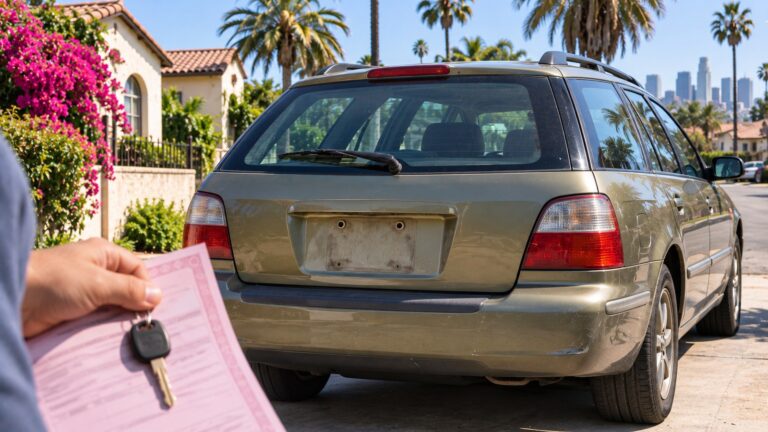
The plates generally remain with an ordinary California vehicle when ownership changes unless a special plate rule applies. Expired tags do not mean you should automatically remove them. The plate identifies the vehicle; it does not give the new owner permission to drive it.
This distinction becomes particularly important if the vehicle did not actually remain off public roads after PNO was filed.
PNO Saves Money Only While the Car Is Truly Kept Non-Operational
Filing PNO is not a permanent waiver that protects the car regardless of what happens afterward.
For example, suppose you properly filed PNO while the vehicle sat in your North Hollywood driveway. Six months later, contractors needed the driveway, so you pushed the car into the street and left it there for four days. You may think the PNO remains untouched because the engine never ran.
The DMV can look at the situation differently because PNO concerns use and presence on public roads, not merely whether the engine was running. If the vehicle is driven, parked, towed, or left standing on a public road in a manner that makes registration due, full registration fees and penalties can become payable. A parking citation can also create a record showing that the supposedly non-operational vehicle was on a public street during the PNO period.
This can completely change the economics of a sale. A seller may believe the car has a clean transfer-only PNO record and promise the buyer there are no back charges, only to discover that public-road use triggered a larger balance.
If the car was moved onto the street or otherwise used after PNO was filed, check the record before making promises about the fees. Do not assume the old PNO filing still protects you simply because the car was not driven very far.
This also explains why the sale date and handoff record matter. If you violated the PNO restrictions before the sale, filing an NRL afterward does not erase what happened while you owned the vehicle. If the buyer takes possession and then drives the car illegally, your sale documents and timely release-of-liability filing help establish when your responsibility ended.
By this point, many sellers discover one more problem created by the car sitting for years: the title has disappeared.
Losing the Pink Slip Does Not Mean You Have to Register the Car Again
Suppose the vehicle has been properly on PNO for two years, but somewhere between moving house, cleaning the garage, and putting old papers into storage, you lost the California title.
The car is still yours.
The missing pink slip is a document problem rather than proof that ownership vanished.
California’s REG 227, Application for Replacement or Transfer of Title, can be used in qualifying situations involving a lost, stolen, or damaged title. Depending on the circumstances, the replacement and ownership transfer can sometimes be addressed together instead of making you wait for a newly printed title and then beginning another transaction.
But REG 227 only solves the problem it was designed to solve. If a lender still has a legal interest, the lien still needs to be released. If another registered owner is listed, that owner’s rights still matter. If unpaid fees or a suspension exist, those issues remain separate.
This is why a detailed explanation is much more useful to a buyer than saying, “The title is missing, but DMV will fix it.” For example, saying, “The vehicle is on valid PNO, I am the registered owner, there is no lender, and the original title was lost,” gives the buyer a specific ownership picture. If the car has both missing-title and registration complications, mention all of them before pickup. Cash Cash Cars reviews vehicles without a title in qualifying situations, but ownership has to be established before a lawful purchase can proceed.
And once ownership is transferred, the buyer inherits one important decision that you no longer need to make: when to put the car back on the road.
The Buyer Can Own the Vehicle Today and Register It for Road Use Later
This is the distinction that makes the entire subject easier to understand.
Ownership does not equal road permission.
A buyer can acquire a non-operational vehicle while it remains unregistered for ordinary use. To return the car to normal California roads, the new owner generally needs to satisfy the applicable registration charges, obtain required smog certification, and maintain the legally required financial responsibility.
The source draft correctly notes that California’s minimum liability limits changed in January 2025 to $30,000 for injury or death to one person, $60,000 for injury or death to more than one person, and $15,000 for property damage. Older advice referring to the previous $15,000/$30,000/$5,000 limits is therefore outdated.
But getting the DMV paperwork active is only part of returning a stored car to use. A vehicle that has been sitting for two years may also need tires, brakes, a battery, fluids, fuel-system work, or other mechanical attention before anyone should drive it. A permit does not make an unsafe car safe.
This is another reason the seller may not need to restore everything before the sale. The buyer can decide how much work the vehicle needs, where to repair it, and when it makes sense to reactivate registration. From the seller’s side, the remaining decision is purely financial: will putting money into this car before selling leave you with more money afterward?
Spending Money on Registration Only Makes Sense When the Car Becomes Worth Enough More
Imagine a well-maintained car that was put on PNO only because you stopped using it. It runs well, passes smog, has good tires, and needs very little before returning to the road. Restoring registration and selling it as a ready-to-drive vehicle may produce enough of a price increase to justify the expense.
Now change the car. The engine is blown, the registration expired before you filed anything, it failed smog before being parked, one tire is flat, and the body has accident damage. Bringing registration current does not solve the main reasons the car is worth less. This is where sellers can spend $1,500 or $2,000 on registration, insurance, emissions work, and mechanical repairs only to increase the selling price by $1,000.
At that point, you did not improve the economics of the sale. You simply converted an unwanted car into a more expensive unwanted car.
So rather than automatically paying every charge because the tags look old, compare the vehicle’s as-is value with its realistic value after the money is spent. If restoring registration creates a genuine net gain, do it. If the repair and registration costs absorb most or all of the additional selling price, selling the car in its current condition can be the better decision.
This is also where a direct offer becomes useful because it gives you a real number to compare rather than a theoretical private-sale price.
Cash Cash Cars Can Value the Vehicle Before You Decide What Is Worth Fixing
Cash Cash Cars buys old, unwanted, damaged, wrecked, salvage, mechanically troubled, and non-running vehicles throughout Los Angeles, the San Fernando Valley, Santa Clarita, and nearby communities. A car being on PNO, having expired tags, or carrying an insurance-related registration suspension does not automatically prevent it from being reviewed.
The important thing is to describe the actual situation rather than reducing everything to “expired registration.”
For example, a clean PNO vehicle with a failed transmission is different from a car with five years of delinquent registration, an insurance suspension, and a missing title. Both may have old stickers on the plate, but the paperwork, value, and pickup process are completely different.
Before requesting an offer, gather the year, make, model, VIN, title or other available ownership documents, mileage, and DMV notices. Explain whether the vehicle is officially on PNO, whether registration was suspended because of insurance, or whether the renewal simply expired. Mention known fees, liens, missing paperwork, or smog problems during the same conversation.
Then explain the physical condition. Does the car start? Does it roll? Does the steering move? Are the wheels present? Is it sitting in an open driveway or inside a garage where a full-size tow truck may not fit? Cash Cash Cars provides free towing for qualifying purchases, but the pickup still has to match the vehicle and location.
Once the ownership, condition, registration situation, and final offer are confirmed, payment is completed before the vehicle leaves. You can request a cash offer or call 818-822-1863 and compare what the car is worth today with what it would cost you to put it back on the road. That comparison is often more useful than asking whether every registration problem can theoretically be fixed.
Finish the Sale So the Registration Problem Stops Following You
Once the vehicle leaves, file the California Notice of Transfer and Release of Liability, commonly known as the NRL or REG 138, within five calendar days.
Use the buyer’s correct name and address, the vehicle information, and the actual transfer date, then save the confirmation with your bill of sale, title documents, PNO paperwork, and any records showing what fees or restrictions were disclosed.
This is particularly important when selling a PNO or suspended-registration vehicle because the buyer may not put it back on the road immediately. For example, they may tow it to private property and spend six months repairing it before completing active registration. You do not want tolls, parking notices, or later registration problems returning to you simply because the buyer delayed their own work.
The NRL has limits too. It does not complete the buyer’s title transfer, erase old debts, or protect you from PNO violations that occurred before the sale. What it does is establish when you told the DMV the vehicle left your ownership.
That is exactly how the sale should end.
The important decision was never simply whether the registration could be restored. Almost any paperwork problem can become expensive if enough money is thrown at it. The better question is whether spending that money leaves you financially better off.
A properly maintained PNO vehicle may transfer without another year of ordinary registration. A car with expired registration may carry back fees. An insurance suspension creates another issue. Smog, missing titles, liens, and improper public-road use can each change the transaction in their own way.
So first find out what the DMV actually says.
Then find out what the car is worth.
Only after that should you decide which problems are worth paying to fix.
The objective is not to make an unwanted car road-ready again simply because you can. It is to sell it without spending money on a version of the car you no longer intend to keep.