How to Sell a Car in Los Angeles With an Out-of-State Credit Union Lien
Can you sell a car in Los Angeles when an out-of-state credit union holds the lien or title? Learn how to obtain a payoff quote, arrange direct lender payment, handle negative equity, release the lien, and transfer an out-of-state title without unnecessary delays.
Selling a financed car is already more complicated than selling one you own outright. The situation becomes even more confusing when the lender is a credit union in another state. For example, you may have financed the car while living in Arizona, Texas, or another state because your old credit union gave you a better interest rate. You later moved to Los Angeles, registered the vehicle here, and continued making payments without thinking much about where the title was actually being held. Now you have a buyer ready to pay, but the credit union is hundreds or thousands of miles away and nobody can simply meet at a local branch, hand over a check, and leave with a clean title.
The good news is that you do not necessarily have to pay off the entire loan from your own savings before you can even look for a buyer. The transaction can often be structured so that part of the buyer’s money goes directly to the credit union to satisfy the loan, while any remaining equity comes to you. The real problem is making sure the lender’s lien is actually released and the correct title reaches the right person afterward. This is where sellers often focus on the wrong issue. They think:
“My credit union is out of state, so this must be some special kind of sale.”
Sometimes it is more complicated, but not simply because of the lender’s mailing address. A credit union in Colorado can still hold a lien on a California title. A California-registered vehicle can still have its actual title issued by another state. And a car can even be registered in California with wording showing that California never issued a transferable title at all.
So before negotiating the final price, the first question should be much more basic:
Who actually holds the title, and which state issued it?
Until you know that, you do not yet know how the sale will close.
A California Registration Card Does Not Always Mean You Have a California Title
Suppose you bought the car in Nevada, financed it through a Nevada credit union, and later moved to North Hollywood in Los Angeles. You went to the California DMV, registered the car, received California plates, and have been renewing it here ever since. It would be natural to assume California now has the title too. That is not always what happened. When the lender or another state continues controlling the original ownership document, California can sometimes issue registration without issuing a normal transferable California title. Your registration card may contain wording such as “Nontransferable” or “No California Title Issued.” That small phrase can completely change the sale.
For example, if you find a buyer in Los Angeles and tell them:
“It has California registration, so you just take the pink slip to DMV,”
but there is no California pink slip because the actual title is still controlled by another state and the credit union, the buyer may not be able to complete the transfer the way either of you expected. This is why the registration card should be checked before the buyer pays. If it shows a California legal owner or lienholder, note the exact lender name. If it says nontransferable or indicates that no California title was issued, you need to determine where the actual title resides and what California requires before the vehicle can become transferable.
The credit union’s address alone does not answer that question. For example, a Utah credit union may be listed as the legal owner on a California electronic title. In another case, that same lender may physically hold an Arizona paper title. Those two transactions do not close the same way. So call the credit union’s auto-loan or title department and ask directly:
Which state issued the title? Is it paper or electronic? Who holds it now? And where will it go after the loan is paid? Those four answers can save you weeks of confusion later.
The Loan Balance on Your App Is Not the Number That Releases the Car
Once you know where the title is, the next number you need is not the vehicle’s asking price. It is the lender’s payoff amount. Suppose your online banking account shows that you owe $12,100. You find a buyer willing to pay $17,000 and assume you will walk away with $4,900. Then the credit union gives you a payoff quote of $12,400 because interest has continued accruing and another small charge is included. Now your expected equity is $4,600 instead. That is why the balance shown on a monthly statement or banking app should not be treated as the final amount needed to release the lien.
Ask the credit union for a written payoff calculated through a specific date. A lender may give you a 10-day, 15-day, or another good-through period depending on its own procedures. Also ask for the daily interest amount in case the money arrives after that date. This matters more with an out-of-state lender because mailing, wire processing, buyer financing, or document review can add time. For example, you might schedule the sale for Friday using a payoff that expires Thursday. The buyer sends exactly what the old quote required. The credit union receives the funds one day later and says another amount is still due. That remaining balance may be small, but the lien is still not fully satisfied. So build a little time into the payoff rather than planning the entire transaction around the final hour of the quote.
You should also ask how the lender accepts payment. Can the buyer wire funds directly? Does the credit union require a cashier’s check? Does it accept payment from a third party? What account reference should be included? And most importantly, when does the lender consider the loan actually paid: when the money is sent, when it arrives, or only after it clears internally? Those details determine when the title-release process starts.
There is another easy problem to overlook here too. Suppose an automatic monthly payment is scheduled while the payoff is being processed. Cancel it without asking and you could accidentally create a delinquency if the payoff is delayed. Let both payments go through and you may end up waiting for an overpayment refund. Ask the credit union what it wants you to do rather than guessing. Once the payoff is clear, the transaction itself becomes much easier to structure.
The Safest Sale Usually Sends the Lender’s Money to the Lender
Imagine the car sells for $17,000 and the lender payoff is $12,400. The cleanest arrangement is often for the buyer’s $12,400 to go directly to the credit union while the remaining $4,600 comes to you. That gives everybody a much clearer transaction. The buyer knows the money required to release the lien was not simply handed to the seller with a promise that it would eventually reach the bank. You know exactly how much equity remains after the loan is satisfied. And the credit union can connect the incoming payment directly with the account and VIN.
A domestic wire can work well for this if the lender accepts it. But do not simply forward bank instructions from an email and tell the buyer to send the money. Wire fraud is real. Call the credit union using a number you independently know is legitimate and verify the beneficiary, routing information, account reference, and any other instructions. A cashier’s check can also work if the lender permits it, but shipping and clearing may add several days. Whatever method is used, keep the confirmation. Then get another confirmation once the lender actually posts the payoff. A wire receipt showing that $12,400 was sent does not necessarily prove that the lender received the correct amount and closed the loan.
This is where a simple written agreement can make the transaction much easier to understand. Suppose the buyer pays $17,000 total. The agreement can state that $12,400 goes directly to the credit union, $4,600 goes to the seller, the lender currently controls the title, and the released ownership document will be sent according to the lender’s instructions. If possession is going to change before the title arrives, that should also be stated clearly. The agreement should not claim:
“Lien paid and released”
if the buyer has merely initiated the wire. There is a difference between money being sent, the loan being paid, the lien being released, and the title actually being delivered. Those events may happen days apart. And this is exactly why simply giving the buyer the car and promising to “send the title later” can become risky.
If the Buyer Is Financing the Car, Two Lenders Now Have to Agree on the Same Transfer
Imagine your buyer is approved for an auto loan through their own bank or credit union. Now there are two lenders involved. Your out-of-state credit union wants to be paid and removed. The buyer’s lender wants to fund the purchase and become the new lienholder. This is not necessarily a problem. But both lenders need to understand the transaction before closing.
The buyer should tell their lender from the beginning that the vehicle already has an outstanding lien held by an out-of-state credit union. The buyer’s lender may ask for your written payoff statement, VIN, registration information, purchase agreement, and details about where the title is currently held. If it accepts the transaction, it may send the payoff directly to your credit union and give instructions for the released title to be forwarded to its own title department. In some cases, the buyer’s lender may use a letter of guarantee or another document explaining that it is funding the sale and expects to receive the title once the old lien is satisfied. Some lenders handle liened private-party purchases regularly. Others do not want them. Some may refuse a transaction where the title is issued by another state. So before promising your buyer that their bank will “take care of everything,” have them confirm exactly what their lender will fund and which documents it needs. The financial side can still fall apart even when both lenders are cooperative if the car is worth less than what you owe.
Negative Equity Is Not a Title Problem, Even Though It Can Stop the Title From Being Released
Suppose the credit union payoff is $18,000. The best buyer you can find offers $15,000. The title is perfectly valid. The lender is cooperative. The buyer is ready. You still have a $3,000 problem. The car’s market value does not erase the remaining loan. The lender normally has no reason to release its security interest after receiving only $15,000 when it is still owed $18,000. Somebody needs to cover the difference.
If you have $3,000 available, you can bring it into the transaction together with the buyer’s payment. If you do not, you can ask the credit union whether it would consider another arrangement for the remaining deficiency. For example, it might be willing to restructure part of the balance or approve another form of repayment. That is entirely the lender’s decision. You cannot demand a lien release simply because the vehicle is only worth $15,000. Get any special arrangement in writing before the buyer receives the car.
Another option may be an unsecured personal loan to cover the shortage, although that simply converts part of the secured vehicle debt into another debt and may be expensive. A dealership may sometimes roll negative equity into financing on another vehicle, subject to lender approval. That can make it feel like the old $3,000 disappeared. It did not. You are now paying for it inside the next car.
This becomes particularly important when the vehicle has mechanical problems. For example, you owe $14,000 on a car that might be worth $12,000 in normal condition, but the
transmission just failed and an as-is buyer only offers $7,000. Now the negative equity is not $2,000. It is closer to $7,000. Cash Cash Cars evaluates damaged vehicles and other problem cars based on their actual condition, but no buyer can make a legitimate lender lien disappear simply because the repair bill is high. The selling value and the loan payoff have to be calculated separately.
Do Not Sell the Car and Plan to Keep Paying the Loan Afterward
Suppose you are behind on payments and need the monthly expense gone quickly. A buyer offers enough money to help. You think:
“I’ll sell the car now, take the money, and just continue paying the credit union every month until the loan is finished.”
That sounds like a practical cash-flow solution. It creates a serious title problem. The buyer has paid for a vehicle that still secures your loan. The lender has not released its interest. The buyer may be unable to obtain clear ownership. And if your financial situation gets worse and the payments stop, the lender’s rights against the vehicle may still exist.
This is why a lender-approved sale is so important when repossession is becoming a possibility. If you are falling behind, tell the credit union that you are trying to sell the car and request the current payoff and title instructions. Selling before repossession can sometimes leave you with more control over the vehicle’s price and the remaining debt, but only if the lender recognizes how its lien is being satisfied. Cash Cash Cars discusses the larger decision in its article about selling a car versus voluntary surrender when facing repossession. Once the payoff is actually completed, the next question is what the lender does with the title. And this is where the state that issued it becomes important again.
The Loan Can Be Paid Today While the Title Still Takes Days to Reach Anyone
Imagine the buyer wires the exact payoff amount Monday morning. The credit union posts the funds. Your loan balance becomes zero. That does not necessarily mean the buyer receives a title on Monday afternoon. The lender may still need to process its release. If the title is paper, the credit union may sign the lien-release area on the original certificate and mail the document to you, the buyer, or the buyer’s lender depending on the arrangement. There may also be a separate lien-satisfaction document. Ask where the title is going. Do not assume. And ask for tracking when the credit union sends original documents.
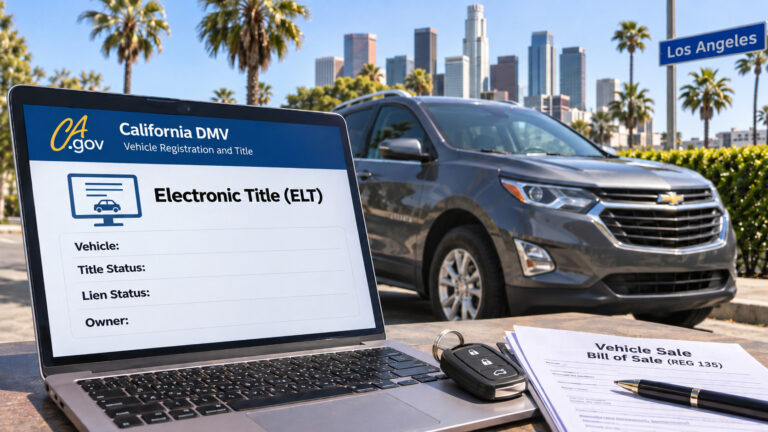
If the lender holds a California electronic lien instead, the process is different. A credit union participating in California’s Electronic Lien and Title system generally releases its interest electronically through the DMV. The DMV can then issue the appropriate paper title or record the new lienholder as required. This is one reason you should not treat a generic paper lien-
release form as a substitute for every electronic-title situation. The lender needs to follow the release process associated with the title it actually holds.
For a qualifying paper-title transaction, California REG 166 may sometimes document lien satisfaction. The form can require notarization depending on how it is used, and a properly signed lien release on the title itself can sometimes serve the same basic purpose. But even if the lender emails you a scan saying the loan is paid, ask whether the DMV will still require an original title or original release document. Proof that the money was paid and proof sufficient to transfer title are not always the same thing.
This is why promising a buyer:
“You’ll have the title by Friday”
before speaking with the credit union’s title department is risky. You may know exactly when the loan will be paid. You may have no idea how long the ownership document will take to arrive. And when the title was issued by another state, California may require more than simply receiving it.
An Out-of-State Title Can Turn the Sale Into a California Title-Conversion Problem
Suppose the credit union is holding an Arizona title. The vehicle is currently registered and parked in Burbank, near Los Angeles. After payoff, the credit union releases the Arizona title. The buyer now wants a California title. This is not necessarily the same transaction as transferring an ordinary California pink slip. Depending on how the vehicle is currently recorded here, the buyer may need the signed out-of-state title, proper lien release, California title or registration application, VIN verification, and other applicable documents such as smog or odometer disclosure.
Now compare that with a vehicle that already has a California title and simply happens to be financed through an out-of-state credit union. In that situation, the buyer may be completing a normal California title transfer once the lender’s interest is released. This is why the lender’s location is not the deciding factor. The title state is.
The distinction becomes particularly important when your California registration says “Nontransferable” or “No California Title Issued.” That language tells you California registration exists but the normal ownership title is elsewhere. Before telling the buyer they can complete an ordinary California transfer, find out what is required to convert that record. California generally needs the actual title from the last titling state together with the appropriate lienholder release before a transferable California title can be issued.
REG 227, California’s replacement-title form, does not simply replace another state’s lost title. If the out-of-state title itself is missing, you may have to work through the state that issued it.
Cash Cash Cars’ guide to selling a car without a title explains why a missing California certificate and an unavailable foreign title are not always the same problem. Once the ownership documents are understood, you still need to think about something more practical: whether the buyer can actually drive the car while everybody waits for the title.
The Title Can Be in the Mail While the Car Is Still Legally Driveable, or Not Driveable at All
A title being delayed and a vehicle being legal to operate are separate issues. For example, the car may have current California registration, valid plates, insurance, and no operating restriction. The lender’s paper title may still be traveling from another state. That does not automatically make the car illegal to operate.
Now change one detail. The California registration is nontransferable, expired, or otherwise incomplete. The buyer has a bill of sale and proof that the lender was paid. Those documents do not automatically give them permission to drive the vehicle wherever they want while waiting for the title. Temporary operating permits exist for certain California registration situations, including some qualifying incomplete applications or nonresident vehicles. But a temporary permit is not guaranteed simply because an out-of-state lender is slow mailing paperwork.
So before the buyer takes the keys, establish the car’s actual registration and insurance status. If the vehicle cannot yet be legally driven, transport it rather than assuming a payoff receipt will satisfy a traffic stop. This is particularly important if the car is non-running or already sitting at a repair shop, storage facility, or private property where pickup requires special access. Cash Cash Cars’ guide to selling a vehicle in Los Angeles while living in another state or country discusses some of the same distance and title-routing complications from the owner’s side. But even with perfect planning, the credit union itself may delay the release.
If the Loan Is Paid and the Credit Union Still Will Not Release the Lien, Document the Delay
Suppose the buyer’s money reached the credit union three weeks ago. Your account shows zero. The lender still appears on the title or the released certificate has not arrived. At this point, repeated general customer-service calls may not get you very far. Start building a clear written record. Get confirmation of the payoff date. Get the transaction or payment reference. Confirm that the money went to the correct account. Then contact the lender’s title department and ask exactly what condition is preventing the release. For example:
“Loan account ending 1234 was paid in full on October 20 for vehicle VIN ending 56789. Please confirm when the lien release was submitted and where the title will be sent.”
That is much easier for a title department to investigate than:
“I paid my car off and still don’t have anything.”
Sometimes the problem is not delay at all. It is a name mismatch. Perhaps the credit union shown on the old title merged years ago and now operates under another name. The payoff letter comes from the successor institution, while the DMV still shows the old lender. Now the DMV may need documentation connecting those two institutions. A Statement of Facts can explain what happened. It cannot replace proof that the institution signing the release is legally connected to the lienholder shown on the title. Ask the credit union for merger, successor, or name-change documentation if needed.
If the lender continues failing to address a legitimate paid-off lien, regulatory complaints can become appropriate. Depending on the institution, that may involve the National Credit Union Administration, a state credit-union regulator, or another consumer-finance authority. But a complaint should not be treated as a same-day title service. Its purpose is to get the lender’s conduct reviewed and the problem corrected. It does not itself release the lien.
A bonded-title process can sometimes arise when legitimate ownership documents cannot be obtained, but this is another area where sellers can misunderstand the tool. A bond is not a way to bypass a loan you still owe. It applies only to qualifying ownership situations where the DMV permits that route. So before buying a bond or paying somebody who promises one will “clear the lien,” ask the DMV whether your particular record qualifies. And when the buyer wants the car today, the same basic rule still applies: urgency does not erase the lender.
Cash Cash Cars Can Review the Payoff and Title Situation Before Pickup
If the vehicle is old, damaged, non-running, or simply no longer worth keeping while you continue making payments, Cash Cash Cars can review the vehicle even when an out-of-state credit union still holds the lien or title. The important thing is to explain the financing situation during the first conversation rather than after the truck arrives. Start with the car itself: year, make, model, mileage, condition, VIN if available, and location. Then explain the lender side. Which credit union holds the loan? Approximately how much is owed? Is the title California or out of state? Is it paper or electronic? Does the California registration say nontransferable? Is somebody else named on the loan or title?
Those details matter because vehicle value and loan payoff are two completely different calculations. For example, Cash Cash Cars may value the vehicle at $10,000 while the credit union requires $8,000. There may be equity for you. The same car with a $13,000 payoff creates a $3,000 shortage that has to be handled before the lien can be released. The fact that the car starts, runs, or needs towing does not change that lender math. Likewise, an out-of-state paper title can delay closing even when the selling price is already agreed.
Cash Cash Cars’ vehicle lien and payoff page explains the information needed to review those transactions. If the lender physically controls the title, it makes more sense to contact Cash Cash
Cars with the details before scheduling collection than to arrange pickup as though the pink slip were already clear. After a completed sale, file California’s Notice of Transfer and Release of Liability within five calendar days.
Cash Cash Cars can review lien and payoff questions for sellers across Los Angeles, Van Nuys, Santa Clarita, and nearby communities. You can request a cash offer or call 818-822-1863, but explain the lender, payoff, and title location first so the company can assess whether a lawful sale is possible.