How to File a California Notice of Transfer and Release of Liability?
Sold a car in California? Learn how to file the Notice of Transfer and Release of Liability, what REG 138 does, and how to protect yourself after the sale.
Selling your car in California is not finished the moment you sign the pink slip and hand over the keys.
There is another step that protects you after the buyer drives away: filing a Notice of Transfer and Release of Liability, commonly called an NRL or REG 138.
California requires a seller to notify the Department of Motor Vehicles within five calendar days after selling or transferring a vehicle. The notice tells the DMV when the vehicle left your possession and who received it.
That matters because the buyer may not immediately transfer the title. If your name remains associated with the vehicle record, parking tickets, toll notices, registration notices, or questions about the vehicle can still find their way to you.
Filing the NRL creates a record showing that you transferred the vehicle and identifies the person who took ownership.
If you are selling an older, damaged, non-running, or unwanted vehicle rather than making a conventional private-party sale, the same paperwork issue still matters. A licensed buyer such as Cash Cash Cars can help simplify the vehicle-sale process, but the seller should still understand what the NRL does and make sure the transfer is properly documented.
What Does a California Notice of Transfer and Release of Liability Do?
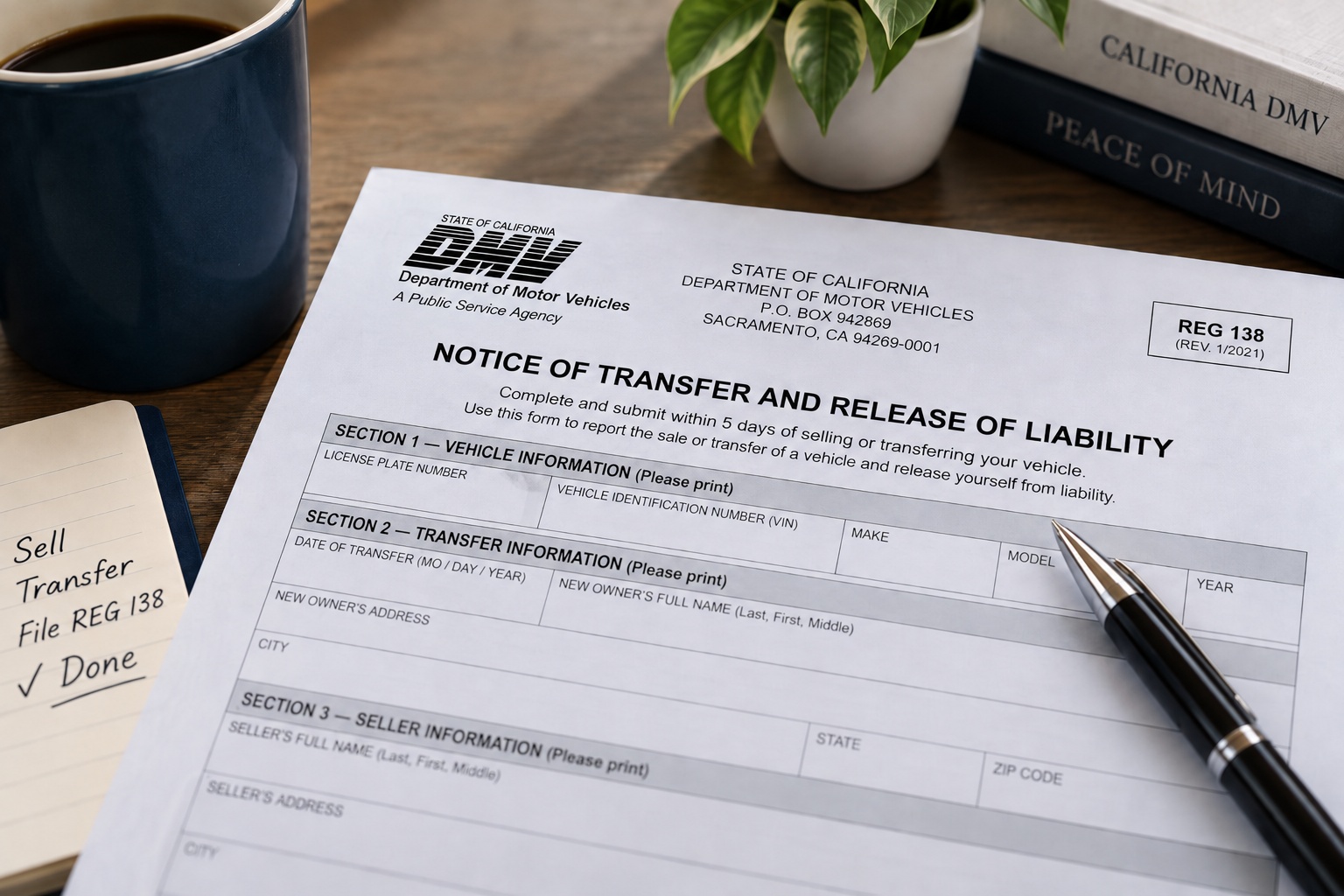
The NRL tells the California DMV:
- which vehicle was transferred
- when the transfer occurred
- who transferred it
- who received it
- what the odometer showed at the time
According to the California DMV, once a properly completed NRL has been received, liability for parking violations, traffic violations, and civil litigation occurring after the date of sale generally shifts to the subsequent purchaser when the statutory requirements have been satisfied.
California law also connects the seller’s release from liability with actually transferring and delivering possession of the vehicle, not merely filling out a form.
That makes the NRL much more than routine paperwork.
However, there is an equally important limitation.
Filing an NRL Does Not Transfer the Title
An NRL is a notice of transfer. It is not the title transfer itself.
The buyer still has to complete the required ownership transfer process with the DMV and pay any applicable fees.
For a private-party purchase, California generally gives the buyer 10 days to complete the ownership transfer. The seller’s five-day NRL obligation is separate from that requirement.
This distinction explains why you may occasionally receive mail concerning a vehicle after selling it. The buyer may still not have completed the DMV transfer.
Your NRL is the evidence showing when your involvement with the vehicle ended.
When Do You Have to File REG 138?
California requires the NRL to be submitted within five calendar days of the sale or transfer.
Do not interpret that as five business days.
Weekends count.
The safest practice is even simpler: file it as soon as the vehicle leaves your possession.
There is little benefit to waiting until day five.
California’s rules connect the release from liability with the transfer of the vehicle and delivery of possession. That distinction becomes important when different parts of a transaction occur on different days.
Suppose you:
- sign the title Monday
- receive payment Tuesday
- let the buyer pick up the vehicle Friday
The transaction should be documented carefully around the date possession is actually delivered. You do not want the paperwork suggesting the buyer had the vehicle several days before they actually did.
For unusual transactions where ownership, payment, and possession occur at different times, keeping a written record of exactly when possession changed hands can prevent later disputes.
What Information Do You Need to File an NRL?
Gather the information before the buyer leaves whenever possible.
The DMV requires enough information to correctly identify both the vehicle and the new owner.
For an online NRL, have the following ready:
- vehicle license plate number
- last five digits of the VIN
- odometer reading at the time of transfer
- date of sale or transfer
- new owner’s full name
- new owner’s address
- seller’s information
The paper REG 138 also includes vehicle-identifying information and the selling price. If the vehicle is a gift, the seller generally enters 0 as the selling price.
Verify the Buyer’s Information Before They Leave
Do not treat the buyer’s name and address as an afterthought.
Ideally, copy the information from a reliable identification document and make sure it matches the paperwork being used for the transaction.
A minor spelling mistake may be fixable. An unidentified buyer with an incomplete address creates a much bigger problem.
The entire purpose of the NRL is to tell the DMV who took the vehicle from you. Accurate buyer information makes that record much more useful if a dispute later occurs.
How to File a California NRL Online
For most sellers, filing directly through the California DMV website is the simplest option.
The process starts with a vehicle lookup using the license plate number and the last five characters of the VIN.
From there, provide the requested seller, buyer, vehicle, mileage, and transfer information.
Before submitting, check every field carefully, especially:
- license plate
- VIN digits
- buyer’s name
- buyer’s address
- date of transfer
- odometer reading
After submission, the DMV provides an NRL confirmation.
Save it.
Print it, save it as a PDF, or keep a second digital copy somewhere safe. If a parking ticket or toll notice arrives months later, the confirmation can help establish that you notified the DMV.
Can You Mail REG 138 Instead?
Yes.
California still allows sellers to complete a paper REG 138 and mail it to the DMV.
The problem is that paper filing gives you less immediate confirmation than the online process.
If you use the paper method:
- Complete every required field legibly.
- Make a copy before mailing it.
- Keep evidence showing when it was mailed.
- Retain the copy with your other sale documents.
For most ordinary transactions, online filing provides a cleaner paper trail because you receive confirmation after submitting the notice.
What If You Miss the Five-Day NRL Deadline?
Do not decide that it is too late and simply do nothing.
The five-day deadline is the California seller’s statutory reporting requirement, so the correct course is to submit the notice as soon as you realize it was missed.
Late filing can make disputes harder because you no longer have a contemporaneous DMV filing showing that you promptly reported the transaction.
If weeks or months have passed, preserve as much evidence of the sale as possible, including:
- signed title copies
- bill of sale
- payment records
- messages with the buyer
- pickup or towing records
- photographs
- DMV confirmation
The sale date and actual transfer of possession may become important if someone later questions who controlled the vehicle when an incident occurred.
What Happens If the Buyer Never Transfers the Title?
This is one of the main reasons sellers should file their own NRL.
The buyer has their own obligation to complete the title transfer. You should not simply assume that signing the title and handing it over will prevent every future notice from reaching you.
You might receive:
- a parking citation
- a toll notice
- a delinquent registration notice
- an impound-related notice
- correspondence concerning the vehicle
Do not automatically throw these away.
Read the notice and follow the issuing agency’s dispute procedure. Supply your NRL confirmation, bill of sale, and other proof of transfer where appropriate.
That is also why keeping your own sale records matters even when you are working with a professional vehicle buyer.
Keep More Than Just the NRL
The NRL should be part of a larger paper trail.
A strong seller file can include:
- NRL confirmation
- signed bill of sale
- photograph or copy of the completed title before you hand it over
- odometer documentation
- buyer’s verified name and address
- payment records
- messages documenting pickup
- date and, when useful, time possession changed hands
Recording the exact handover time is not required on the NRL, but it can be useful when a sale and a later ticket, toll, accident, or tow occur on the same day.
What If You Sell or Trade the Car to a Dealership?
Do not assume that selling to a professional business makes the NRL irrelevant.
If a dealership buys or accepts your vehicle as a trade-in, keep the dealership paperwork and accurately identify the business receiving the vehicle.
The same cautious approach makes sense when transferring a vehicle to a licensed dismantler or other automotive business.
Other businesses may have their own DMV reporting obligations, but your safest approach is to make sure your seller-side reporting obligation has been handled rather than relying entirely on someone else’s paperwork.
This is particularly important with vehicles that are being sold for dismantling, recycling, or parts. If you are disposing of an unwanted vehicle, you can also review the paperwork and sale considerations involved in selling junk cars, trucks, SUVs, and minivans.
Do You File an NRL When Gifting a Car?
Yes.
An NRL applies to transfers, not only ordinary cash sales.
If you give the vehicle to a relative or another person, enter the appropriate gift information on the transfer paperwork. The recipient may also have additional DMV forms to complete depending on the circumstances.
Do not skip the NRL merely because you know or trust the person receiving the vehicle.
What About Donations?
A vehicle donation is also a transfer.
Keep the charity’s receipt and transfer documents along with your NRL confirmation.
If a towing company collects the vehicle for a charity, make sure your paperwork accurately identifies the organization or entity that is actually receiving ownership rather than simply guessing based on the tow truck that arrives.
What If There Are Multiple Owners on the Title?
This is where you need to distinguish the title transfer from the NRL.
California’s rules for signing away ownership depend on the conjunction between the owners’ names.
If the names are joined by AND, all owners generally must sign to release ownership.
If the owners are joined by OR or AND/OR, the signature of one owner is generally sufficient to transfer ownership.
Do not assume that filing an NRL can cure a defective title transfer.
If an owner whose signature is legally required refuses to sign, the underlying ownership problem needs to be resolved before an ordinary voluntary sale can be completed properly.
What If One Owner Has Died?
The answer depends on how ownership is listed and whether special designations appear on the title.
California DMV may require documents such as:
- death certificate
- Affidavit for Transfer Without Probate, REG 5
- Letters Testamentary
- Letters of Administration
The precise requirements depend on how ownership is recorded.
For a deceased co-owner, resolve the title authority first rather than assuming the surviving person can always sign alone.
What If the Vehicle Has a Lien?
An NRL does not erase or bypass a lender’s legal interest in the vehicle.
If money is still owed, the lien generally has to be resolved as part of the sale. The payoff amount, title-release process, and timing can all affect when ownership can be transferred cleanly.
If that applies to your vehicle, see this guide to selling a car with a lien in California before completing the transaction.
The important point is that the NRL documents the transfer. It does not substitute for a required lien release.
What If the Registration Is Expired?
Expired registration does not eliminate the need to file an NRL.
The vehicle’s registration status and the seller’s obligation to report a transfer are separate issues.
If you are selling a vehicle with overdue registration rather than renewing it first, it is worth understanding how California handles back fees, transfer paperwork, and buyer types. This guide explains the process for selling a car with expired registration.
Once the vehicle is actually sold, the NRL should still be filed promptly.
What If You Enter the Wrong Information on the NRL?
Accuracy matters because incomplete or incorrect identifying information may prevent the record from being updated correctly.
If you discover a mistake, do not simply assume the DMV will figure out what you intended.
For straightforward problems, contact the DMV or submit corrected documentation promptly.
Keep both the original and corrected documentation.
For more complicated circumstances, such as a sale being rescinded and the vehicle being returned, the facts are no longer a routine completed transfer. In that situation, contact the DMV and make sure its record reflects the actual ownership situation rather than assuming a second online filing automatically erases the first transaction.
What If a Test Driver Takes the Car and Never Comes Back?
That is fundamentally different from a voluntary sale.
If you never agreed to transfer ownership and someone simply takes the vehicle during a test drive and does not return it, do not create a fictional sale merely to get your name off the vehicle.
Report the circumstances to law enforcement and your insurer as appropriate.
An NRL is designed to report an actual transfer of a vehicle, not to substitute for a stolen-vehicle report.
Do Not Cancel Insurance Too Early
The NRL and your automobile insurance policy are separate matters.
Submitting an NRL does not automatically remove the vehicle from your insurance policy.
Coordinate the insurance cancellation or vehicle removal with the actual transfer. Do not cancel coverage merely because someone says they intend to buy the vehicle tomorrow.
Wait until the transaction has actually occurred and possession has been transferred, then notify your insurer promptly and follow its instructions.
Keep the insurer’s confirmation with your sale records.
If an accident occurs shortly after the transaction and someone contacts you because your name appears in an older vehicle record, provide accurate information about when you sold and delivered the vehicle. Your NRL confirmation, bill of sale, title documentation, and possession records can help establish the timeline.
Remember to Remove the Vehicle From Your FasTrak Account
Selling the car and filing an NRL do not necessarily clean up every private account connected with the vehicle.
If the vehicle or plate is associated with a FasTrak account, parking account, insurance policy, fleet account, connected-car service, or similar service, update those separately.
Remove your FasTrak transponder from the vehicle before handing it over and update the plate information associated with your account.
The NRL deals with the DMV record. It does not automatically close unrelated commercial accounts.
The Most Common California NRL Mistakes
Most problems come from a handful of avoidable mistakes.
Waiting for the buyer to file everything.
The buyer’s title-transfer responsibility and your NRL obligation are separate.
Thinking the NRL transfers ownership.
It doesn’t. The buyer still has to complete the title transfer.
Missing the five-day deadline.
File as soon as possible rather than treating five days as a waiting period.
Entering incomplete buyer information.
An NRL is far less useful when the DMV cannot identify the new owner.
Forgetting to save the confirmation.
Keep a copy in case you need to prove when the notice was submitted.
Keeping no copy of the title or bill of sale.
The NRL is stronger when it is supported by a complete transaction record.
Ignoring later notices.
Even when you properly sold the vehicle, respond through the issuing agency’s dispute process if a citation, toll, or collection notice is directed to you.
California Seller Checklist After Selling a Car
The cleanest process starts before the buyer drives away.
Before handing over the vehicle
Verify the buyer’s full name and address.
Record the current odometer reading.
Complete the bill of sale and other required transfer documents.
Make sure every owner whose signature is legally required signs the title.
Take a clear photograph or copy of your completed seller paperwork before releasing the originals.
Document when possession is transferred, particularly if the timing could later become disputed.
Immediately after the buyer leaves
File the NRL online rather than putting it off.
Enter the vehicle and buyer information carefully.
Save or print the confirmation.
Remove personal belongings and any toll transponders from the vehicle.
Update relevant toll, parking, connected-car, and similar accounts.
Notify your insurance company that the vehicle has been sold and follow its procedure for removing the vehicle.
Keep a permanent sale file
Store together:
- NRL confirmation
- bill of sale
- title photographs or copies
- buyer information
- payment evidence
- odometer record
- pickup or delivery documentation
- insurance cancellation confirmation
You may never need any of it again.
But if a parking ticket, toll violation, accident inquiry, impound notice, or ownership dispute appears months later, having a complete record can turn a complicated argument into a straightforward timeline.
Filing the NRL Is a Small Step That Can Prevent a Big Problem
A California vehicle sale should not end when the buyer drives away.
The seller still has an important DMV obligation: submit the Notice of Transfer and Release of Liability within five calendar days.
The better approach is to do it immediately.
Verify the buyer’s information, document the handover, file the NRL online, save the confirmation, update your insurance and toll accounts, and keep your sale paperwork together.
Most importantly, remember what REG 138 does and does not do.
It documents your transfer and helps establish your release from liability after the sale. It does not replace the title transfer, and it does not eliminate the need for accurate paperwork.
Those few minutes spent filing the NRL can save you from having to explain someone else’s tickets, tolls, or vehicle problems months after the car stopped being yours.