How to Sell a Car with an Active Safety Recall in Los Angeles
An open safety recall doesn't always prevent a car sale in Los Angeles. Learn when to repair or sell as-is, how to disclose recalls, and what safety warnings mean.
You decide it is finally time to sell your car in Los Angeles, start gathering the title and registration, and then discover something you had completely forgotten about: the vehicle still has an open manufacturer safety recall. Maybe the notice arrived months ago and got buried in a drawer. Maybe you called the dealer but the replacement part was unavailable. Or perhaps you only found the recall when a prospective buyer ran the VIN and asked why it had never been repaired. At that point, the natural reaction is to assume the sale has to stop. After all, if the manufacturer has officially declared that something on the car is unsafe, how can you legally hand it to somebody else?
Fortunately, an unresolved safety recall does not automatically prevent an ordinary private owner from selling a used vehicle in California. The title does not become invalid merely because a recall remains open, and the DMV does not automatically freeze every ownership transfer involving a recalled vehicle. But this is where the real issue begins. A software recall that can be completed in an hour is one thing. A defective airbag, fuel-system problem, fire risk, or manufacturer’s instruction not to drive the car is something completely different. The law may still allow an ownership transfer, but the car’s safety, value, transportation, disclosure, and even smog situation can change the whole transaction.
So before deciding whether to repair the car or sell it as-is, the first question should not simply be: “Does this car have a recall?” It should be: “What exactly is the recall telling me about this vehicle today?”
An Open Recall Does Not Automatically Make the Car Unsellable
A safety recall means the manufacturer or federal safety authorities have identified a defect that creates an unreasonable safety risk or fails to comply with an applicable safety standard. That defect might involve the airbags, brakes, steering, fuel system, electrical components, seat belts, or another important part of the vehicle. An open recall simply means the corrective action has not yet been recorded as completed for that VIN. For an ordinary private seller, that alone does not create a blanket prohibition against selling the car. This is where private sellers often confuse the rules that apply to new vehicles with the rules for used vehicles. Federal law can prevent certain new vehicles with unresolved safety recalls from being sold or delivered. That does not mean every privately owned used car with an open recall is automatically locked out of the market.
So imagine your 2016 sedan has an unresolved airbag recall. The car runs normally. The title is clear. Registration is current. You can generally still transfer ownership. But being legally able to sell the car is not the same thing as saying the car is safe to drive or that the recall can be ignored.
That distinction matters because the recall may affect three separate things at once: whether ownership can move, whether the vehicle should physically be driven, and whether California registration or emissions rules create another problem. Once you separate those questions, the decision becomes much easier. The first step is to find out exactly what the manufacturer says about your VIN.
Check the VIN Before You Advertise the Car
Do not rely on memory. Do not rely on the old letter in your glovebox. And do not assume the recall has somehow disappeared because the car has been driving normally for the last two years. Use the vehicle’s 17-character VIN and check the official recall history. The VIN is usually visible at the lower driver’s side of the windshield and also appears on the registration and other vehicle records. The National Highway Traffic Safety Administration recall lookup can identify unresolved manufacturer safety recalls associated with a specific VIN.
What matters is not just whether a recall appears. Read the actual campaign information. Look at the affected component. Look at the stated risk. Check whether the manufacturer has published a remedy. And most importantly, look for special instructions telling owners whether the car can continue to be driven normally, should be parked outside, or should not be driven at all.
This is where two cars that both have “one open recall” can become completely different selling situations. For example, one vehicle may need a software update that is already available. Another may have a fuel-system defect with a warning that a fire can occur. Those cars should not be marketed, test-driven, or transported the same way.
The recall database also has limits, particularly with older vehicles, newly announced campaigns, and manufacturer programs that are not classified as federal safety recalls. So if the car is older or the result is unclear, contact the manufacturer’s authorized service department and ask them to check the VIN directly. You want to know whether the recall is still open, whether the repair is free, whether parts are available, and whether there are any interim safety instructions. Keep that information. Once a buyer starts asking questions, it is much easier to show what the manufacturer actually said than to rely on:
“I think the dealer told me it is probably fine.”
And once you confirm the recall, another common misunderstanding usually appears:
“The car is out of warranty, so I guess I have to pay for this.”
Not necessarily.
A Safety Recall Is Not the Same Thing as an Expired Warranty
A factory warranty and a manufacturer safety recall solve different problems. A warranty usually covers specified defects during a certain period or mileage. A safety recall exists because the manufacturer or safety regulator has identified a safety-related defect affecting a group of vehicles. So your warranty can expire while a recall repair is still available at no charge.
For example, you may own a high-mileage vehicle with 160,000 miles and no remaining factory warranty. If that VIN is covered by an eligible federal safety recall, the manufacturer may still be responsible for the recall remedy. That can mean the repair itself costs you nothing. And buying the car used normally does not remove that benefit either. The recall generally follows the affected vehicle, not just the original buyer. So if you bought the car from a private seller three years ago, you can still qualify for the applicable recall remedy.
There is an important federal age limitation connected with mandatory no-charge recall remedies, but even that rule is commonly misunderstood. It is not simply:
“The car turned 15, so the free repair ended.”
The relevant comparison involves when the vehicle was originally purchased and when the defect or recall was identified. Manufacturers can also choose to continue providing free repairs beyond the minimum federal requirement. So before paying anybody to fix a recalled component, ask the manufacturer what is actually covered. This matters because a repair that would normally cost hundreds or thousands of dollars may still be free. If the car is otherwise in good condition, that can make the decision very easy.
Get the recall repaired. Document it. Then sell a car with one less problem. But that simple answer falls apart when the manufacturer cannot actually perform the repair yet.
A Free Repair Does Not Help Much When No Repair Is Available
Sometimes the problem is not that the owner ignored the recall. The manufacturer announced the defect, but the final repair has not been developed. Or the remedy exists but the replacement part is on backorder.
Now imagine you own an older SUV in Santa Clarita and the manufacturer says the fuel system may leak. You call the authorized service department. They confirm the recall. They also tell you the replacement part is unavailable and there is no appointment date. Meanwhile, you are moving in two weeks and need the vehicle gone.
At that point, telling yourself:
“The repair is free”
does not solve the actual problem. The useful questions become:
Can the vehicle still be driven safely?
What interim instructions has the manufacturer issued?
When is the repair realistically expected?
And:
How much does waiting cost me?
A private sale may still be possible, but the buyer should know that the recall remains unresolved because the remedy is not currently available. That is a very different disclosure from saying:
“I just never bothered getting it fixed.”
If the recall significantly limits the car’s use, contact the manufacturer’s customer-assistance department as well. In serious situations, the manufacturer may offer a loaner, rental support, or another temporary solution, although those benefits are not automatically available for every recall. You can also ask whether a replacement or repurchase option exists in your particular case. But do not assume that a delayed part automatically creates a right to force the manufacturer to buy the vehicle back. If the manufacturer is failing to provide a remedy that should be available, NHTSA can also become relevant. The important point is that the buyer needs the actual situation, not your best guess about when the recall will be resolved. And if the recall includes a warning not to drive, the sale changes much more dramatically.
A “Do Not Drive” Warning Changes the Sale Before It Changes the Price
Some recalls are serious enough that the manufacturer specifically tells owners not to operate the vehicle until the repair has been completed. Other recalls carry a “Park Outside” warning because of a fire risk, sometimes even when the car is turned off. Those warnings should change how you physically handle the vehicle.
For example, suppose your sedan has an unresolved airbag recall and the manufacturer has issued an explicit “Do Not Drive” instruction. You may still be able to transfer ownership. But inviting a private buyer to take the car around the block for a test drive would be a terrible way to sell it. The buyer should know about the warning before showing up. The vehicle should not be driven across Los Angeles just because meeting the buyer at a shopping center is more convenient. And if the manufacturer says to park the car outside because of a fire risk, leaving it in an attached garage while waiting for the buyer defeats the point of the warning.
At that stage, towing becomes part of the transaction. A flatbed may be the practical solution in many cases, depending on the manufacturer’s transportation guidance. Now the recall is no longer just a line on a vehicle-history report. It affects how the car is shown, inspected, moved,
and valued. And it can change the type of buyer who is interested. Someone shopping for a daily commuter may have no interest in buying a vehicle they cannot legally or safely use right away. A professional buyer accustomed to non-running, damaged, or repair-needed vehicles may look at the same car differently. That does not mean you should automatically sell it cheaply. It means the recall has changed the market for the vehicle.
So now the next question becomes much more practical: Is it worth waiting for the repair before selling?
A Free Recall Repair Can Still Cost You Time
Imagine a 12-year-old sedan with 140,000 miles. It runs well. The body is decent. Registration is current. There are no major mechanical problems. The manufacturer confirms that the recall repair is free, the replacement part is available, and the work can be completed in one appointment.
If you plan to sell privately, getting the recall fixed first makes a lot of sense. You remove the safety concern. You remove one negotiation point. And you give the buyer documentation showing that the manufacturer has already completed the corrective work.
Now change the vehicle. It is a 15-year-old SUV with a failed transmission, body damage, expired registration, and an open recall. The recall work itself may still be free. But the vehicle cannot be driven to the dealer. You need to arrange towing. You may need to wait for an appointment. And after the recall is fixed, you still have a non-running SUV with thousands of dollars in unrelated problems. At that point, completing the recall may add very little to the car’s actual selling value.
This is where the decision should stop being emotional. Do not think:
“The repair is free, so I should definitely do it.”
Think:
“What does completing this repair change about the amount I will actually receive?”
If the vehicle is otherwise roadworthy, the answer may be significant. If the car is already a salvage-oriented or repair-heavy vehicle, the recall may barely change the offer. Our guide to selling a car that needs repairs explains that same calculation from the repair side. The important thing is to compare the realistic post-repair value with a real as-is offer and then include the time, towing, scheduling, and inconvenience required to reach that higher value. And if you decide not to repair the recall first, disclosure becomes one of the most important parts of the sale.
Trying to Hide the Recall Creates More Risk Than the Recall Itself
California does not impose one universal rule requiring every private seller to obtain a recall report and repair every open manufacturer safety recall before selling a used car. But that does not mean you should stay silent about a serious defect you already know about. For example, imagine the manufacturer has repeatedly warned you about a dangerous airbag defect. You advertise the car as having “no known safety problems.” The buyer pays. A week later, they discover the unresolved recall and learn that you had received several notices. Now the argument is no longer simply about whether private sale of a recalled vehicle was allowed. The buyer can argue that you intentionally withheld information that mattered to the purchase. An “as-is” statement does not magically protect a seller from intentional concealment or misrepresentation.
So the safer approach is much simpler. Tell the buyer. Use the official recall number. Explain the affected system. Explain what the manufacturer says can happen. Tell them whether the repair is available. And if the manufacturer has issued a “Do Not Drive” or “Park Outside” instruction, say that plainly. Do not reduce a serious warning to:
“There is just some little recall thing.”
If the repair has been scheduled, say so. If the dealer says parts are unavailable, say that too. If the manufacturer has confirmed the remedy is free, explain that without promising anything you cannot guarantee.
A written acknowledgment can also help. The bill of sale or a separate document can record that the buyer was informed about the specific recall, understood that it remained unresolved, and received any relevant safety instructions or repair-status information. That does not erase every possible legal issue. It gives both sides a record of what was actually disclosed. And once the buyer knows about the recall, the next argument usually becomes price.
An Open Recall Does Not Have One Standard Dollar Value
There is no formula saying:
“Open recall equals $1,000 off.”
The effect depends on the recall itself. For example, a simple recall with readily available parts may barely affect the car’s value. A buyer may simply have to spend an afternoon at an authorized service department.
Now compare that with a fuel-system recall involving fire risk and no available replacement part. That buyer may be taking on weeks or months of uncertainty. The car may need towing. It may need to remain parked outside. They may need alternate transportation. Those are real costs and inconveniences even if the eventual manufacturer repair is free.
So start with the value of the actual vehicle. Look at comparable Los Angeles cars with similar mileage, condition, accident history, and equipment. Then adjust for the recall based on the real inconvenience or risk. For example, suppose similar cars are selling around $8,000 and yours is already priced at $7,400 because of its condition and unresolved recall. If the buyer then wants another $500 discount solely because “it has a recall,” you can reasonably explain that the price already accounts for the issue. On the other hand, if you discover that the recall has escalated into a “Do Not Drive” warning with no available repair, the market may support a much larger reduction. The buyer is not wrong simply because the manufacturer eventually plans to fix it for free. Time, towing, uncertainty, and safety still affect value. And in California, there is another type of recall that can create an entirely different problem.
An Emissions Recall Is Not Just Another Safety Recall
A safety recall and an emissions-related manufacturer campaign can both sound like “recalls,” but they do not necessarily affect a California sale in the same way. For an ordinary unresolved safety recall, the DMV generally does not place a blanket ownership-transfer hold simply because the safety defect remains open. An emissions recall can become more complicated because California registration and emissions compliance may be involved. Depending on the manufacturer campaign and California Air Resources Board requirements, certain emissions- related recalls can affect registration renewal until the correction is completed. Now you are dealing with something more than buyer confidence. You may be dealing with a registration requirement. This is why the NHTSA safety-recall lookup is not always enough for a California seller. It does not necessarily show every emissions-related manufacturer campaign. If the DMV has specifically told you that an emissions recall must be corrected, or the manufacturer identifies an outstanding California emissions campaign, find out exactly what has to be completed and what proof the DMV needs.
Smog is another separate issue. A safety recall does not automatically mean the car will fail Smog Check. But an emissions defect may trigger a check-engine light, diagnostic failure, or other condition that prevents the car from passing. For a normal California private sale, that can become a much bigger obstacle because the seller generally remains responsible for providing the required qualifying smog certification unless an exemption applies.
A handwritten agreement saying:
“Buyer accepts car without smog”
does not necessarily remove that legal responsibility. So if the car already has emissions problems, review our guide to selling a car that failed smog before assuming the recall and smog issues can simply be handed to the next owner. Once you have decided whether to repair
the recall, disclose it, or sell through another route, the rest of the California sale still needs to be done properly.
The Recall Does Not Replace the Normal California Sale Paperwork
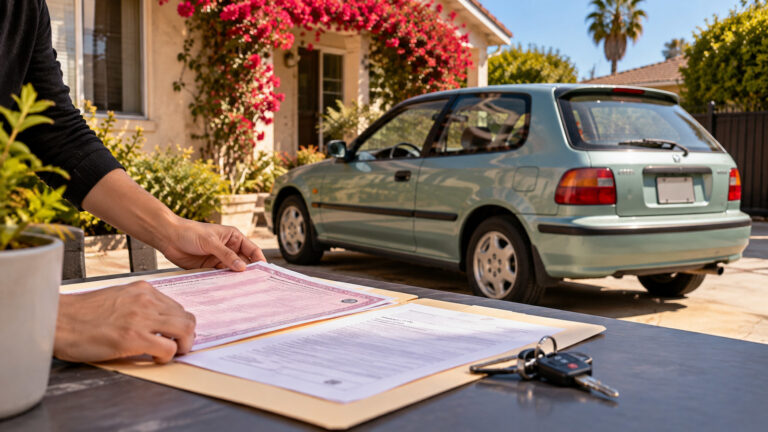
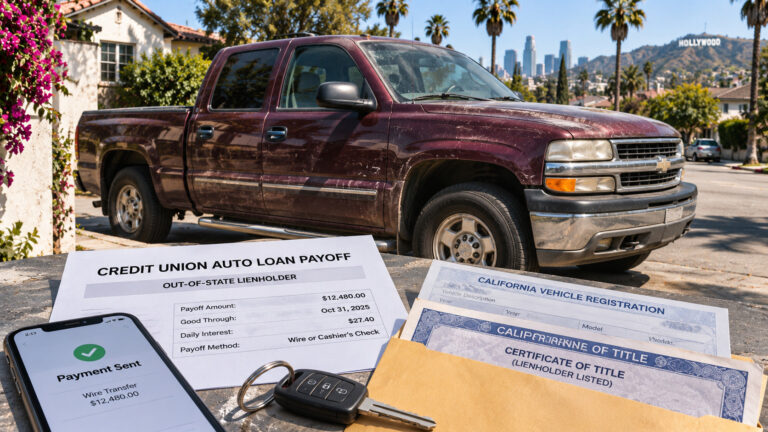
Even with an open recall, the car still needs a valid ownership transfer. Start with the California title. Make sure you actually have authority to sell. Check for another owner. Check for a lender. If a lien remains, it still has to be resolved. If the title is missing, REG 227 may become part of the transfer, depending on the ownership situation. Mileage disclosure can also matter. For many 2011-and-newer passenger vehicles, federal and California odometer disclosure rules continue until the applicable 20-model-year threshold is reached. Where the title itself cannot accommodate the required disclosure, REG 262 may become relevant.
Then prepare a bill of sale. Document the VIN, sale price, date, buyer and seller information, and anything important about the vehicle’s disclosed condition. For a recalled vehicle, it makes sense to keep the recall information with that paperwork. Give the buyer a copy of the manufacturer notice or recall lookup. If the repair has already been completed, provide the service record. If parts are unavailable, say so. And if the car must not be driven, make sure the transportation plan reflects that. The title can be legally signed while the vehicle still needs to leave on a flatbed. Those are two separate things. Once the vehicle is gone, there is still one important DMV step left.
File the NRL Even When the Buyer Still Has Recall Work to Do
California sellers should file the Notice of Transfer and Release of Liability within five calendar days after the sale. This is especially important with a car that may not be immediately roadworthy. You do not want the vehicle to leave your possession and then remain tied to you while the buyer waits for parts, stores it somewhere else, or drives it against manufacturer instructions. Use the correct buyer details, VIN and plate information, sale date, and mileage. Then save the confirmation. The NRL does not transfer title by itself. The buyer still has to complete the ownership process. And the NRL does not magically protect you from every possible dispute about what you disclosed. What it does is create a record showing when you reported that the vehicle left your possession. Keep that confirmation together with the signed bill of sale, recall acknowledgment, title paperwork, and any manufacturer correspondence. If questions appear later, you want one file that tells the whole story. At this point, the final decision becomes less about legality and more about effort.
A Professional Buyer Can Make More Sense When the Recall Is Only One of Several Problems
Imagine your car has an open recall, but it otherwise runs well, has a clean title, and could be sold privately for a strong price. Waiting a week for a free recall repair may be worth it.
Now imagine a completely different vehicle. It has an open airbag recall. The engine barely runs. Registration expired. The front bumper is damaged. And you have already spent two weekends answering private-buyer messages. The recall is no longer the main reason the car is difficult to sell. It is one more problem on top of several others.
That is where a professional buyer can become more practical. A commercial buyer can evaluate the VIN, recall status, mechanical condition, title, and transportation needs together instead of asking you to solve each issue before anybody will consider the vehicle. The offer may be lower than what you could theoretically get from a patient private buyer after repairing and preparing everything. But that is not the only comparison. The real comparison is what you receive after considering repair delays, towing, advertising, repeated inspections, negotiation, and the chance that the private buyer walks away anyway. This becomes even more obvious when the car is non-running. Our guide to selling a non-running car explains why condition, accessibility, and towing can become just as important as the selling price. And some recalled vehicles spend so long waiting for parts that they eventually develop problems completely unrelated to the original defect.
A Car Parked for Months Can Become Worse While You Wait for the Recall
Suppose you follow the manufacturer’s instruction and stop driving the vehicle while waiting for a repair. Several months pass. The recall is still open. Now the battery is dead. The tires have deteriorated. The brakes may have started sticking. Old fuel may create starting problems. The car that originally needed one free manufacturer repair now has several ordinary maintenance problems as well.
Registration can also become part of the situation. If the vehicle will remain off public roads for a long time, California Planned Non-Operation status may be worth considering when the vehicle qualifies and the filing window is still available. But PNO does not make the car roadworthy. It does not let you drive it around while waiting for parts. And it does not erase every requirement connected with a later sale.
So if registration has already expired or additional mechanical problems have appeared, do not automatically assume you need to pay for every repair and renewal before anybody can make an offer. The answer depends on the buyer and transaction. Cash Cash Cars reviews vehicles with expired registration as well as vehicles that stopped being driven because of mechanical or other problems. The recall status should simply be explained together with the registration and operating condition. That gives the buyer the real vehicle to evaluate rather than the car you remember from before it sat for six months.
How Cash Cash Cars Looks at a Vehicle With an Open Recall
An unresolved recall does not automatically make a vehicle unacceptable to Cash Cash Cars. What matters is the whole situation. For example, an older car with a blown engine and an open airbag recall may be valued largely for its remaining components and salvage potential. A newer car that runs well but is simply waiting for a manufacturer part may be valued very differently because the free recall repair can eventually restore the vehicle to normal use.
That is why you should disclose the recall before pickup. Provide the year, make, model, mileage, VIN, and recall campaign information if you have it. If the manufacturer issued a “Do Not Drive” or “Park Outside” warning, say that clearly. Explain whether the vehicle starts, rolls, steers, and brakes. Tell us whether the recall remedy is available or whether the parts are still on backorder.
Then describe where the vehicle is sitting. An open driveway is simple. A low-clearance apartment garage, repair shop with unpaid charges, or locked parking area is different. Cash Cash Cars offers free towing for qualifying purchases, but the pickup needs to be planned around the actual vehicle and the recall restrictions.
If the title is missing, the car is still financed, or another owner appears in the records, explain that too. Some missing-title situations can be reviewed, but a recall does not change who legally has authority to sell the vehicle. Once the paperwork is verified and the transaction is approved, payment is completed before the vehicle leaves.
The Best Decision Depends on Whether the Recall Is the Main Problem or Just One More Problem
An active safety recall does not automatically leave you stuck with a car you no longer want. For a vehicle that otherwise runs well and has a free repair available next week, completing the recall before selling may be the smartest move. It removes the safety issue, gives buyers more confidence, and can make the sale easier. For an old, badly damaged, non-running, or low-value vehicle, waiting for a recall repair may add very little to the final value. And if the manufacturer has issued a serious warning with no available remedy, selling as-is to the right buyer can make more sense than keeping the vehicle indefinitely while storage, registration, and additional mechanical problems continue. The important thing is not to confuse the right to sell with the right to ignore the defect.
Check the VIN. Understand what the manufacturer is warning about. Find out whether the repair is free and actually available. Follow any “Do Not Drive” or “Park Outside” instruction. Consider the car’s total condition instead of looking at the recall in isolation. And be honest with the buyer about what remains unresolved.
If repairing the car no longer makes financial or practical sense, you can request a cash offer from Cash Cash Cars or call 818-822-1863 and explain the recall, vehicle condition, title status, and pickup location. A recall may complicate the sale. It does not automatically have to stop it.