How to Sell a Car With an Electronic Title in Los Angeles
Can you sell a car with an electronic title in Los Angeles? Learn how California's ELT system works, what happens after loan payoff, how to handle a delayed or missing pink slip, and how to complete the sale.
Selling a car normally feels much easier when you can put the pink slip on the table and show the buyer exactly who owns it. But many California owners no longer have that piece of paper while the vehicle is financed. For example, you may still owe money on the loan and the lender’s interest exists only in California’s electronic title system. In another case, you already made the final payment weeks ago, your bank account shows the loan is closed, and you still have no paper title because the lender or DMV has not finished the release. Or perhaps the lien was cleared correctly and the new title is simply somewhere in the mail.
From the seller’s point of view, all three situations look almost identical:
There is no pink slip in your hand.
Legally and practically, however, they are very different. California’s Electronic Lien and Title system allows participating lenders to hold and release their title interest electronically rather than handling a physical certificate while the loan remains active. This means the absence of a paper title is not automatically the problem. The real question is whether the lender still has a legal interest in the vehicle, has already released that interest but the DMV has not updated the record, or has been removed from the record and only the paper certificate is missing or delayed.
That distinction determines almost everything that happens next. If the loan is still active, the lender has to be paid or otherwise satisfied before a clear transfer can be completed. If the loan is paid but the electronic lien has not yet been released, the seller needs the lender to finish that part of the process. And if the electronic lien is already gone but the paper title has not arrived, the problem may have shifted from lien clearance to missing ownership paperwork.
So before looking for a buyer, first answer one question:
What does the DMV believe about this car today?
Paying Off the Loan and Clearing the Title Are Not the Same Event
Imagine you make your final payment on Monday. By Tuesday, your online account shows a zero balance. You naturally think:
“Great. The car is mine now.”
Financially, the loan may indeed be satisfied. But that does not mean the lender disappears from the California DMV record the same moment the money arrives. Under California’s ELT process, the lender still has to report its lien satisfaction electronically. After the release is processed, the DMV updates the title record and normally issues a paper title to the registered
owner. The DMV registration manual reports an average of about eight days to receive a paper title after an electronic transaction, although actual processing and mailing time can vary.
This is where sellers can lose time because they keep checking the wrong thing. They call general customer service and ask:
“Is my loan paid off?”
The representative says yes. That answers the debt question. It does not necessarily answer the title question. If you are planning to sell, contact the lender’s title or lien department and ask whether the electronic lien satisfaction has actually been transmitted to the California DMV. Ask when it was sent and whether there is any confirmation showing the release was submitted.
A zero-balance letter is useful. It proves the lender recognizes the loan as paid. But if the DMV still shows the lender as legal owner, the title side of the transaction is not finished yet. This is why the buyer’s offer should not be the first number you collect. The first important number is the lender’s current payoff or the confirmation that the payoff has already been completed.
If You Still Owe Money, Start With the Payoff, Not the Asking Price
Suppose you want to sell your car for $18,000. You check the loan and discover the lender’s current payoff is $11,000. At first, this sounds straightforward. The lender gets $11,000, you keep roughly $7,000, and the buyer gets the car. That basic math is correct. The part that matters is how the transaction is actually completed.
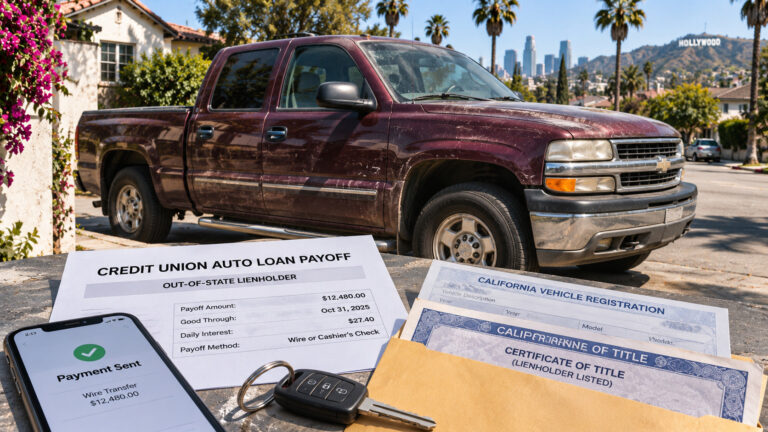
A lender’s payoff figure is not always the same as the balance shown on your latest statement because interest can continue accruing daily. This is why a dated payoff quote, often covering a short period such as ten days, is much more useful than simply reading the principal balance from your account. The seller also needs to know how the lender accepts payment, how long the payoff remains valid, and what happens immediately after the money is received.
For example, if the lender has a local branch that can process auto-loan payoffs, the buyer may be able to meet you there. The buyer sends or delivers the amount owed to the lender and pays the remaining purchase amount to you. That sounds ideal because everybody sees where the money goes. But even this does not necessarily mean the DMV lien disappears while you are still standing at the counter. The lender may need additional time to submit the electronic release. So before arranging the meeting, ask the branch what it can actually provide after receiving payment. Will you get a payoff receipt? Will the electronic release be transmitted the same day? Is another title department responsible for the ELT update?
If the lender operates remotely, the transaction needs even more coordination because neither you nor the buyer wants to send tens of thousands of dollars into a process nobody fully understands. A reputable escrow arrangement can sometimes help with a private sale because
the buyer’s funds can be held while the lender receives its payoff and the agreed ownership conditions are completed. But again, the real purpose is not to make the transaction look sophisticated. It is to make sure the buyer does not lose control of the money while the seller still has a vehicle carrying an unresolved lender interest.
This is why the lien should be disclosed before the buyer comes to see the car. A bill of sale can document the agreement. A payoff receipt can show that money reached the lender. Neither document automatically replaces the lender’s release in the DMV system. Do not assume that giving the buyer keys and a payoff receipt completes the transfer. If the lender’s release is delayed or the payoff amount was short, the buyer may have the car while the lien remains. Agree in writing on when payment, release, and possession will occur, and do not hand over the vehicle until both sides understand the process.
Negative Equity Means the Buyer Can Pay Full Market Value and Still Not Solve the Loan
Suppose the car is worth $12,000. Your payoff is $15,000. You are $3,000 underwater. A buyer offering the full $12,000 market value is not doing anything wrong. The lender is still short $3,000. This is why an electronic title can feel like the problem when the real problem is negative equity. The lender normally will not release its interest merely because you found somebody willing to pay what the car is worth. The remaining shortage has to be addressed through money you contribute yourself, another lender-approved arrangement, or some other acceptable solution.
For example, you might bring the additional $3,000 from savings. In a different situation, you may be considering trading the vehicle toward another financed car, where the unpaid amount can potentially be carried into the next loan. That can make the current sale easier, but the debt has not disappeared. You have simply moved it into the next vehicle. And if the car is damaged, non-running, or expensive to repair, negative equity can become even larger because the vehicle’s actual as-is value may be far lower than the loan balance.
This is where a real offer becomes useful because it gives you something concrete to compare with the payoff. Cash Cash Cars discusses this broader issue in its guide to selling a car with a lien. Once you know the payoff and the vehicle’s actual value, you can see whether a sale is financially possible. But many sellers have the opposite problem: the loan is already fully paid and they are still waiting for the lender or DMV to make the title catch up.
A Zero Balance Does Not Help if the DMV Still Shows an Electronic Lien
Imagine you paid the vehicle off three weeks ago. You have the bank’s payoff confirmation. You already found a buyer. The buyer is ready to close today. Then you check the record and discover the lender still appears as legal owner. From your perspective, the debt is gone. From the DMV’s perspective, the lender still has not disappeared.
This is why the lender’s title department becomes more important than normal customer service. Ask whether the electronic release was actually transmitted. If it was not, ask the lender to submit it. If the lender says the release has already been sent, ask for the date and any information that can help the DMV trace the transaction.
At this stage, sellers sometimes look for a paper-form shortcut. For example, they hear about REG 166, Lien Satisfied/Title Holder Release, or REG 227, Application for Replacement or Transfer of Title, and assume those two documents will let them bypass the electronic system. This is where the paperwork has to be matched to the actual problem.
California’s REG 227 specifically cannot be used to release an active electronic lien. A paper lien- release form also does not automatically override a lender that still appears electronically through the ELT system. The lender may need to complete the electronic release before the vehicle can proceed through the normal clear-title transfer route. So if the DMV still shows an active ELT lien, do not waste days repeatedly submitting forms that were never intended to remove it. Push the lender to finish the electronic release.
Once that part has actually been completed, the situation changes significantly. Now you may no longer have a lien problem. You may simply have a paper-title problem.
Once the Electronic Lien Is Gone, the Missing Pink Slip Becomes a Different Problem
Suppose the lender confirms that the ELT release has been processed. The DMV record no longer shows the lender. You still have no paper title. This is where the sale becomes much easier because the lender is no longer standing between you and the transfer. In a normal ELT payoff, the DMV automatically issues the paper certificate after the electronic release. But processing and mailing mean there can be a period where the title record is clear even though the physical document has not reached you yet.
Now REG 227 may become relevant. California’s Application for Replacement or Transfer of Title can support certain transactions where the paper certificate is unavailable. In qualifying circumstances, the form allows the existing owner to release the vehicle and the buyer to provide the information needed for the new title without forcing everybody through two completely separate applications.
But this does not mean REG 227 is automatically the right form every time the paper title is late. For example, the DMV may already have issued the paper certificate and the document may simply be in transit. In that case, the DMV may tell you to wait for the existing title rather than beginning a replacement process immediately. This is why the seller should establish one more fact before using REG 227:
Has the paper title already been issued?
That one answer determines whether you are waiting for a title, replacing a title, or potentially transferring without the original certificate. And if the buyer insists on seeing the actual pink slip, even a perfectly legitimate DMV workaround may not make them comfortable.
The Buyer Is Allowed to Be Nervous About a Car With No Physical Title
You know the loan is paid and the lender released its interest. The buyer does not know that until you prove it. From their perspective, a seller saying:
“The title is electronic and the bank is gone, trust me”
can sound uncomfortably similar to someone trying to sell a financed car they do not fully own. This is why a cautious buyer may insist on seeing the actual California title before handing over the money. That does not mean they are being unreasonable. A missing certificate can make it hard for a private buyer to distinguish a routine delay from an unresolved lien, a missing owner signature, or another ownership problem.
You can explain how California’s ELT process works and show whatever lender-release or vehicle-record information is available. If appropriate, you can also complete the transaction through a DMV field office or another suitable official process once the necessary paperwork is ready. But if the buyer still says:
“I want the paper title,”
waiting may simply be the cleaner choice. Do not pressure somebody into accepting ownership documents they do not understand. And if they already gave you a deposit, look at what the written agreement says about title availability, delivery timing, and refund conditions. A small disagreement over a delayed pink slip can become a much bigger dispute if each side assumed something different.
Sometimes, however, the paper title is not merely delayed. The DMV says it was already issued and it never arrived.
A Title That Has Not Been Issued and a Title That Was Lost in the Mail Are Two Different Problems
Suppose the electronic lien was released correctly. The DMV issued the paper title. Three weeks pass. Nothing arrives. Maybe the title was sent to an old address. Maybe it was lost in the mail. Maybe the document reached your home and disappeared with other paperwork. Before requesting another certificate, first confirm that the DMV actually issued the first one. This matters because applying for a replacement does not solve a lien release that is still being processed.
If the DMV confirms that the title was issued but you never received it, REG 227 has a specific process for a title not received from the DMV. The form instructs applicants to allow 30 days from the title’s issue date before treating it as not received.
Also check the address on the DMV record. This is an easy problem to create after a move. You pay off the car. The lender releases the lien. The DMV does exactly what it is supposed to do and mails the title to the address you used four years ago. Now the sale is delayed even though nothing is actually wrong with the ownership.
If the title has genuinely been lost after issuance, ask whether the replacement application can be combined with the ownership transfer rather than forcing you to obtain another pink slip only to sign it over immediately afterward. Again, the exact record matters. Do not assume every “no title” situation uses the same form and fee. The important part is to find out whether the certificate was issued and where it was mailed before asking for another one.
Do Not Start With a Stack of DMV Forms Before You Know Why You Need Them
Electronic-title sales become confusing when sellers collect every form they can find and hope one combination will work. The better approach is to match each document to its purpose.
REG 227 becomes relevant when a California title is lost, damaged, or otherwise unavailable in a qualifying replacement or transfer situation. It can sometimes combine the replacement and transfer into one process. What it cannot do is release an active ELT lien.
REG 166 can document a lien release in certain qualifying title situations, but it should not be treated as a universal paper replacement for an electronic lienholder that is still active in California’s ELT system.
REG 262 enters the transaction for odometer disclosure when the title itself cannot provide the required secure mileage statement or another qualifying situation requires the form. Vehicles from model year 2011 generally remain subject to the newer 20-model-year federal disclosure period until the applicable exemption begins. REG 262 is a secure original form rather than an ordinary PDF you download and print.
REG 135, the bill of sale, documents the basic transaction: who bought the car, who sold it, the VIN, sale price, and date. For an electronic-title sale, the bill of sale can be even more useful when it also explains what happens with the lender payoff, whether the paper title is pending, and when possession changes hands.
None of these forms should contradict each other. If the bill of sale says the lender is being paid as part of the transaction, the lender’s actual payoff and release need to support that. If the title is missing, REG 227 should be used only where the record permits it. And if the odometer history is uncertain, the mileage disclosure should tell the truth instead of using an unsupported
number simply because the rest of the paperwork is already complicated. Then there is another requirement sellers can easily forget because the title problem has consumed all of their attention. Smog.
A Current Registration Does Not Mean the Car Is Automatically Ready for Transfer
Imagine you finally solve the electronic title issue. The lender is gone. The paperwork is ready. The buyer shows up. Then somebody asks for the smog certificate. The registration may be current. That does not automatically mean the ownership transfer satisfies California’s change- of-ownership emissions requirements.
For qualifying private-party transactions, the seller generally needs a valid smog certification unless the vehicle or transaction falls within an applicable exemption. In some cases, a recently issued certificate may still be usable if it falls within the permitted period. The transfer rules include an exemption for qualifying newer vehicles and a typical 90-day validity period for a qualifying smog certificate.
So do not let the title delay distract you from the rest of the sale. If the vehicle already failed smog, that problem should be understood before you promise a buyer that everything will transfer normally. Keep the registration card and current identification available as well. A missing registration card may not automatically stop every transfer, but when the seller already has no physical title, removing another easy source of vehicle information only makes the buyer more nervous.
The same principle applies to multiple owners. If two people are listed, establish who has to sign before the buyer arrives. The way the names are joined on the record can determine whether one or both owners need to participate.
File the NRL After the Sale, Even if the Title Process Felt Complicated Enough Already
Once the vehicle is actually sold and possession changes hands, file California’s Notice of Transfer and Release of Liability, commonly called the NRL or REG 138, within five calendar days. This is one of those steps sellers are tempted to ignore after spending days dealing with lenders and title departments. Do it anyway. The NRL records the buyer, seller, vehicle, and transfer date and helps establish when you reported that the vehicle stopped being yours. That is particularly useful in Los Angeles, where tolls, parking citations, and other notices can continue reaching the former owner’s information if the transaction is not documented promptly.
The NRL does not complete the buyer’s title transfer. The buyer still has their own responsibility to submit the ownership documents within the applicable deadline. This is why you should file the NRL yourself instead of relying on the buyer to “take care of DMV.” Keep the confirmation
with the bill of sale, lender payoff, lien-release information, title paperwork, and payment records.
At that point, the entire transaction should tell one consistent story: You owned the vehicle. The lender was paid. The electronic lien was released. The ownership paperwork matched the DMV record. The buyer paid. The car changed hands. And you notified the DMV when that happened. That is what a clean electronic-title sale should look like.
The Missing Pink Slip Is Usually Not the Real Problem
A seller sees no paper title and naturally thinks:
“I cannot sell the car.”
But the paper itself is only one stage of the ownership process. If the loan remains active, the real problem is the lien. If the loan is paid but the lender has not released the ELT record, the real problem is the lender’s electronic release. If the lender is already gone and the title has merely not reached you, the real problem is an unavailable document. Those three situations can look almost identical from your kitchen table. They require different solutions.
So do not start by downloading every DMV form you can find. Start with the lender and the DMV record. Find out whether the lien is active, released, or already gone. Then determine whether a paper title has been issued. Only after that should you decide whether you need a payoff arrangement, an electronic release, REG 227, a replacement title, or simply a few more days for the mail.
The absence of a pink slip does not automatically stop a sale. But knowing why you do not have it tells you whether the next step is a payoff, a lender release, a replacement-title application, or simply receiving the certificate already on its way.
Cash Cash Cars Can Review the Title Problem Before the Truck Is Sent
If you need to sell a vehicle with an electronic title, Cash Cash Cars can review the payoff and title situation before arranging pickup. Start with the year, make, model, mileage, condition, and pickup location in Los Angeles or a nearby service area. Then explain the ownership side. Do you still owe money? If yes, who is the lender and what is the current payoff? Did you already pay the loan off? If so, has the lender actually released the ELT interest? Has the DMV issued the paper title? Did the title fail to arrive? Is another owner listed?
These details are particularly important when the vehicle is damaged, non-running, or no longer worth repairing because the condition determines the offer while the title determines whether the sale can legally close. Cash Cash Cars may be able to evaluate a non-running vehicle with an
outstanding payoff or a missing-title situation after the lien has been released. An unresolved electronic lien still needs a legitimate payoff and release process before the sale can close.
Before spending money preparing a vehicle for sale or committing to a private buyer, find out where the electronic-title process stands and what the car is worth in its present condition. Contact Cash Cash Cars or call 818-822-1863 with the lender, payoff, ownership, and vehicle details. You can also request a cash offer once the title situation is understood. The goal is to establish a workable sale, not to treat a missing pink slip as a problem that will somehow resolve itself after the vehicle is gone.