How to Sell a Junk Car in LA When Multiple Family Members Are on the Title?
Selling a junk car with multiple family members on the California title? Learn how AND/OR ownership, deceased owners, liens, POA, and missing titles affect the sale.
When a family inherits an old car, selling it can look like the easiest part of settling everything after a death. For example, your grandfather passes away, leaves an old sedan in the driveway, and nobody in the family actually wants it. The car may not run, the registration may have expired years ago, and repairing it would probably cost more than the vehicle is worth.
That’s when everyone agrees to sell the car to clear the driveway. But someone looks at the title and sees your grandpa wasn’t the only person listed. Maybe your aunt’s name appears beside his. Maybe three family members are listed. Maybe one of them lives in Texas, another is in Los Angeles, and one died years ago. To make things more complicated, the names may be separated by AND, OR, AND/OR, a slash, or another ownership designation that nobody in the family has paid attention to before.
At this point, getting rid of a $2,000 junk car already feels complicated, but it gets worse when the landlord wants it removed or someone in the family wants to free the parking space, etc. If you are facing such a difficult situation in Los Angeles or California, Cash Cash Cars suggests starting with the one document that controls almost everything: the California Certificate of Title. Arranging towing, negotiating a price, or asking relatives to sign anything will come later. To start, read the Entire Ownership Line.
Cash Cash Cars has noted that most families remember who “owned” the car but not how the ownership was actually written. For example, everyone may say, “It was Grandpa and Uncle David’s car,” but that doesn’t tell you who can legally sell it. So, if you are calling our phone number to get a quote, when you read the actual title, read the complete ownership line, including the word, slash, or abbreviation printed between or after the owners’ names. This tells you who can legally sell the car.
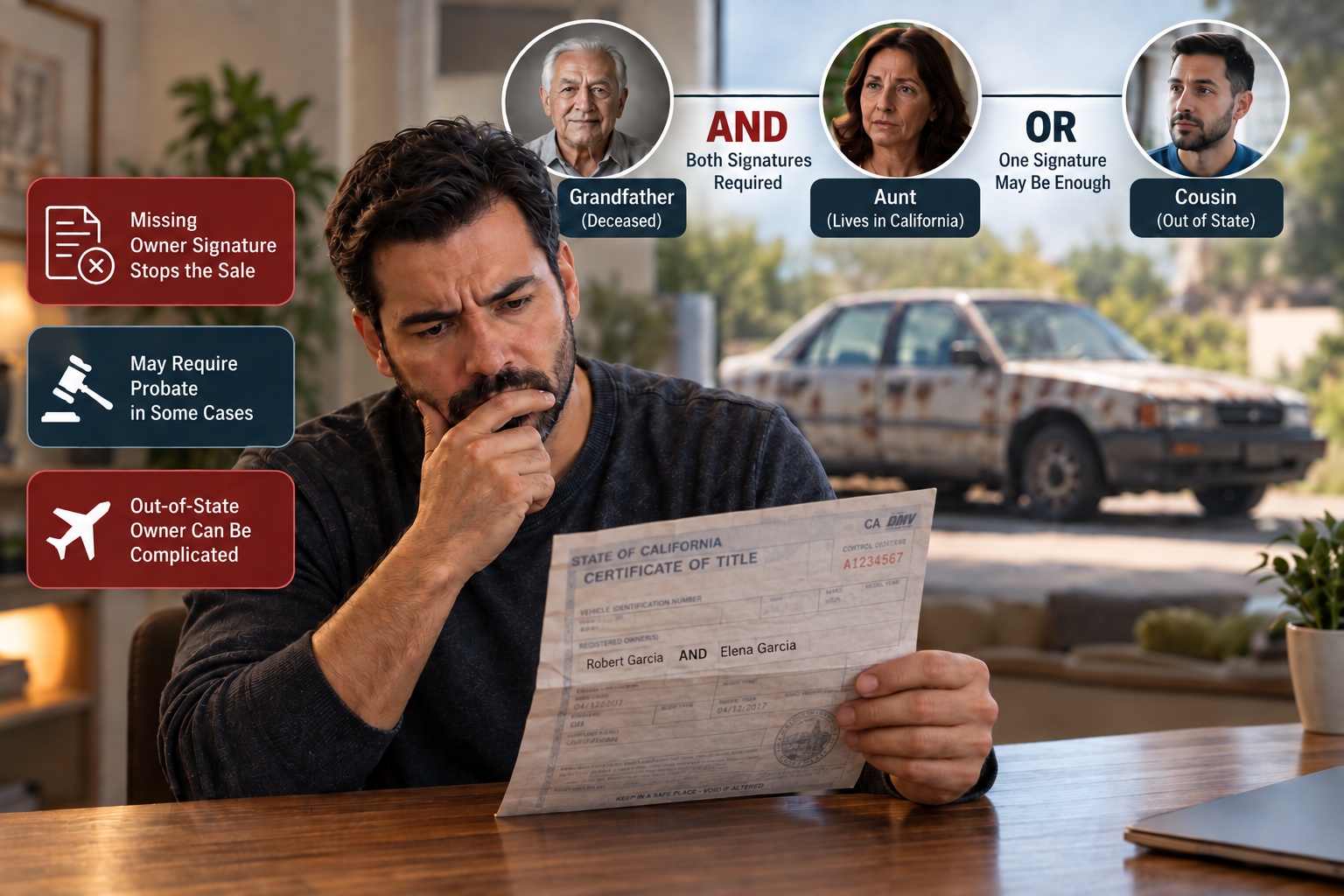
For example, Maria Lopez AND David Lopez is not handled the same way as Maria Lopez OR David Lopez, and both can differ from ownership marked TEN COM (Tenants in Common), JTRS (Joint Tenants with Right of Survivorship), or COMPRO (Community Property). Generally, an AND title requires all living owners to participate in the transfer. An OR title generally allows either owner to sign. AND/OR is generally treated more like OR, while a slash commonly follows the AND procedure. Other designations can change what happens when an owner dies. Understanding these distinctions clearly can save a family days of unnecessary paperwork.
For More Explanation:
If the title says Maria Lopez OR David Lopez and Maria is available in Los Angeles, she can generally complete the ownership release without waiting for David to fly in from another state.
But if it says Maria Lopez AND David Lopez and both are alive, Maria normally cannot simply sign the title herself because the car happens to be sitting at her house. Even the car’s value can’t change that. It means that a $700 junk car can still have the same ownership problem as a $30,000 vehicle.
On the other hand, an “AND” Title Becomes More Interesting When One Owner Has Died. This is often where families receive contradictory advice, as someone may say, “It says AND, so Grandpa’s heirs must sign,” while another person may say, “No, Grandma automatically owns the whole car now.”
Generally, both statements can sound believable, which is exactly why you should not settle the question through family assumptions. California has vehicle-specific co-ownership rules, and an ordinary California title using AND can carry survivorship rights even though both owners would have needed to sign while they were alive. That means the death of one AND owner does not automatically require every heir to approve the sale.
For example, suppose the title reads, Robert Garcia AND Elena Garcia, and Robert dies. Now, the family may assume Robert’s children now own part of the vehicle. But if survivorship applies to that ownership arrangement, Elena may instead establish that she is the surviving owner and proceed using the title and acceptable proof of Robert’s death.
Now change one small detail, and let’s suppose the title expressly says TEN COM, meaning tenants in common. This can produce a different result because the deceased owner’s interest generally passes through the estate instead of automatically moving to the surviving co-owner.
So, you can see how the word AND creates so many problems, which is why you always have to read the complete ownership line when talking to Cash Cash Cars to get a quote on your vehicle.
When The Surviving Owner Can Handle The Sale
If survivorship resolves the ownership issue, the process can be much simpler than the family first expects. For example, imagine Grandma is still alive and was properly listed with Grandpa in a way that gives her survivorship rights. Instead of locating every child and grandchild for signatures, she may be able to establish the death and release the vehicle herself.
In this situation, the paperwork may include the original California title, the surviving owner’s signature, a certified copy of the deceased owner’s death certificate, identification, and any additional DMV paperwork required for that particular record. However, the key word is ‘may,’ because you cannot schedule a tow truck just because the family thinks the paperwork looks right.
For example, the truck arrives, the car is loaded, and only then does someone notice a lienholder still appears on the title. Or the death certificate is only a photocopy when another form of certified documentation is required. Or the ownership designation means you still need an estate document.
That is why reviewing the document package before pickup saves the LA car sellers from a lot of frustration. For families dealing specifically with an inherited vehicle, Cash Cash Cars has also prepared a guide to selling a deceased relative’s car in Los Angeles.
Sometimes The Car Really Does Have To Go Through The Estate
Survivorship does not solve every inherited-car situation. For example, Grandpa may have been the only owner. Or the title may show an ownership structure where his share passed into the estate. Or another relative may claim that the car belongs to them under the will. So now the question is no longer simply, “Who signs the pink slip?” It becomes, “Who legally has the authority to act for the deceased owner?”
One possible route is California DMV Form REG 5, Affidavit for Transfer Without Probate, when the estate and successor meet the applicable requirements. However, this procedure generally requires waiting at least 40 days after the owner’s death to confirm that no conflicting probate proceeding prevents the transfer.
After all, it is critical to establish that the person signing the document is legally entitled to succeed to the vehicle and meets the applicable small-estate requirements. So, this is not just a form that the most convenient relative signs. For example, three siblings cannot simply decide, “Mike lives closest to the car, so Mike will sign REG 5.” The person using the affidavit must actually have legal authority to claim the vehicle, and REG 5 is signed under penalty of perjury.
If probate is already open, the estate does not qualify for the simplified procedure, or two relatives genuinely dispute who owns the vehicle, the matter can require the executor, administrator, or probate court. The DMV processes vehicle ownership documents. It is not there to decide which side of an inheritance argument is telling the truth.
An Out-Of-State Relative Does Not Always Have To Fly To Los Angeles
Now imagine everyone agrees to the sale, but one required owner lives 1,500 miles away. Technically, this is a very different problem from an inheritance dispute.
For example, the title reads Maria Lopez AND David Lopez. Maria has the car in Los Angeles while David lives in Texas. David wants to sell the car and has no objection to the price. He simply cannot come to California to sign paperwork in person.
In situations like this, California DMV Form REG 260, Power of Attorney, may allow David to appoint Maria to complete permitted parts of the vehicle transaction on his behalf. Maria can then sign in a way that clearly shows she is acting on David’s authority, such as David Lopez by Maria Lopez, POA. That can turn what looked like a travel problem into a paperwork problem. And paperwork is usually much easier to solve.
However, REG 260 is not a general power over everything David owns. It relates to the identified vehicle transaction. So, Maria cannot suddenly use that form to manage David’s bank account, sell his other property, or make unrelated decisions on his behalf.
The form details also matter, and a badly altered POA, pasted signature, unexplained correction, or mismatched vehicle information can give a buyer good reason to stop the transaction until the paperwork is cleaned up.
A Power Of Attorney Dies With The Person Who Gave It
This distinction causes a lot of confusion in estate-related vehicle sales. For example, Grandpa signed a power of attorney several years before he died, and another family member still has the document. Now, it may feel logical to say, “We already have his POA, so we’ll just use that to sell the car,” but that does not work. A power of attorney ends when the person who granted the authority dies. REG 260 cannot be used to sign on behalf of a deceased owner, and no heir can create a new vehicle power of attorney in that deceased person’s name.
Now this point alone helps to separate three very different situations:
A living owner who agrees to sell but lives far away may be able to use REG 260.
A deceased owner’s interest may require survivorship documentation, REG 5, or probate authority.
A surviving co-owner with full authority may not need either route.
So, while these scenarios may all involve the same old car, they don’t present the same legal problem.
Reg 260 Also Does Not Magically Cover Every Form
Another mistake is assuming that once you have a power of attorney, the local relative can sign absolutely everything, but this is not correct either.
For example, certain factual certifications may require the person making the statement to sign personally. The rulebook specifically notes that REG 260 generally cannot be used to sign REG 256 when the individual making the factual certification must sign personally.
Odometer Disclosure Can Also Create Another Issue
Depending on the vehicle’s model year and transaction, you may need an original, secure REG 262, Vehicle/Vessel Transfer and Reassignment Form, printed on security paper. So, imagine David in Texas mails Maria the REG 260, and everyone thinks they are finished. The envelope arrives three days later. Then the buyer reviews the file and says, “We still need David’s original signature on the odometer paperwork.” Now another document has to travel across the country.
Why The Document Package Should Be Identified Before Everything
The smart approach is to identify the entire document package before anyone mails anything, because sending one complete envelope is much easier than fixing the transaction form by form.
To dig deeper, let’s add a Missing Title to this situation because family cars have a habit of creating several problems at once. For example, the signatures are finally sorted out, everyone agrees to sell, and then someone asks about the pink slip, but nobody knows where it is. Maybe it was stored with Grandpa’s papers. Maybe another family member took it years ago. Maybe it disappeared during a move.
A missing California title does not necessarily mean the vehicle cannot be sold. Depending on the situation, the family may be able to use REG 227, Application for Replacement or Transfer of Title. But REG 227 does not erase the underlying ownership rules.
For example, if two living owners are joined by AND, losing the title does not suddenly allow one of them to sell alone. If the owners are joined by OR, the normal OR signing rule may still help. And if a bank’s electronic lien is still attached to the DMV record, REG 227 does not magically remove that interest either.
That’s why the missing title is often only one layer of the problem. If your family is dealing with both missing ownership documents and an unwanted vehicle, Cash Cash Cars is open to completing the broader process, and all you have to do is tell us you want to sell a car without a title or registration in Los Angeles.
An Old Loan Can Surprise The Entire Family
Now imagine everyone believes the vehicle was paid off years ago. Grandpa certainly acted as if it was. But the DMV record still shows a lender. This can happen when the financial obligation was satisfied, but the ownership record was never properly cleaned up.
In that case, the family may need an acceptable lien release before the buyer can receive clear ownership. For example, that may involve REG 166 or other qualifying documentation from the financial institution, depending on how the lien appears and what type of release is required. If money is actually still owed, the situation becomes even simpler conceptually because the family cannot eliminate the lender’s rights just because all the relatives agree to sell the car. The lender still has to be dealt with.
Just like this, repair-shop and towing liens can create another problem. For example, the vehicle may have been left at a mechanic because the deceased owner could not afford the repairs. Months of storage may now be involved. That is different from a relative saying, “This car has occupied my driveway for six months, so I’m charging the estate $100 per day.”
You cannot invent a garageman’s lien merely because the car has become inconvenient.
If you have an actual lender, you can sell the car directly through Cash Cash Cars’ page about selling a car with a lien.
Expired Tags Usually Aren’t The Biggest Problem
Many inherited junk cars have not been driven in months or years. So expired registration is almost expected. For example, Grandpa stopped driving the car two years ago. The tags expired. Nobody renewed them because the vehicle was sitting behind the house. Now the family wants to sell it, but expired registration doesn’t automatically make the transfer impossible. However, DMV fees, penalties, and the vehicle’s registration status can affect what the buyer is willing to pay. So, disclose this when getting offers, not when the tow truck arrives.
Overall, different buyers may treat registration issues differently. One may factor outstanding fees into the offer. Another may handle the vehicle under a different licensed process. The important thing is knowing the situation before everyone agrees on a price.
A Failed Smog Test Can Actually Change Which Buyer Makes Sense
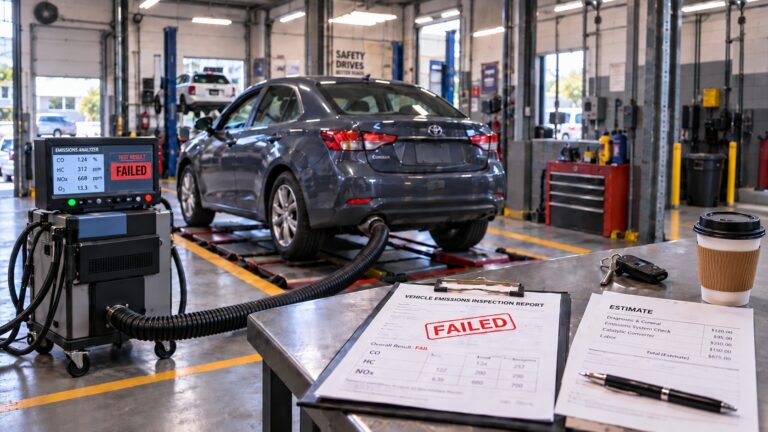
Now imagine the car still runs, but it cannot pass emissions testing. The check-engine light is on. The catalytic converter may need replacing, but nobody wants to put another $2,000 into a car worth $3,500 on a good day. That changes the economics of the sale.
A vehicle sold directly to a properly licensed California dismantler for dismantling may qualify for a smog-transfer exemption under California Vehicle Code section 11520. That can make a licensed dismantler particularly useful for an old, non-running, or emissions-failing family vehicle.
But you should also note what the smog exemption does not solve. It does not create a missing signature. It does not resolve an inheritance dispute. It does not release a bank lien. And it does not turn someone who does not own the vehicle into its legal seller.
That’s why an ownership authority still comes first. You solve who can sell the car, and then you solve how the car can be sold.
Can An Out-Of-State Family Member Handle Everything In One Day?
In short, they can handle everything, but only sometimes. Mostly, “same day” also depends on what happened before that day.
For example, if the title says OR, the local owner has everything required, there is no lien, and the vehicle is ready for pickup, the transaction can be relatively straightforward. Now change it to an AND title with one owner living in Florida. That person may need to sign REG 260, complete any other required original paperwork, and send the documents to Los Angeles. But when the family discovers all of this at 10 a.m. and expects the vehicle gone by 3 p.m., the problem is no longer the buyer. The problem is geography.
That is why the better approach is to identify every required document first. Then the out-of-state relative signs the complete package once, sends the originals by tracked delivery, and keeps copies.
Scanned documents can still be useful, but they do not solve every problem. For example, the buyer can review photographs or scans and say, “Yes, this looks like the correct paperwork, but we will need the original before final transfer.” Overall, that is much better than overwriting documents without anyone checking them. Original titles, secure odometer forms, certified death certificates, lien releases, and replacement-title paperwork can all carry different document requirements. So when people say they want a “same-day junk-car sale,” the fastest route is usually to handle the paperwork before pickup day.
The Hardest Problem Is Usually Not Distance. It Is Refusal.
An owner in another state can often cooperate, but an owner who refuses to cooperate is much harder to deal with. For example, three siblings inherit interests connected with a vehicle. Two want it gone. The third says, “I don’t care what you do with the driveway. I’m not signing.”
REG 260 cannot solve that because a power of attorney must be given voluntarily. You cannot use a POA to take ownership authority away from somebody who does not consent. The family may need to negotiate, buy out the person’s interest, use a mediator, or speak with an attorney about whether a court order is appropriate.
This is where the economics get frustrating. Imagine spending $4,000 on attorneys fighting over a car worth $1,800. It happens because once the disagreement becomes emotional, the car’s value stops being the real issue. That is why a written family agreement is often worth far more than the extra few hundred dollars someone hopes to squeeze out of the sale. What you should never do is “solve” the dispute by signing the other owner’s name. A rejected transfer would be bad enough, and an unauthorized signing can create much more serious civil and potentially criminal problems.
Owning The Driveway Does Not Mean You Own The Car
Where the car is parked also creates another common family misunderstanding.
For example, the vehicle has been sitting on your property for eight months. You own the house. You pay the mortgage. You have asked everyone repeatedly to remove the car. At some point, it is natural to think that if nobody takes responsibility for it, I’ll just sell it myself. But ownership of the land and ownership of the vehicle are two different things. The fact that a car is parked on your property does not give you the right to sign its title or sell someone else’s ownership interest. You may have options for having a vehicle removed from private property, but those are towing procedures, not ownership transfers.
California Vehicle Code section 22658 governs private-property towing in qualifying situations and includes requirements involving notice, signs, authorization, property type, and other circumstances. An improper tow can also create liability. So you don’t want frustration over an abandoned family car to lead to an even more expensive towing dispute. Los Angeles also has abandoned-vehicle reporting procedures, including MyLA311, depending on where and how the vehicle is parked.
But again, removal and sale are not the same thing. A government agency or towing company may be able to remove a qualifying abandoned vehicle. That does not automatically give the homeowner the right to sell it.
Moving The Problem To The Street Usually Makes It Worse
When the driveway problem becomes unbearable, someone may suggest a shortcut that you push it onto the street and let the city take it. That can be an expensive way to avoid paperwork. The DMV record still connects the vehicle to its registered owners. Meanwhile, citations, towing charges, storage fees, and other costs can begin growing. Instead of solving a junk-car problem, the family may simply convert it into an impound problem. The same logic applies to leaving it on somebody else’s property. The legal ownership question doesn’t disappear just because the vehicle changed parking spaces.
Waiting Six More Months Rarely Improves A Junk Car
Families often postpone the decision because nobody wants to deal with the paperwork. That is understandable after a death. But an old vehicle usually does not improve while everyone waits.
For example, a car that needs a battery today may need a battery, tires, fuel-system work, rodent cleanup, and towing six months from now. A small oil leak may become a driveway stain. The paint deteriorates. The interior develops mold. The HOA starts sending notices. Or the landlord finally says the vehicle has to go. Meanwhile, the car still takes up space someone else could use. This is why waiting can cost you more than people realize.
Repairing the vehicle can make sense if the likely increase in sale value clearly exceeds the repair costs, waiting time, and risk of discovering more problems. But consider a different example.
The vehicle might sell privately for $4,500 after $2,000 in repairs, a successful smog test, several weeks of listings, and multiple buyer appointments. A licensed buyer like Cash Cash Cars offers $2,800 as-is with towing. The headline difference is $1,700. The real difference shrinks once you subtract repairs, time, towing, and uncertainty. In the end, there is no universal answer, but there should be an actual calculation.
Donation Does Not Bypass Ownership Either
Another relative may say, “Why don’t we just donate it?” That can be a perfectly reasonable choice in some situations. But donating the vehicle does not eliminate the ownership question. A charity still needs legal authority to receive the car.
For example, if two living AND owners are required to approve a transfer, calling the recipient a charity instead of a buyer does not make the second owner’s interest disappear. The tax consequences also depend on the family’s particular situation. So, a donation may change what happens to the vehicle, but it does not magically clean up a disputed title.
The Fastest Sale Usually Starts Before Anyone Calls The Tow Truck
When multiple family members appear on a California title, the natural instinct is to start with the car. Does it run? How much is it worth? Who will tow it? All those questions matter, but they usually come second. Cash Cash Cars advocates starting with ownership.
For example, if the title says OR, one available owner may be enough. If it says AND and both owners are alive, both may need to participate. If one owner lives out of state but cooperates, REG 260 may help. If one owner has died, survivorship, REG 5, or probate authority may determine who can act. If the title is missing, REG 227 may become part of the package. If there is a lien, you must address it separately. And if the car cannot pass smog, the type of buyer may matter after you resolve ownership.
Once you think about the transaction in that order, what first looked like one huge family problem becomes a series of smaller questions.
A Practical Way To Sort Out The Family Paperwork
Before scheduling pickup, put the title on a table and work through the situation logically. First, photograph the complete ownership line so everyone is discussing the same document. Then identify which named owners are alive. If someone has died, get the certified death documentation and determine whether survivorship, REG 5, or formal probate authority controls that person’s interest. If everyone is alive, determine whether the conjunction requires one signature or several.
If a required owner lives elsewhere but agrees to the sale, determine whether REG 260 and any original odometer paperwork are needed. If the pink slip is missing, find out whether you can use REG 227. Next, check for a lender or other lienholder. And before mailing documents across the country or scheduling a truck, have the complete package reviewed. That may sound like more work at the beginning. But in reality, it is usually what prevents the same transaction from being stopped three different times.
Keep The Final Sale Simple Enough That Everyone Understands It
Family transactions become suspicious when nobody can explain exactly what happened. For example, Cousin Mike says he sold Grandpa’s car for $2,400. Someone else says it was worth $5,000. Another relative says they never agreed to the sale. Now everyone is arguing months after the vehicle disappeared.
A clean transaction helps avoid this. Keep a written record showing the vehicle, buyer, sale price, and transaction date. Keep copies of the title paperwork, estate documents, power of attorney (if one was used), lien release, payment record, and towing receipt. Then file the California Notice of Transfer and Release of Liability within five calendar days after the sale and keep the confirmation.
You do not need to turn a junk-car sale into a corporate closing. You just need enough documentation so another family member can review the file later and understand who had authority to sell it, who signed, why those signatures were sufficient, what happened to any lien, who bought the vehicle, how much they paid, and when ownership left the family. When those questions have clear answers, there is much less room for another argument.
Last But Not The Least Is To Get The Ownership Right Before You Worry About Getting The Car Gone
When an unwanted vehicle is taking up space, speed feels like the biggest priority. But the fastest solution is not always the person who promises to tow the car first. It is the transaction that secures ownership before the vehicle moves.
For example, an OR title may allow one local family member to complete the sale quickly. An AND title with two living owners may require both signatures or a valid REG 260 from the person who cannot be there. A deceased owner’s interest may be resolved through survivorship, REG 5, or formal estate authority. A missing title can add REG 227. A lender can add another layer. And none of those problems disappear simply because the vehicle is old, broken, or worth very little.
The good news is that once we identify the right ownership path, the rest of the transaction usually becomes much easier.
Let’s not forget to add that Cash Cash Cars has experience dealing with Los Angeles vehicles involving multiple owners, deceased family members, missing titles, liens, non-running cars, and other paperwork complications. We can review the situation before pickup so the family knows which documents will matter, instead of discovering another problem with the tow truck already outside.
If a family junk car has become more complicated than it’s worth, call Cash Cash Cars at 818-822-1863 and explain exactly how the names appear on the title. That one detail is often the best place to start.
Disclaimer: This article provides general information and is not legal, probate, or tax advice. Vehicle ownership, estate administration, liens, towing rights, and DMV requirements depend on the specific facts and documents involved. When ownership is disputed or probate issues are involved, consult the California DMV and an appropriate California attorney.