Where To Sign On A Pink Slip When Selling A Car?
Selling a car in Los Angeles? Learn exactly where to sign the California pink slip, plus rules for co-owners, liens, odometer disclosure, and lost titles.
If you are selling a car in Los Angeles, signing the California pink slip incorrectly can turn a straightforward sale into a DMV headache.
The good news is that the basic process is simple. For most California-titled vehicles, the registered owner releases ownership by signing Line 1 on the front of the California Certificate of Title. Depending on the age of the vehicle and the version of the title, you may also need to complete and sign the odometer disclosure section.
The complications usually start when there are two owners, a lender is still listed, the title has been lost, someone makes a mistake, or the vehicle is owned by a trust or business.
Here is how to handle each situation under California DMV rules.
Where Does the Seller Sign a California Pink Slip?
For a standard private-party sale, start on the front of the California Certificate of Title.
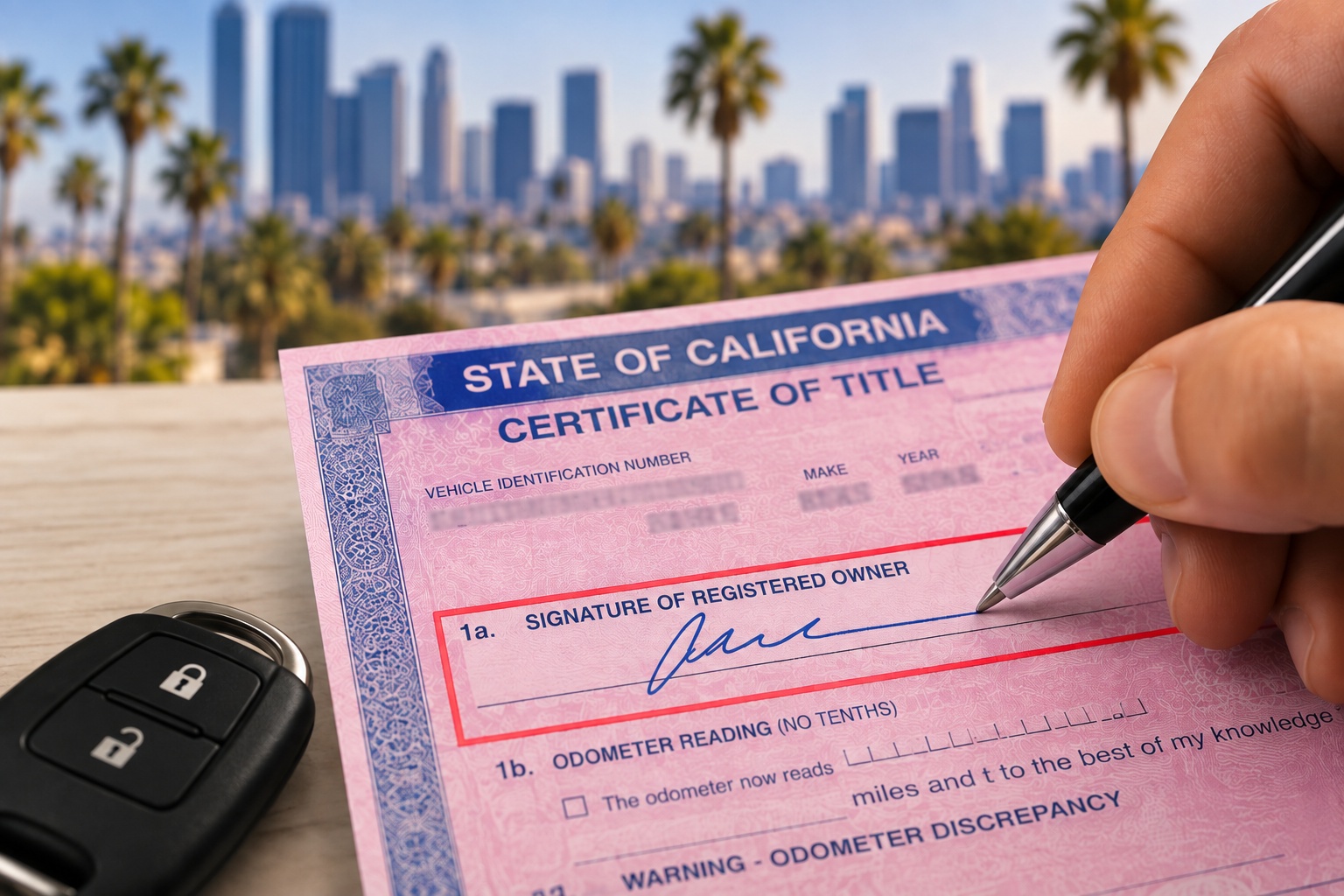
The seller’s main release is on Line 1, the registered-owner release section. California DMV specifically requires the person whose name appears as the registered owner to release their interest there.
On many California titles this appears as:
Line 1a – Signature of Registered Owner
If two signatures are required, the second registered owner uses the corresponding additional owner signature space.
Do not start filling out random sections on the back of the title just because they are blank. California has issued different title designs over the years, and dealer reassignment and new-owner sections may appear in different places.
The safest approach is to follow the labels on the actual title you are holding.
For most sellers, the important areas are:
- Registered-owner release on Line 1.
- Odometer disclosure, when required.
- Legal-owner or lienholder release on Line 2, if a lienholder is listed.
The buyer completes the new-owner information required for the transfer.
Do You Have to Sign the Pink Slip Twice?
Sometimes.
Your signature on Line 1 releases your ownership interest in the vehicle.
A separate signature may also be required as part of the odometer disclosure. California’s complying titles contain a mileage disclosure section on the face of the title, with the seller reporting the mileage and the buyer acknowledging it.
That means signing Line 1 does not automatically complete every seller requirement.
Before handing the title to the buyer, check whether the title also asks you to:
- enter the odometer reading
- print your name
- sign as the transferor or seller
- date the disclosure
The buyer may also have to acknowledge the same mileage.
What If Two People Are Listed on the Title?
This is one of the most important things to check before anyone signs.
California treats co-owned vehicles differently depending on the word connecting the owners’ names.
If the title says “OR”
Only one owner has to sign to release the vehicle.
For example:
John Smith OR Mary Smith
Either John or Mary can normally complete the ownership release.
If the title says “AND/OR”
Again, the signature of only one owner is required.
If the title says “AND”
Both owners must sign.
For example:
John Smith AND Mary Smith
John cannot privately sell the entire vehicle without Mary’s required release, and Mary cannot do it without John’s.
What does a slash between names mean?
California DMV treats a slash between co-owner names as “AND.”
So:
John Smith / Mary Smith
requires both owners’ signatures.
If the ownership document was issued without “and” or “or” being specified, DMV records generally represent the ownership with a slash and require both owners to release their interests.
What If One Co-Owner Lives Outside California?
Being physically present in Los Angeles is not normally what determines whether an owner must sign. The ownership wording does.
If both signatures are required, one practical solution is to send the original title to the absent owner so that person can complete the required release.
Power of attorney may also be available in appropriate circumstances, but odometer disclosures have additional federal requirements. California DMV has specific rules governing powers of attorney when mileage disclosure is involved, so sellers should not assume a general authorization automatically substitutes for every required odometer signature.
If an absent co-owner’s signature is required, resolve that issue before accepting payment and handing over the vehicle.
Where Do You Put the Mileage?
On a California title that complies with federal odometer rules, the mileage disclosure is normally on the front of the title.
Enter the mileage that appears on the vehicle’s odometer at the time of transfer.
The disclosure must indicate whether that reading:
- reflects the actual mileage
- is not the actual mileage
- exceeds the mechanical limits of the odometer
The seller and buyer must complete the appropriate acknowledgment when odometer disclosure is required.
Do not guess at mileage.
If an odometer is broken, has been replaced, or the actual mileage cannot be determined, use the appropriate mileage-discrepancy declaration.
Which Cars Require an Odometer Disclosure?
This rule changed significantly in recent years.
For transfers occurring on or after January 1, 2021, federal rules generally require odometer disclosure for vehicles less than 20 model years old, beginning with model-year 2011 vehicles.
For example, a 2011 vehicle continues to require mileage disclosure through calendar year 2030. In 2031 it reaches the 20-model-year exemption.
Certain other vehicle categories may also be exempt.
Because older DMV consumer pages can still contain references to the previous 10-year rule, the current DMV odometer manual is the safer authority when determining whether a particular vehicle requires disclosure.
When Do You Need REG 262?
The Vehicle/Vessel Transfer and Reassignment Form, REG 262, becomes important when the ordinary title cannot properly handle the transfer or mileage disclosure.
California DMV requires or accepts REG 262 for situations including:
- the title is a noncomplying older title
- the original title was unavailable when the vehicle was sold
- a REG 227 replacement/transfer application is being used
- an error or alteration was made in the title’s odometer disclosure
- multiple transfers require additional reassignment or odometer disclosures
REG 262 is printed on secure paper, so it is not provided as an ordinary downloadable form.
One important point: REG 227 itself does not replace the secure odometer disclosure when mileage disclosure is required. Sellers and buyers using REG 227 may also need REG 262 for the mileage disclosure.
What If You Make a Mistake on the Pink Slip?
Do not reach for correction fluid.
A California title is a legal ownership document, and alterations can complicate or invalidate the transfer.
For many ordinary title mistakes, the person who made the error can complete a Statement to Record Ownership/Statement of Error or Erasure, REG 101 explaining what happened.
Examples can include signing in the wrong ownership area or entering incorrect ownership information.
The basic strategy is:
Leave the original error visible and document the correction properly instead of attempting to conceal it.
Odometer mistakes are handled differently
The mileage section is much stricter.
If an error is made in the odometer disclosure on a complying title, DMV may require:
- a properly completed REG 262 for the mileage disclosure
- a REG 256 Statement of Facts explaining why a separate odometer disclosure is being submitted
If the mistake occurs on REG 262 itself, a new REG 262 is generally required.
Do not erase, overwrite or alter mileage figures.
What If the Pink Slip Is Lost?
A lost title does not necessarily mean you have to obtain a new title in your own name and then start the sale over.
California’s Application for Replacement or Transfer of Title, REG 227, can be used in connection with a transfer when a California title has been lost, stolen, missing, mutilated or rendered illegible.
The transfer version allows the registered owner to release the vehicle and the buyer to apply for ownership.
If the damaged title still exists, DMV may require its remaining pieces to be submitted with the application.
Where odometer disclosure is required, REG 262 may also be needed.
If you are dealing with this situation specifically, see how Cash Cash Cars handles questions about how to sell a car without a title before arranging pickup or assuming the vehicle cannot be sold.
What If a Bank Is Listed on the Pink Slip?
Look for the legal owner or lienholder information before signing the car away.
If a lienholder is still recorded, the lienholder generally must release its interest on Line 2 of the California title.
DMV also recognizes the Lien Satisfied/Title Holder Release, REG 166, in qualifying situations. If REG 166 is attached instead of a release directly on Line 2, DMV procedures call for “L/S att” to be entered on Line 2.
There is an important exception for very new vehicles: for a California-titled vehicle two model years old or newer, the California Certificate of Title itself may be required to release the lien.
Replacement-title transactions involving a lienholder can also require notarization of the lienholder’s releasing signature.
If the title is electronic through California’s Electronic Lien and Title system, the lender and DMV may need to complete the electronic lien-release process before the seller has the documents needed for a conventional transfer.
Do not assume that simply paying off the loan automatically removes the lien from the title paperwork in your hand.
If you still owe money on the vehicle or the lender holds the title, review the process for how to sell a car with a lien before scheduling a sale or pickup.
Can You Sell a Car Without Smogging It First?
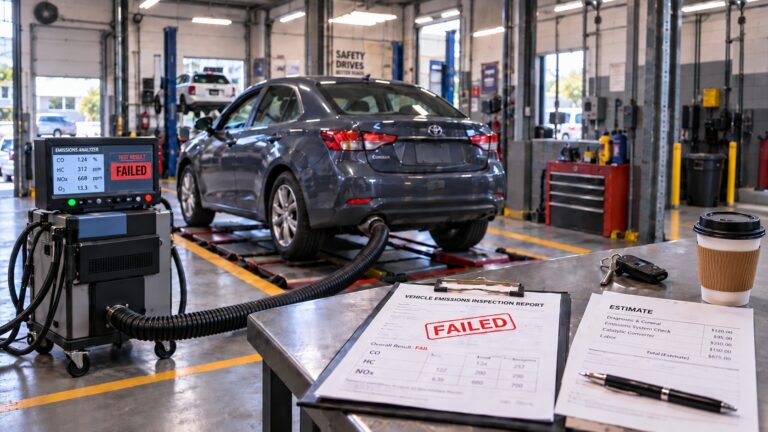
For an ordinary private-party sale in Los Angeles, California generally requires the seller to provide a valid smog certification when the vehicle is subject to the Smog Check program.
For a private sale that requires smog, the inspection generally must have been completed within the previous 90 days.
There are exemptions.
For example, certain newer vehicles may be exempt from the change-of-ownership inspection, with the buyer instead paying the applicable smog transfer fee. Certain family transfers are also exempt, as are categories such as fully electric vehicles and motorcycles.
Do not assume that writing “as-is” on a bill of sale eliminates a statutory smog requirement.
Also, putting a car into Planned Non-Operation status is not, by itself, a blanket substitute for California’s change-of-ownership smog rules.
If the vehicle has already failed emissions testing and you are deciding whether repairs are worthwhile, Cash Cash Cars also covers options for owners looking to sell a car that failed smog.
Selling to a Dealer, Dismantler or Junk-Car Buyer
Your basic ownership release does not suddenly move to a different part of the title just because the buyer is a business.
The registered owner still releases the vehicle as required on Line 1.
Licensed dealers, dismantlers and other occupational-license holders then have additional DMV paperwork and reporting requirements of their own. Dealers may use dealer reassignment sections rather than immediately obtaining a normal retail title in the dealership’s name.
Odometer rules also continue to apply where required.
If you are selling to a car-buying company, keep documentation showing:
- the buyer’s legal business name
- the vehicle and VIN
- the date of sale
- the amount paid
- the buyer’s address
- any applicable dealer or dismantler license information
- proof of payment
Do not sign a title and intentionally leave the identity of the buyer blank.
A blank signed title can create serious problems if the vehicle changes hands again without the intermediate buyer completing the proper transfer.
If the vehicle is old, damaged, non-running, or no longer worth preparing for a private sale, you can also review the process for how to sell a junk car in Los Angeles and what paperwork should be discussed before pickup.
What If the Vehicle Is Owned by a Business?
California requires the business entity’s name and an authorized representative’s countersignature.
For example, a release might identify:
ABC Logistics LLC, by Jane Smith
rather than simply containing Jane Smith’s personal signature with no indication she is acting for the company.
The business entity name and authorized representative should be clearly connected on the ownership release.
What If the Vehicle Is Owned by a Trust?
If the trustee is already listed on the title, the trustee signs for the trust.
If the title names the trust but does not identify the trustee, California DMV may require a REG 256 Statement of Facts from the trustee certifying their appointment as trustee or successor trustee.
Do not sign a trust-owned title as though the vehicle belonged to you personally.
The signature should clearly indicate that you are acting in your trustee capacity.
What If One of the Owners Has Died?
The correct procedure depends heavily on how ownership is shown.
If owners are joined by “OR” or “AND/OR,” one surviving owner may generally be able to release the ownership interest, subject to exceptions such as Tenants in Common or other special ownership designations.
If owners are joined by “AND,” the deceased owner’s interest must be properly addressed through the estate or heir process.
California may allow an heir to use Affidavit for Transfer Without Probate, REG 5, where the statutory conditions are satisfied. Probate documents such as Letters Testamentary or Letters of Administration may instead control in other cases.
Do not simply imitate the deceased owner’s signature.
What About a Salvage or Revived-Salvage Title?
A salvage brand does not normally mean the registered-owner signature moves to an entirely different seller-release location.
What changes is the vehicle’s legal history and the paperwork that may accompany the transaction.
California titles can display title brands, including salvage-related information, and sellers should never conceal or misrepresent that history.
Read the actual branded title carefully and make sure the buyer knows what vehicle status is being transferred.
What If It Is an Out-of-State Pink Slip?
A title issued by another state follows that state’s title requirements.
Do not automatically apply California’s Line 1 rules to a Nevada, Arizona, Texas or other state’s title.
The seller should follow the release and notarization instructions printed on the issuing state’s document.
If the California registration says “Nontransferable/No California Title Issued,” REG 227 generally cannot simply replace the foreign title. The owner may need to obtain the title from the state where the vehicle was last titled.
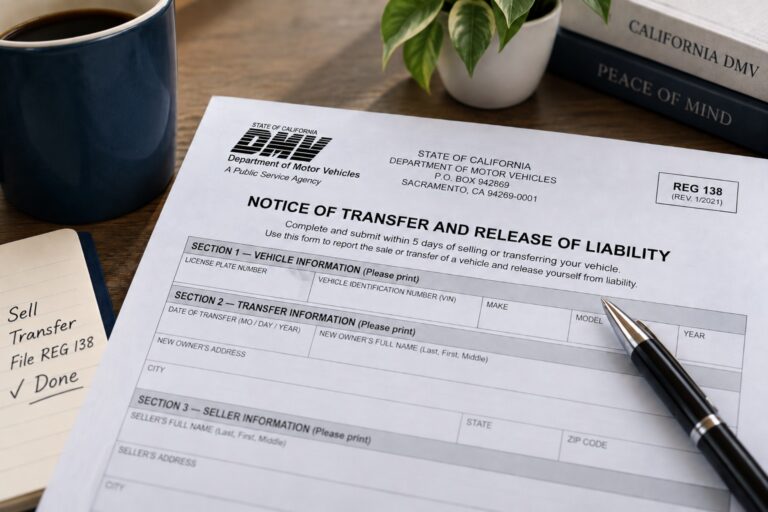
Do Not Forget the Notice of Transfer and Release of Liability
Signing the pink slip is not the final seller step.
California requires the seller to submit a Notice of Transfer and Release of Liability, commonly called the NRL, within five days of the sale.
The buyer generally has 10 days to complete the ownership transfer.
Before the buyer leaves, collect the information needed for your NRL, including the buyer’s identifying information and the sale details.
Filing the NRL does not physically complete the buyer’s title transfer. Rather, it tells DMV that you have disposed of the vehicle and records the transfer information while the buyer completes the ownership process.
Keep your confirmation.
That record becomes especially important if the buyer delays transferring the vehicle and parking tickets, toll notices or other vehicle-related issues later appear under the old DMV record.
A Simple Seller Checklist Before You Hand Over the Keys
Before completing a Los Angeles vehicle sale, work through these items in order:
- Confirm that the VIN on the title matches the car
- Confirm exactly how the registered owner’s name appears
- Check whether there is one owner or multiple owners
- If there are multiple owners, check for “AND,” “OR,” “AND/OR,” or a slash
- Check whether a lienholder or legal owner is still listed
- Sign the registered-owner release on Line 1
- Complete the odometer disclosure if required
- Have the buyer complete their required information
- Do not erase, white-out or alter mistakes
- Provide a valid smog certification when the transfer requires one
- Keep a bill of sale or other written proof of the transaction
- Record the buyer’s information before releasing the vehicle
- File the NRL with California DMV within five days
The Most Important Rule: Read the Title You Actually Have
California has used several title formats over the years.
That means an image you find online may not look exactly like the pink slip sitting on your kitchen table.
Do not sign a blank line simply because an online diagram says a signature should be “around here.”
Instead, look for the wording that identifies the registered-owner release, odometer disclosure and legal-owner release.
For a normal California transfer, the core rule is straightforward: the registered owner releases ownership on Line 1.
If your title is old, damaged, unusual, branded, issued by another state, connected to an estate, or lists ownership you do not understand, get the paperwork clarified before signing it.
Fixing an uncertainty before the car changes hands is much easier than trying to repair a broken chain of ownership after the buyer has already driven away.