Common Check Engine Light Issues and Solutions
Understand common check engine light problems, what the codes mean, which fixes you can handle yourself, and when repairs may cost more than the car is worth.
A check engine light can be frustrating because it tells you something is wrong without telling you exactly what the problem is. In one car, the cause may be nothing more than a loose gas cap. In another, the same warning light may point to a serious misfire, a cooling-system problem, or a failing catalytic converter.
That range is exactly why the right response is not to panic, but also not to ignore it.
Your car’s computer constantly monitors the engine, ignition, fuel, transmission, and emissions systems. When it sees a reading outside the expected range, it stores a diagnostic trouble code and may turn on the check engine light.
The warning itself is not a diagnosis. It is the car telling you that something needs to be investigated.
The smartest place to start is by looking at two things together: how the light is behaving and how the car itself is behaving.
Can You Drive With the Check Engine Light On?
Sometimes, yes. But it depends on both the light and the symptoms.
A solid check engine light usually means the computer has found a fault that needs attention, but not necessarily an immediate emergency. You may be dealing with something like:
- A loose or damaged gas cap
- A small EVAP leak
- A weak oxygen sensor
- A dirty mass airflow sensor
- An emissions-system fault
- An early catalytic converter efficiency problem
If the car feels normal, you can usually drive it cautiously while arranging a diagnosis soon.
A flashing check engine light is different.
What Does a Flashing Check Engine Light Mean?
A flashing or blinking check engine light commonly points to an active misfire.
When a cylinder fails to burn the air-fuel mixture properly, unburned fuel can enter the exhaust and overheat the catalytic converter. Keep driving long enough and a relatively small ignition problem can turn into a much more expensive exhaust repair.
The condition of the car matters just as much as the light. Stop driving if you notice symptoms such as:
- Severe engine shaking
- Jerking or major hesitation
- Rapid loss of power
- Rising engine temperature
- Strong raw-fuel smell
- Repeated stalling
Do not assume a steady light makes those symptoms safe to ignore. The way the car behaves always matters.
What Usually Causes a Check Engine Light?
There are dozens of possible causes, but several problems show up far more often than others.
Loose or Damaged Gas Cap
This is one of the simplest possibilities.
Your vehicle’s EVAP system is designed to contain fuel vapors. If the gas cap is loose, missing, damaged, or no longer sealing correctly, the system may detect a leak and turn on the check engine light.
Codes such as P0440, P0442, P0455, or P0457 can point toward an EVAP fault. That does not automatically prove the gas cap is the problem, but it is an easy place to start.
Tighten the cap properly, inspect the rubber seal for cracks, and replace it if necessary. The warning light may not disappear immediately because the vehicle usually needs to rerun its EVAP test over the next few drive cycles.
Worn Spark Plugs or Failing Ignition Coils
Misfires are one of the most common reasons a check engine light appears.
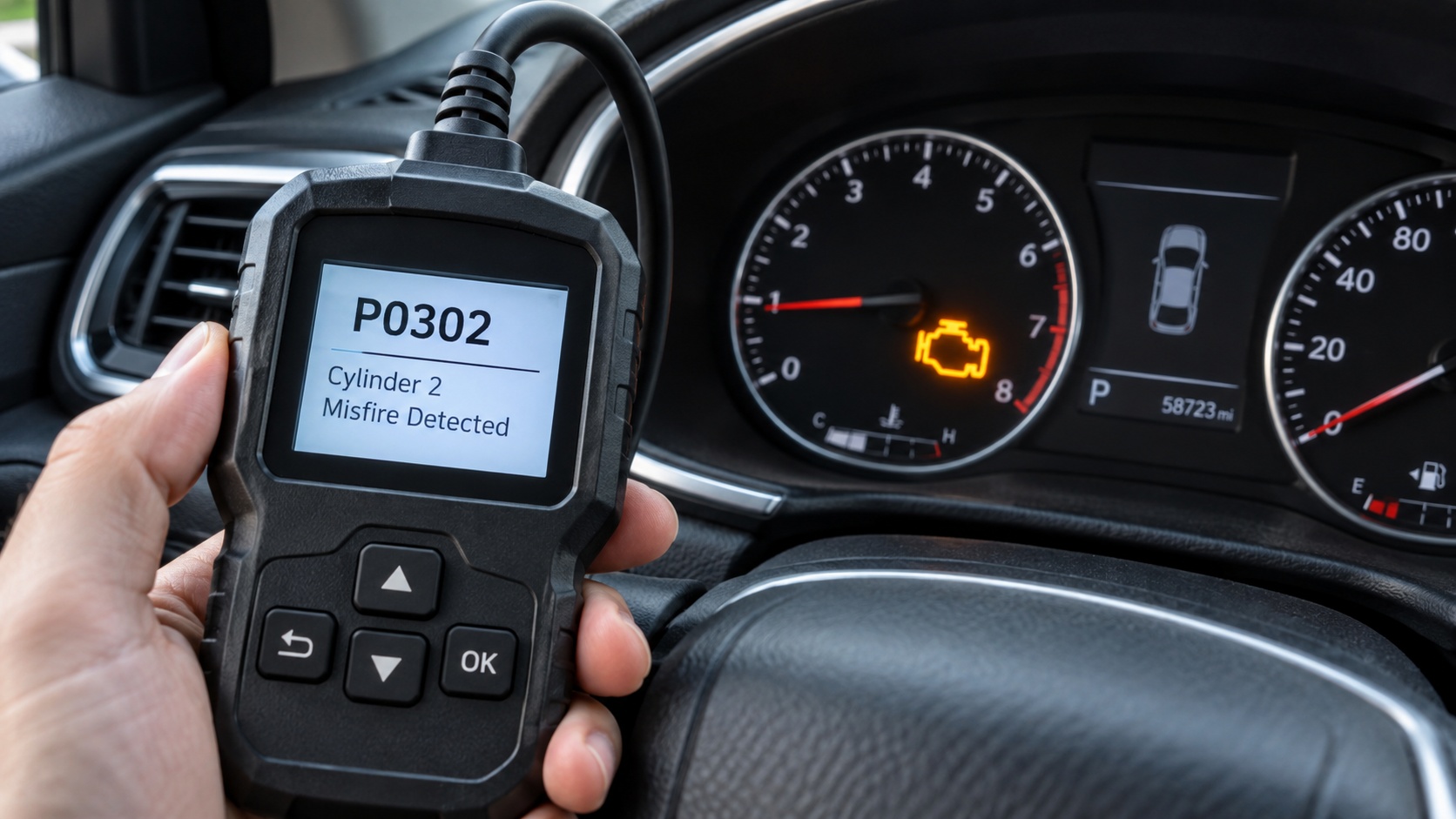
Codes in the P0300-P0308 range usually indicate that one or more cylinders are not firing correctly. P0300 generally means random or multiple-cylinder misfires, while a code such as P0302 points to cylinder 2 specifically.
Common causes include:
- Worn spark plugs
- Failing ignition coils
- Clogged fuel injectors
- Vacuum leaks
- Fuel-delivery problems
- Low compression
A bad plug or coil is often relatively inexpensive to repair. The real cost comes from ignoring the problem and allowing unburned fuel to damage the catalytic converter.
Dirty or Faulty Mass Airflow Sensor
The mass airflow sensor, usually called the MAF sensor, measures how much air is entering the engine. The computer uses that information to calculate how much fuel to inject.
When the sensor becomes dirty or starts reporting incorrect readings, you may notice:
- Rough idle
- Hesitation
- Poor acceleration
- Reduced fuel economy
- Stalling
Codes such as P0100, P0101, and P0102 can indicate a problem with the MAF circuit or airflow readings.
However, this is a good example of why you should not replace a part just because its name appears in the code description. A torn intake hose, vacuum leak, dirty electrical connector, or another airflow problem can produce similar readings.
Oxygen Sensor Problems
Oxygen sensors monitor oxygen levels in the exhaust and help the computer control the air-fuel mixture.
Problems in these circuits often trigger codes in the P0130-P0161 family.
A failing oxygen sensor does not always make the car difficult to drive. In many cases, the first sign is simply worse fuel economy because the computer starts adding more fuel than necessary.
But an oxygen sensor code still needs diagnosis. Exhaust leaks, wiring faults, or another engine problem can cause a good sensor to report abnormal readings.
Catalytic Converter Efficiency Problems
Codes P0420 and P0430 are among the best-known check engine light codes.
They indicate that the computer believes the catalytic converter is not working as efficiently as expected.
The converter itself may be worn out, but other problems can cause the same result, including:
- Persistent misfires
- Exhaust leaks
- Excessively rich fuel mixtures
- Oil consumption
- Coolant entering the combustion process
- Incorrect oxygen sensor readings
Replacing the catalytic converter without identifying the underlying cause can be a very expensive mistake.
Cooling System and Thermostat Problems
A code such as P0128 commonly indicates that the engine is not reaching its expected operating temperature quickly enough.
A thermostat stuck open is one possible cause. The car may still seem to run normally, but an engine that stays too cool can use more fuel and build deposits over time.
A thermostat stuck closed is far more urgent because it can cause overheating. The same is true of a failed water pump or major coolant leak.
If the temperature gauge climbs into the hot range, do not keep driving simply because the check engine light is steady.
Common Check Engine Light Codes at a Glance
The code does not always identify the failed part, but it does tell you where to start looking.
| Code | What It Usually Indicates | Common Causes | Typical Urgency |
|---|---|---|---|
| P0300 | Random or multiple misfires | Plugs, coils, injectors, vacuum leak, fuel issue | High if engine is shaking |
| P0302 | Cylinder 2 misfire | Plug, coil, injector, compression problem | High if severe |
| P0101 | MAF performance/range problem | Dirty MAF, intake leak, wiring, airflow issue | Moderate |
| P0128 | Engine running cooler than expected | Thermostat, coolant sensor, cooling-system issue | Moderate |
| P0133 | Slow oxygen sensor response | Aging sensor, wiring, exhaust leak | Moderate |
| P0420 | Catalyst efficiency below threshold | Converter, misfire, exhaust leak, mixture problem | Moderate to high |
| P0442 | Small EVAP leak | Gas cap, hose leak, EVAP component | Usually low |
| P0455 | Large EVAP leak | Loose cap, damaged hose, purge/vent fault | Usually low |
The important point is not to turn this table into a shopping list. A code tells you what the computer detected, not necessarily which component you should replace.
Use the Symptoms to Narrow Down the Problem
The trouble code gives you direction, but the way the car behaves often gives you the next clue.
Rough Idle or Shaking
If the car shakes or stumbles while idling but smooths out once you start moving, a misfire or vacuum leak is a strong possibility.
Likely causes include worn plugs, failing coils, clogged injectors, or extra air entering through a cracked hose.
Sluggish Acceleration
If you press the accelerator and the car feels weak, delayed, or bogged down, think about airflow, fuel delivery, or exhaust restriction.
Possible causes include:
- Dirty MAF sensor
- Restricted air filter
- Vacuum leak
- Fuel pressure problem
- Restricted catalytic converter
Sudden Drop in Fuel Economy
A noticeable decline in gas mileage often points to a sensor or mixture problem.
The engine may still feel normal, but incorrect data from an oxygen sensor, coolant temperature sensor, or airflow sensor can make the computer command too much fuel.
Stalling or Dying at Low Speeds
Stalling can come from several systems, including:
- Dirty throttle body
- Weak fuel pump
- Crankshaft position sensor problems
- Airflow problems
- Vacuum leaks
- Electrical faults
Intermittent stalling should not be dismissed just because the car restarts afterward.
Strange Smells or Noises
A sulfur-like or rotten-egg odor can accompany catalytic converter or fuel-mixture problems. A strong raw-fuel smell is more serious because it can point to a severe misfire or actual fuel leak.
A few noises can also help:
- Hissing may indicate a vacuum or intake leak
- Metallic rattling can come from damaged material inside a catalytic converter
- Ticking that follows engine speed can sometimes point to an exhaust manifold leak
These clues do not replace diagnosis, but they can make the diagnostic code much more useful.
How to Diagnose a Check Engine Light With an OBD-II Scanner
If your car was sold in the United States from the 1996 model year onward, it uses the standardized OBD-II diagnostic system.
The diagnostic port is normally located under the dashboard on the driver’s side. You can plug in a basic scanner, switch the ignition on as directed by the device, and read the stored trouble codes in a few minutes.
The important part is understanding what the code actually tells you.
Take P0302 as an example. It means the computer detected a misfire in cylinder 2.
It does not mean the ignition coil is definitely bad.
The actual cause could be the spark plug, injector, coil, wiring, compression, or another mechanical problem.
That distinction is one of the most important things to understand about check engine lights:
The trouble code tells you what the computer detected. Diagnosis tells you why it happened.
Check Engine Light Problems You Can Often Fix Yourself
Some issues are very realistic DIY repairs if you are comfortable with basic tools.
Check the Gas Cap
If you have an EVAP-related code, inspect the cap first.
Make sure it tightens securely, check the rubber seal for cracking, and replace it if the seal looks damaged.
Replace the Engine Air Filter
A dirty air filter is easy to inspect and replace on most cars.
Open the housing, remove the old filter, and install the replacement with the seal seated correctly.
Clean the Mass Airflow Sensor
If the sensor is contaminated, cleaning may solve the problem.
Use only a cleaner made specifically for MAF sensors. Do not scrub the sensing wires or spray them with brake cleaner or WD-40.
Replace Accessible Spark Plugs or Ignition Coils
On some engines, plugs and coils are directly accessible from the top and can be replaced with basic tools.
The main cautions are to use the correct parts and follow the manufacturer’s torque specifications. Cross-threading a plug into an aluminum cylinder head can create a far more expensive repair than the one you started with.
When to Let a Mechanic Diagnose It
DIY work has limits.
Professional diagnosis makes more sense when:
- The same code keeps coming back
- The engine is overheating
- The car stalls unpredictably
- Several unrelated codes appear together
- A catalytic converter code is present
- Transmission problems are suspected
- Wiring or electrical faults are involved
- Diagnosis requires fuel-pressure testing, smoke testing, or detailed live data
Sometimes paying for diagnosis is cheaper than buying several unnecessary parts while trying to find the actual fault.
The Most Common Check Engine Light Mistakes
A warning light usually becomes expensive because of what happens after it appears.
Replacing Parts Based Only on the Code
This is sometimes called “parts darting.”
You see P0101 and buy a mass airflow sensor, only to discover that the real problem was a split intake hose.
The code identifies the area of concern. It does not always identify the failed part.
Clearing the Code and Assuming the Car Is Fixed
Pressing “Clear Codes” on a scanner or disconnecting the battery only removes the warning temporarily.
If the underlying problem remains, the computer will detect it again.
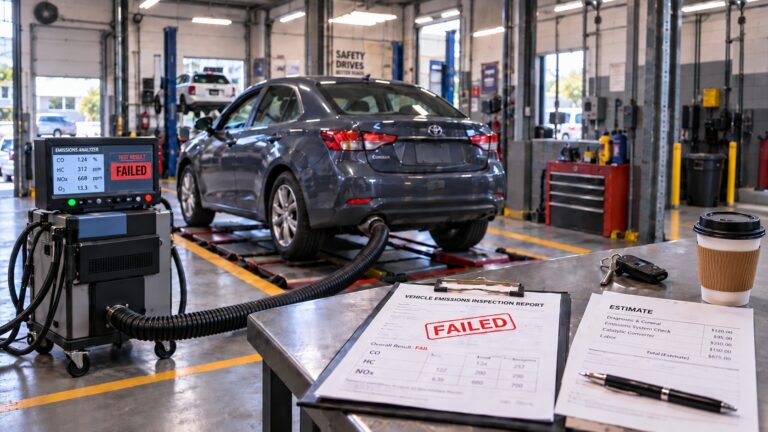
Clearing codes can also reset readiness monitors, which matters if the vehicle is due for an emissions inspection.
Continuing to Drive Through Serious Symptoms
A flashing light, severe shaking, overheating, major loss of power, or strong fuel smell should never be treated as a problem to deal with later.
A misfire can damage a catalytic converter. A cooling-system problem can damage the cylinder head or head gasket.
In both cases, the original repair may have been relatively manageable before the car was driven further.
Ignoring the Light Because the Car Feels Fine
Modern engine-management systems can detect small faults long before the driver feels anything.
That is useful because it gives you a chance to deal with the problem before it becomes more serious.
Why Is My Check Engine Light On if the Car Runs Fine?
A steady warning light with no obvious symptoms is extremely common.
That does not mean the computer is wrong.
A tiny EVAP leak can trigger the light without changing the way the car drives. A slow oxygen sensor can reduce fuel economy without causing rough running. A catalytic converter can lose efficiency before it becomes physically restricted.
A thermostat stuck open can also keep the engine below its ideal operating temperature while the car continues to feel normal.
Electrical problems can behave the same way. A weak ground, corroded connector, or brief voltage drop may set a code even if the fault temporarily disappears.
If the light stays on, read the codes instead of waiting for the car to develop obvious symptoms.
Will a Check Engine Light Go Away on Its Own?
Sometimes.
If the condition that triggered the code disappears and the computer completes enough successful self-tests, the light may eventually switch off without being manually cleared.
That does not mean every intermittent light should be ignored.
The computer may still retain a stored or pending code, and a problem can return once the same operating conditions occur again. If a check engine light appears even temporarily, reading the codes can help you understand what the computer detected before the information becomes harder to trace.
How Much Does It Cost to Fix a Check Engine Light?
There is no single check engine light repair cost because the warning can represent anything from a loose gas cap to major engine damage.
Minor fixes can involve relatively inexpensive items such as:
- Gas cap replacement
- Engine air filter
- MAF cleaning
- Basic vacuum hose repair
- Spark plugs
Moderate repairs can include oxygen sensors, ignition coils, thermostats, coolant leaks, or wiring problems.
The expensive end of the scale includes catalytic converters, transmission faults, head gasket repairs, or internal engine damage.
That is why getting the actual problem diagnosed matters more than asking how much a “check engine light repair” costs.
How to Decide Whether the Repair Is Worth It
Many check engine light repairs are easy financial decisions.
A gas cap, air filter, dirty MAF sensor, worn spark plug, or single ignition coil is usually inexpensive enough to fix without much debate.
Other problems require more thought.
A failed ignition coil may be cheap, but ignoring it can damage the catalytic converter. A thermostat or small coolant leak may also be relatively affordable, while overheating can turn it into a much larger engine repair.
Once the problem involves a catalytic converter, major transmission fault, head gasket, or internal engine damage, the economics change.
Look at three things:
- The current value of the car
- The cost of the repair
- The overall condition of the rest of the vehicle
A $2,000 repair on a $3,000 car that also needs tires, suspension work, and has ongoing oil leaks is very different from a $1,200 repair on an otherwise reliable car.
Do not look at the repair in isolation. Look at the pattern of what the car has cost you over the last year.
If the vehicle has become a cycle of one expensive problem after another, repairing every new check engine light may no longer make financial sense.
That is especially true when the diagnosis points to major engine, transmission, overheating, or emissions repairs. In that situation, it can be useful to compare the repair estimate with what the vehicle is worth as-is. Cash Cash Cars reviews vehicles needing repair, including cars with engine, transmission, overheating, electrical, and failed-smog problems.
How to Know the Repair Actually Worked
The light turning off is encouraging, but it is not always proof that the problem is gone.
After a repair, you can clear the trouble code with a scanner or allow the vehicle to turn the light off on its own after enough successful self-tests.
Either way, the computer still needs time to rerun its internal checks.
These are known as readiness monitors and can include systems such as:
- Catalytic converter monitoring
- Oxygen sensor monitoring
- Oxygen sensor heater monitoring
- EVAP monitoring
- Other emissions-related systems
After codes are cleared or battery power is interrupted, some monitors return to a “not ready” state.
There is no universal drive cycle that works exactly the same way for every vehicle. Different manufacturers and systems require different temperatures, speeds, fuel levels, and driving conditions before particular monitors will run.
In general, the computer may need a mixture of:
- A cold start
- Normal stop-and-go driving
- Steady highway cruising
- Normal acceleration
- Deceleration
- Several separate trips
If you are trying to complete a specific readiness monitor, use the drive-cycle procedure for your exact year, make, model, and engine rather than relying on a generic routine.
After driving, scan the car again.
Look for three things:
- The check engine light has stayed off.
- No pending or confirmed trouble codes have returned.
- The relevant readiness monitors have completed.
If the same code comes back, the original problem has not been fully resolved or another fault is contributing to it.
Routine Maintenance Can Prevent Many Check Engine Light Problems
You cannot prevent every sensor failure, but basic maintenance can reduce many of the conditions that trigger engine and emissions faults.
Keep the air intake system clean by replacing the engine air filter at the interval recommended for your vehicle. Many cars fall somewhere in the 15,000-to-30,000-mile range, although dusty conditions may require more frequent replacement.
Spark plugs should also be replaced according to the manufacturer’s schedule. Traditional plugs may need replacement much sooner than modern platinum or iridium plugs. As plugs wear, the ignition system has to work harder to fire them, which can contribute to misfires and coil failure.
Regular oil changes are equally important. An engine that starts burning oil can contaminate oxygen sensors and catalytic converters over time. Use the oil specification and service interval recommended for your engine.
Cooling-system maintenance matters too. Old coolant can lose its protective properties, while leaks or circulation problems can lead to overheating. Follow the manufacturer’s coolant replacement interval and never ignore a rising temperature gauge.
It is also worth checking battery terminals periodically. Corrosion and weak electrical connections can cause voltage problems that confuse modern engine-management systems and trigger misleading fault codes.
What if the Check Engine Light Repair Costs More Than the Car Is Worth?
A check engine light does not automatically mean you should sell the car. Most of the time, diagnosing the problem first is the sensible move.
But if the code leads to a major repair estimate, especially for the engine, transmission, catalytic converter, or repeated emissions problems, get a realistic idea of the vehicle’s current value before approving the work.
You do not necessarily have to make an older car mechanically perfect before selling it to a buyer that accepts problem vehicles.
Cash Cash Cars reviews vehicles with engine trouble, transmission problems, failed smog, overheating, warning lights, and other repair issues. If the problem has progressed far enough that the vehicle no longer runs, there is also a dedicated guide for selling a non-running car.
The purpose of getting an as-is value is not to assume selling is automatically better. It simply gives you another number to compare with the repair estimate.
Frequently Asked Questions About Check Engine Lights
Can I drive with a solid check engine light?
Usually, you can drive a short distance if the light is steady and the vehicle is otherwise running normally. Get the codes checked soon. If the car is overheating, shaking badly, stalling, losing significant power, or smelling strongly of fuel, stop driving regardless of whether the light is solid.
What does a flashing check engine light mean?
A flashing light commonly indicates a severe misfire that can send unburned fuel into the exhaust and damage the catalytic converter. Find a safe place to stop and avoid continuing to drive the vehicle unnecessarily.
Can a loose gas cap cause a check engine light?
Yes. A loose, missing, or poorly sealing gas cap can allow the EVAP system to detect a vapor leak and trigger a check engine light.
Why is my check engine light on if the car runs fine?
Modern vehicles can detect small EVAP leaks, slow oxygen sensors, early catalytic converter efficiency problems, thermostat faults, and intermittent electrical issues before the driver notices obvious symptoms.
Will disconnecting the battery reset the check engine light?
It can clear or reset diagnostic information on some vehicles, but it does not repair the underlying fault. It can also reset readiness monitors, which may create problems if the vehicle is about to undergo an emissions inspection.
How long does it take for the check engine light to reset after a repair?
It depends on the fault and the vehicle. Some lights turn off after several successful trips, while others require specific monitor conditions to be met. A scanner can help you check whether the code has returned and whether the applicable readiness monitors have completed.
Is it worth fixing a check engine light on an old car?
That depends on the cause. Cheap repairs such as a gas cap, spark plugs, or a minor airflow problem usually make sense. Expensive catalytic converter, transmission, head gasket, or internal engine repairs should be compared with the vehicle’s actual value and overall condition.
What to Do When the Check Engine Light Comes On
When the light appears, do not guess and do not immediately start buying parts.
If it is flashing, or the car is overheating, shaking badly, stalling, losing major power, or smelling strongly of fuel, stop driving and get the problem checked.
If the light is solid and the car feels normal, start with the simple things. Check the gas cap, read the OBD-II codes, and pay attention to how the car feels, sounds, and smells.
Then diagnose before replacing anything.
Fix the actual cause, give the computer time to rerun its tests, and scan the vehicle again afterward.
A check engine light does not automatically mean your engine is failing. In many cases, it is giving you an early warning while the problem is still manageable.
And if the diagnosis eventually shows that repairing the vehicle will cost more than keeping it makes sense, compare the repair bill with its as-is value before deciding what to do next. Cash Cash Cars can review the vehicle for a cash offer with the warning light, repair issue, failed-smog condition, or other mechanical problem disclosed upfront.
The key is to treat the light as useful information, not as something to fear or ignore.