Can I Sell a Car With Expired Tags?
Can you sell a car with expired tags? Yes, you can sell a car with expired tags. Learn how DMV fees, smog rules, paperwork, and the car’s value can affect your best selling option.
Yes, you can sell a car with expired tags in California. Expired tags do not, by themselves, make the vehicle impossible to sell or transfer.
The bigger question is what those expired tags actually represent.
Sometimes the sticker on the plate is old even though the vehicle’s registration is current. In other cases, the registration really has expired and DMV fees and penalties have been accumulating. And if the car also has a smog problem, missing title, or major mechanical issue, simply renewing everything before selling may not make financial sense.
That’s why the first thing to do is not automatically pay the registration. Instead, find out exactly what is going on with the vehicle and compare the cost of fixing the paperwork against what the car is actually worth.
Can You Sell a Car With Expired Tags in California?
Yes.
California allows ownership of a vehicle to be transferred even when its registration is expired. However, expired registration can create additional fees that have to be addressed as part of the transfer.
The California DMV vehicle registration fee calculator specifically notes that when a vehicle’s registration has expired, a transfer calculation may include multiple years of registration fees and penalties that are due.
So if you’re asking, “Can I sell my car with expired tags?”, the practical answer is:
Yes, but find out what DMV actually shows before agreeing on a price.
A $3,000 car with $150 in registration issues is one situation. A $1,500 car with years of penalties, a failed smog check, and a $1,000 repair bill is something completely different.
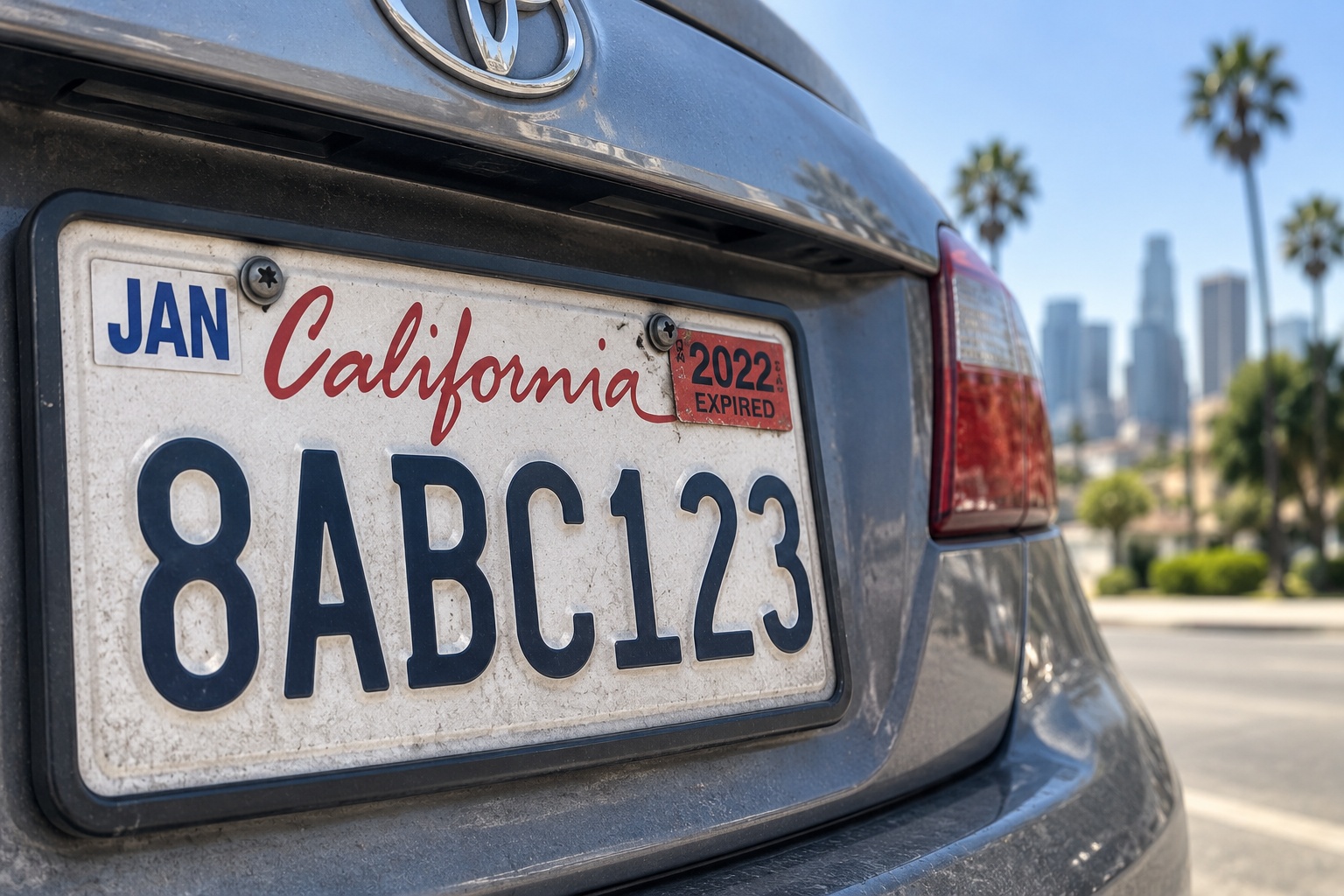
Expired Sticker Doesn’t Always Mean Expired Registration
This distinction matters.
The colored month-and-year tabs on the license plate are evidence of registration, but the sticker itself is not the only thing that matters. California law requires law enforcement to verify DMV records before issuing a citation solely because a vehicle is not displaying current tabs.
Under California Vehicle Code Section 5204, a citation for the tab violation cannot be issued when DMV records show that current registration actually exists.
Hence, you can have a vehicle whose sticker looks expired even though the registration itself has been renewed.
For example, you may have:
- paid the registration but not received the new sticker yet;
- lost the sticker;
- had the sticker stolen;
- paid the fees while another requirement is still pending.
The California DMV also explains what to do when replacement license plates, stickers, or registration documents have been lost, stolen, damaged, or not received.
So before telling buyers that the car has “expired tags,” check the actual DMV record.
If the registration is already current, you may have a sticker problem rather than a delinquent-registration problem.
How Much Do You Owe for Expired Tags?
If the registration really has expired, get an estimate from the California DMV before negotiating with a buyer.
You can use the DMV’s registration renewal fee calculator to estimate what may be due.
And the penalties increase with time.
The California DMV’s registration fee and penalty schedule shows progressively higher late charges depending on how long payment has been overdue.
After more than two years, for example, the penalty calculation can include substantially increased vehicle license fee and weight-fee penalties, along with separate registration and CHP late fees.
Parking violations and toll-evasion amounts can also affect registration-related fees.
That’s why guessing can cost you money.
Before deciding what to do with the car, establish four numbers:
- DMV fees and penalties
- Private-party value if the car were fully sale-ready
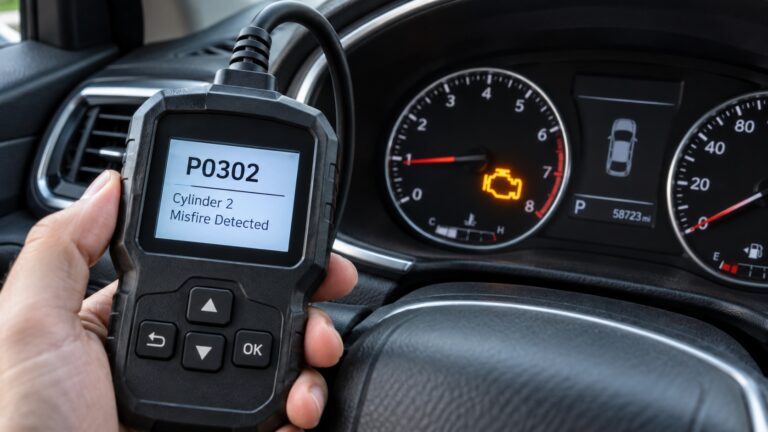
- Repairs required to pass smog or make the car marketable
- As-is value to a dealer, vehicle buyer, or dismantler
Those four numbers tell you much more than the expired sticker itself.
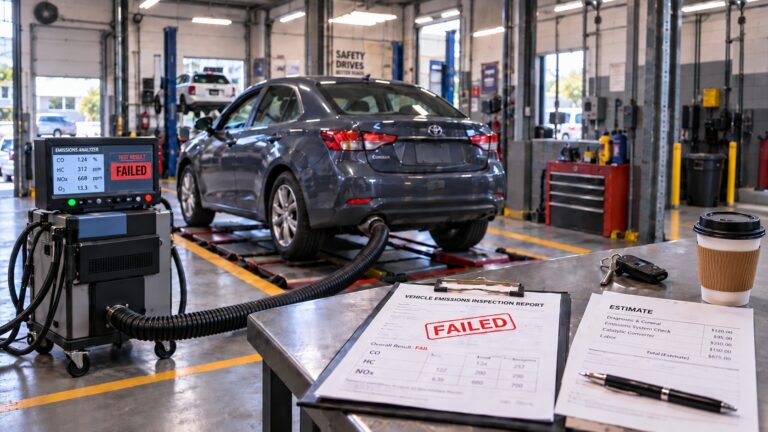
Do You Have to Smog a Car With Expired Tags Before Selling It?
For most private-party sales, yes.
The California Bureau of Automotive Repair’s Smog Check guidance explains that when a Smog Check is required for a change of ownership, the seller must have the vehicle checked before selling it. A passing certificate is generally valid for 90 days.
There are exceptions.
For example, gasoline, hybrid, and alternative-fuel vehicles four model years old or newer generally do not need a Smog Check solely because ownership is changing. Electric vehicles and certain other vehicle categories are also exempt.
But an expired registration sticker itself does not create a smog exemption.
This is where selling an inexpensive car privately can become a bad financial decision.
Suppose the car would sell for $2,500 with current paperwork, but you owe:
- $700 in DMV fees;
- $250 for testing and minor repairs;
- $900 for an emissions-related repair.
You could spend $1,850 trying to turn the vehicle into a $2,500 private-party car.
So the question shouldn’t simply be, “Can I sell a car with expired tags?”
It should be:
How much money will I actually have left after making this car ready for a private sale?
Can You Drive a Car With Expired Tags to Meet a Buyer?
Be careful here.
California does not provide a general registration-renewal grace period.
The DMV makes this clear in its guidance on filing for Planned Nonoperation, where it states that registration renewal fees should be paid on or before the expiration date to avoid penalties.
There is, however, an enforcement distinction.
Under current California law, expired tabs generally cannot be the sole basis for enforcement until the second month after the month in which registration expired.
That does not mean the registration remains legally current during that period.
If the vehicle is stopped for another violation, enforcement for expired registration can still occur.
And under California Vehicle Code Section 22651, certain vehicles with registration expired for more than six months can be removed when found or operated in qualifying public locations.
So don’t treat the enforcement limitation as permission to keep driving an unregistered vehicle.
What if you only need to move it for one day?
California DMV can issue a Vehicle Moving Permit, REG 172, for qualifying vehicles.
The DMV’s Vehicle Moving Permit guidance explains that the permit is free, valid for one day, and can be used for certain purposes such as:
- moving between storage locations;
- going to or from a repair facility;
- obtaining a smog inspection;
- DMV or CHP inspection;
- permanent wrecking or dismantling.
However, these permits are only available when the vehicle meets specific DMV conditions.
If none of those conditions fit, towing may be the cleaner option.
Can PNO Help if Your Tags Are Expired?
Yes, but only if you act within the DMV’s filing window.
Planned Nonoperation, or PNO, is designed for vehicles that will not be driven, towed, stored, or parked on public roads during the registration year.
According to the DMV’s Planned Nonoperation rules, PNO can be filed up to 60 days before registration expires and up to 90 days after expiration.
However, filing after expiration can still result in applicable late penalties.
And this is the important part:
There is no registration renewal grace period.
To avoid penalties completely, PNO needs to be filed by the registration expiration date.
So PNO is excellent for preventing an unused car from becoming a registration problem. It is not a way to go back years later and erase penalties that have already accumulated.
If your vehicle is already properly on PNO, you don’t necessarily need to activate full registration simply because you’re selling it. The ownership transfer and the vehicle’s future operating status are separate questions.
What if You Don’t Have the Title?
Expired tags and a missing title are two separate issues.
If the California title has been lost, stolen, damaged, or is otherwise unavailable, DMV generally allows a transfer using the Application for Replacement or Transfer of Title, REG 227, provided the vehicle and ownership situation qualify.
You can review the DMV’s title transfer and replacement requirements before arranging the sale.
That means a missing pink slip does not automatically make the car unsellable.
However, liens can complicate matters, and newer vehicles with a legal owner or lienholder can have additional requirements.
Hence, don’t assume that a bill of sale alone replaces the title.
For an ordinary private transfer, DMV may require documents such as:
- California Certificate of Title or REG 227 when applicable;
- buyer and seller signatures;
- odometer disclosure when required;
- applicable smog certification;
- applicable fees;
- Bill of Sale where appropriate.
How to Sell a Car With Expired Tags Privately
If the math still favors a private sale, handle it carefully.
1. Calculate What DMV Says Is Due
Use the DMV fee tools rather than estimating from memory.
If the registration has expired for several years or the transaction is complicated, contact DMV before agreeing on the final sale price.
2. Determine Whether the Car Needs a Smog Check
If it does, get the required certificate before completing the private sale.
The California Bureau of Automotive Repair says a private-party vehicle that requires smog must generally have passed within the previous 90 days.
3. Complete the Ownership Paperwork
The seller and buyer need to properly endorse the title or use REG 227 when the title is missing and that form is appropriate.
A Bill of Sale can also document the agreed sale price and date.
4. Don’t Hide the Expired-Registration Situation
If the buyer will be facing overdue registration costs, disclose that before money changes hands.
You can negotiate the price around those expenses, but don’t present an expired-registration vehicle as though all DMV obligations are already cleared.
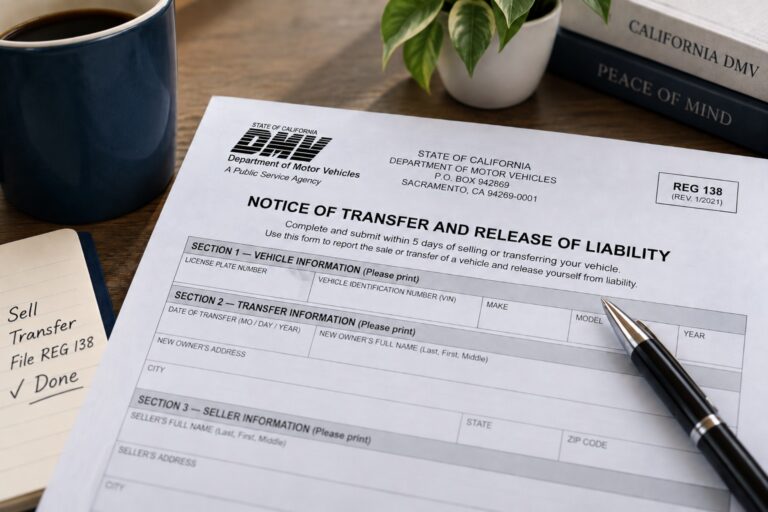
5. File Your NRL
This is one of the most important seller protections.
California requires the seller to submit a Notice of Transfer and Release of Liability within five calendar days after transferring the vehicle.
The DMV explains the filing requirements in its Notice of Transfer and Release of Liability guidance.
The DMV also makes clear that filing an NRL does not itself complete the ownership transfer. The buyer still has to complete the transfer requirements.
However, filing it helps protect the former owner from qualifying liabilities that arise after the reported sale.
Save the confirmation.
When Paying the Expired Tags Makes Sense
Renewing everything before selling can make sense when:
- the car is still reasonably valuable;
- registration penalties are manageable;
- it runs well;
- it is likely to pass smog without expensive repairs;
- the title situation is straightforward;
- the additional private-party sale value clearly exceeds what you’ll spend getting there.
For example, spending $400 to turn a $5,000 as-is car into a $7,000 private-party car can make sense.
Spending $1,500 to turn a $1,500 problem car into a $2,000 sale usually does not.
Hence, think in terms of net proceeds, not asking price.
When Selling As-Is May Be Smarter
If the car still has meaningful value but the paperwork, smog, or registration situation is becoming expensive, get an as-is offer before spending money.
A licensed dealer or professional vehicle buyer may be able to handle a transaction differently from an ordinary private buyer, but don’t assume that every dealer can simply make every DMV obligation disappear.
If you’re trying to decide whether paying the tags first is worthwhile, our guide on how to sell a car with expired tags explains what to consider when you would rather sell the vehicle in its present condition than spend more money trying to make it registration-ready first.
Before accepting an offer, ask specifically:
- whether they’ll buy with expired registration;
- whether they’ll buy without a current smog certificate;
- how outstanding DMV fees affect the offer;
- whether towing is included;
- what ownership documents they need.
That gives you a real number to compare with the private-sale route.
When Dismantling or Junking the Car Makes More Sense
The lower the vehicle’s value gets, the less sense it makes to pour money into registration and repairs merely to create a private-party sale.
Consider a licensed dismantler or junk-car buyer when:
- DMV fees and repairs approach the car’s value;
- the engine or transmission has failed;
- the vehicle is unsafe to drive;
- emissions repairs exceed the likely increase in sale value;
- the vehicle has been sitting for years;
- you would have to tow it anyway.
This is especially true when the alternative is spending hundreds or thousands of dollars just to make an old car legally and mechanically ready for another buyer.
However, confirm with the buyer how your particular DMV record will be handled.
Selling a vehicle for dismantling does not mean every unrelated personal debt, parking obligation, toll issue, or other liability automatically disappears.
A Simple Decision Checklist
If you’re still asking, “Can I sell my car with expired tags, or should I fix everything first?”, run through this checklist.
Sell Privately When:
- the vehicle still has strong private-party value;
- the registration debt is relatively small;
- it runs properly;
- passing smog should be straightforward;
- the extra money from a private buyer comfortably exceeds the cost and hassle of preparing it.
Consider a Dealer or As-Is Buyer When:
- the vehicle still has value;
- registration fees are significant;
- you’re uncertain about smog;
- paperwork is becoming inconvenient;
- speed and certainty matter more than squeezing out the highest possible price.
Consider a Licensed Dismantler or Junk-Car Buyer When:
- the car is worth little compared with what it needs;
- registration and repair costs are eating up the value;
- it doesn’t run;
- it cannot reasonably pass smog without expensive repairs;
- towing and disposal are already part of the equation.
The Bottom Line
Can you sell a car with expired tags in California? Yes.
But expired tags are only the visible part of the problem.
The real questions are whether the DMV registration is actually delinquent, how much is owed, whether a smog certificate is required, whether the vehicle can legally be moved, and whether spending money to prepare it for a private sale will leave you better off.
So before renewing anything, get the numbers.
Check the DMV fees. Estimate the car’s real market value. Find out what it would take to pass smog. Then compare that with an as-is offer.
Because sometimes paying the expired registration is the easiest path to a higher private-sale price.
And sometimes it’s just putting another $1,000 into a car that was already telling you it’s time to sell.