How Much Can I Sell My Junk Car For?
Find out what your junk car may be worth in California, what affects the offer, and how to sell it safely without hidden towing or pickup fees.
If you are asking, “How much can I sell my junk car for?”, the realistic answer in California is usually somewhere between $100 and $1,500 or more. However, that range is wide because buyers are not valuing every junk vehicle as a pile of steel.
A stripped compact car with no catalytic converter may bring little more than basic scrap value. Meanwhile, a complete SUV with reusable parts, a clean title, and an accessible pickup location may be worth considerably more. A vehicle that still runs or can be repaired may even be valued for resale rather than recycling.
That is why the better question is not simply, “How much can I get for my junk car?”
It is:
“What can a buyer still recover from my particular vehicle after transportation, processing, paperwork, and recycling costs?”
Once you understand that calculation, junk-car quotes stop looking quite so random.
The Short Answer: How Much Can You Get for a Junk Car?
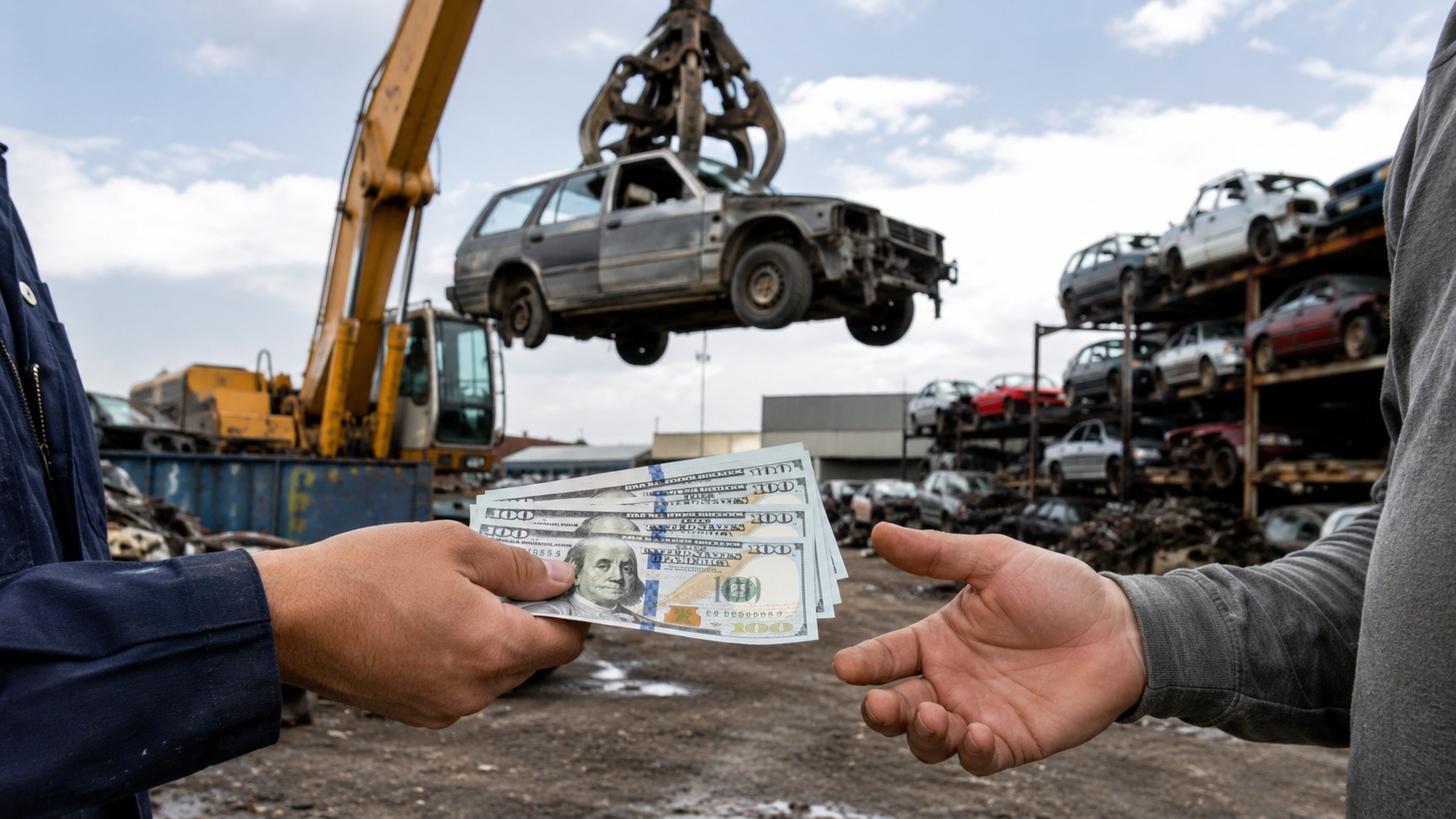
The following ranges provide a useful starting point for California sellers:
| Type of junk vehicle | Possible estimated value |
|---|---|
| Stripped or incomplete shell | $100 to $250 |
| Complete non-running compact car | $200 to $350 |
| Complete non-running midsize sedan | $300 to $500 |
| Complete SUV or pickup | $450 to $900 |
| Running, repairable, or parts-rich vehicle | $900 to $1,500 or more |
These are estimates, not guaranteed statewide prices.
Two identical cars can receive different offers because they are located in different cities, have different title or registration problems, or are being evaluated by buyers with different needs. Scrap-metal markets also move, while local demand for engines, transmissions, body panels, electronics, and other components can change independently of raw metal prices.
So, if you want to know how much you can junk a car for, start with the car’s physical weight, but do not stop there.
What Determines a Junk Car’s Value?
A junk-car quote usually combines three calculations:
- The vehicle’s basic material value
- The value of reusable or resalable parts
- The cost and risk involved in acquiring, transporting, processing, and disposing of it
The buyer starts with what can potentially be recovered and then subtracts what it will cost to deal with the vehicle.
Year, make, and model
A common vehicle can be valuable even when it no longer runs.
Cars such as the Honda Civic, Toyota Camry, and Honda Accord remain common on California roads. That creates demand for used doors, mirrors, lights, electronics, engines, transmissions, and interior components.
The same applies to popular trucks and SUVs. A damaged Ford F-150 may contain parts that other owners, repair shops, and rebuilders regularly need.
An obscure model with very little local demand may have fewer reusable components that can be sold quickly. As a result, its quote may stay much closer to scrap-metal value.
Weight
When a car has limited parts or resale potential, weight becomes one of the biggest factors.
Scrap metal is commonly valued by weight, which is why a large pickup or SUV will normally have a higher material-value floor than a lightweight compact car.
A small car may weigh around 2,500 pounds, while a large SUV or truck can weigh considerably more. That difference alone can produce very different offers, even when neither vehicle runs.
Condition and repairability
A dead battery, failed starter, damaged door, or minor collision does not necessarily turn a vehicle into scrap.
If the buyer believes the car can be repaired and resold profitably, the offer may be based on wholesale or auction potential rather than recycling alone.
However, severe frame damage, a seized engine, extensive fire or flood damage, or major missing components can eliminate that upside. Once a vehicle becomes useful only for dismantling or metal recovery, its value normally falls.
Missing components
A complete vehicle usually receives a stronger offer than one that has already been stripped.
Missing parts that can substantially affect a quote include:
- The engine
- The transmission
- The catalytic converter
- Factory wheels
- Battery
- Radiator
- Electronic modules
- Doors, lights, and body panels
Missing wheels also make the pickup more difficult. If the vehicle cannot roll, the buyer may need a flatbed, winch, skates, or other equipment to load it safely.
Location
Distance affects the cost of collecting a junk vehicle.
A car located near a buyer’s yard or normal service area may receive a stronger offer than an identical vehicle located far away or somewhere difficult to access.
The vehicle’s position matters too. A car sitting in an open driveway is easier to retrieve than one trapped behind another vehicle, parked in an underground garage, or resting without wheels in a narrow side yard.
Ownership and DMV status
A clean California title in the seller’s name normally makes the transaction easier.
A missing title does not always prevent the sale because California’s Application for Replacement or Transfer of Title, REG 227, may be used in qualifying situations. However, additional paperwork, an incomplete ownership chain, an unavailable DMV record, or an unresolved lien can delay or stop the transaction.
If a buyer hopes to repair and resell the vehicle, back registration fees and other DMV requirements may also affect how much the buyer is willing to pay. A vehicle being lawfully dismantled is handled through a different process, but sellers should not assume that every old fee or personal obligation automatically disappears.
How to Estimate Your Junk Car’s Scrap Value
You can make a rough calculation before calling buyers.
Start by finding the vehicle’s curb weight in the owner’s manual, manufacturer specifications, or another reliable source.
Suppose your midsize sedan weighs 3,500 pounds.
Because one net ton equals 2,000 pounds:
3,500 ÷ 2,000 = 1.75 tons
If you use an illustrative scrap rate of $150 per ton:
1.75 × $150 = $262.50
That gives you a rough material-value starting point, not the final amount you should expect to receive.
The calculation does not account for the fact that a vehicle is not made entirely from one grade of recoverable steel. It contains fluids, glass, rubber, plastic, upholstery, and other materials. It also does not account for dismantling, transportation, environmental processing, paperwork, or the value of reusable components.
That is why simply multiplying curb weight by a published scrap-metal rate rarely predicts the exact cash offer.
What Can Increase the Offer?
An intact catalytic converter
Catalytic converters contain recoverable precious metals, so an original converter can materially affect a vehicle’s value. The exact amount depends on the vehicle, converter type, precious-metal content, and current recovery market.
Converters from certain hybrids, imported vehicles, and trucks may be worth more than those from other models. However, sellers should be careful with online claims promising a fixed converter value because two units that look similar can have very different recovery values.
Reusable mechanical parts
A working engine, transmission, alternator, starter, steering assembly, or electronic control module can raise the vehicle above basic scrap value.
However, the buyer must consider whether the component can be tested, removed, stored, and sold profitably. An untested engine is not automatically worth the same as a verified used engine ready for installation.
Clean body and interior parts
Undamaged doors, hoods, tailgates, mirrors, lights, seats, wheels, and other components may add value when there is local demand for them.
Popular models generally benefit most because the buyer has a better chance of selling those parts within a reasonable period.
A clear ownership trail
Paperwork does not add metal to the car, but it reduces the buyer’s risk and workload.
A clean title, matching identification, accessible VIN, and properly released lien can make it easier for a legitimate buyer to complete the transaction. Therefore, resolving paperwork issues before requesting quotes may help you avoid delays or reduced offers.
What Gets Subtracted From the Car’s Gross Value?
The amount recoverable from the vehicle is not the same as the amount the seller receives.
A buyer may have to account for:
- Driver time and fuel
- Flatbed or towing equipment
- Winching or difficult access
- Fluid and battery handling
- Dismantling labor
- Yard and storage costs
- DMV processing
- Auction or resale expenses
- Broker or referral margins
- Repair risk
- Existing towing or storage charges needed to release the vehicle
Some companies advertise free towing while quietly deducting the cost from the offer or adding a pickup fee later. Others include transportation in the written amount from the beginning.
That is why sellers should compare net offers, not just the largest number mentioned during the first phone call.
Should You Remove the Catalytic Converter or Other Parts First?
Usually, no.
A California owner may assume that selling the converter, wheels, battery, and other parts separately will produce more money. In theory, the total resale value of every component can exceed a whole-car offer. In practice, parting out a vehicle requires tools, mechanical knowledge, storage space, advertising, packaging, and months of patience.
There is also a legal issue with detached catalytic converters.
California has strengthened its rules around catalytic-converter transactions because of widespread theft. Buyers of detached converters may be required to collect and retain specific ownership, identification, payment, and transaction records. A legitimate business is unlikely to buy a loose converter from someone who cannot document where it came from.
Removing it can also reduce the whole-car quote by hundreds of dollars, depending on the model. Removing the wheels creates an additional transportation problem because the vehicle may no longer roll onto standard towing equipment.
Unless you are properly equipped to dismantle and market the parts, selling the complete car is usually the cleaner option.
Junk It, Repair It, Sell It As-Is, or Part It Out?
The best choice depends on the financial difference between the options, not just the highest theoretical price.
| Option | Possible return | Time and effort | Main risk |
|---|---|---|---|
| Junk the car | Often $100 to $900+ | Low | Accepting too little without comparing quotes |
| Repair it | Depends on market value | Medium to high | More problems appearing after work begins |
| Sell it as-is | Often higher than scrap | Medium | Buyer delays, smog issues, and transfer risk |
| Part it out | Potentially highest total | Very high | Months of work and an unsold shell remaining |
Junk the car when:
- The engine or transmission has failed.
- The frame is severely damaged.
- The vehicle is badly burned, flooded, stripped, or rusted.
- Repair costs approach or exceed its post-repair value.
- Storage charges are increasing.
- You need the vehicle removed quickly.
Repair the car when:
- The problem is limited and clearly diagnosed.
- The car is otherwise reliable.
- Repairing it creates meaningful value after all expenses.
- The repair cost is comfortably below its realistic post-repair value.
A useful rule is to become cautious when repair costs consume more than half to two-thirds of the car’s realistic value after repair. That is not a California legal rule, but it is a practical warning that the financial margin is disappearing.
Sell it as-is when:
The car has more value than a dismantler may offer, but you do not want to repair it yourself.
This can work well with popular, complete vehicles that appeal to mechanics or project-car buyers. However, California generally places the private-sale smog obligation on the seller when certification is required. Simply writing “as-is” on a bill of sale does not automatically remove that requirement.
Part it out when:
You have the tools, knowledge, private storage space, and time to dismantle the vehicle properly. It makes the most sense for classics, performance vehicles, and models with unusually valuable components.
What Paperwork Do You Need to Junk a Car in California?
A legitimate buyer must be able to establish that you own the vehicle or have legal authority to sell it.
You should normally be ready to provide:
- Valid government-issued identification
- The California Certificate of Title, when available
- REG 227 when applicable to a missing California title
- A lien release when a legal owner is recorded
- Bills of sale needed to complete the ownership chain
- An odometer disclosure when required
- Any estate, trust, or other authority documents relevant to the owner
The California DMV states that a properly completed REG 227 can be used when the California title is lost, stolen, mutilated, or illegible. However, special rules apply when a lienholder remains on record, particularly for newer vehicles. California DMV title-transfer guidance
A dismantler should slow down or refuse the transaction if:
- The seller will not provide identification.
- The seller’s name does not match the ownership documents.
- The ownership chain cannot be established.
- An active lien has not been released.
- The VIN is missing, altered, or inconsistent.
- The vehicle is reported stolen.
- The person possesses only the keys and cannot prove authority to sell.
A buyer who is willing to ignore those problems is not doing the seller a favor. They may be creating a much larger problem later.
Verify That You Are Dealing With the Right Kind of Buyer
California requires a dismantler license for businesses that buy or deal in nonrepairable vehicles for dismantling, parts, or material recovery. Sellers can check relevant businesses through the DMV’s Occupational License Lookup.
This matters because an informal buyer may take the vehicle without completing the required acquisition and dismantling records.
Before accepting an offer, ask for:
- The buyer’s legal business name
- Their relevant California license information
- The final written purchase amount
- Confirmation that towing is free
- Any condition that could change the offer
- The payment method and timing
- The buyer information needed for your NRL
Why Three Buyers May Quote Three Different Prices
Not every company making junk-car offers uses the same business model.
A local buyer may own or directly operate the equipment used to collect vehicles. A national broker may generate a quote and then locate another company to purchase and retrieve the car. Because another party must still perform the work, the broker’s margin and the local operator’s willingness to accept the job can affect the final amount.
Different buyers may also have different outlets for the vehicle. One may want the car only for its material value. Another may need its engine, transmission, doors, or electronics. A third may believe it can be repaired and sold at auction.
That does not automatically make the highest quote dishonest. However, an unusually high offer becomes suspicious when the company refuses to put it in writing or cannot explain when it might change.
Watch for the High-Quote, Low-Payout Tactic
A common complaint in the junk-car market begins with an attractive phone quote.
The seller accepts the offer, rejects competing buyers, and schedules the pickup. Once the tow truck arrives, the driver suddenly claims the wheels are wrong, the converter is aftermarket, or the damage is worse than expected. The offer then drops sharply.
At that point, the seller may accept the reduction simply because the truck is already there and they want the car gone.
You can reduce this risk by:
- Describing the vehicle honestly.
- Sending current photographs.
- Disclosing missing parts and access problems.
- Getting the offer in writing.
- Asking exactly what could change it.
- Refusing pickup-day deductions based on conditions you already disclosed.
A written offer is only useful if it describes the same vehicle condition the driver will see.
How Cash Cash Cars Calculates a Junk-Car Offer
When you contact Cash Cash Cars, we ask for the information that materially affects the vehicle’s value:
- Year, make, and model
- Mileage
- Whether it runs and drives
- Mechanical and collision damage
- Whether the engine, transmission, converter, and factory wheels remain
- Whether the vehicle rolls
- Pickup location and accessibility
- Title, lien, and ownership status
If the vehicle is described accurately, the quoted amount is the amount we pay. The offer would normally change only when the vehicle is materially different from what was disclosed, valuable parts have been removed or changed, or an undisclosed lien or legal restriction prevents the expected transaction.
Cash Cash Cars is based in North Hollywood and serves communities across the San Fernando Valley, Santa Clarita, and the broader Los Angeles area. Pickup is free, without a separate towing charge deducted when the transaction proceeds as agreed.
Our driver verifies the VIN and vehicle condition, completes the required paperwork, and pays the seller before loading the vehicle.
You can learn more about getting cash for junk cars, trucks, SUVs, and minivans and the types of vehicles we purchase.
Complete the California DMV Steps
Signing the title and receiving payment are not the final steps.
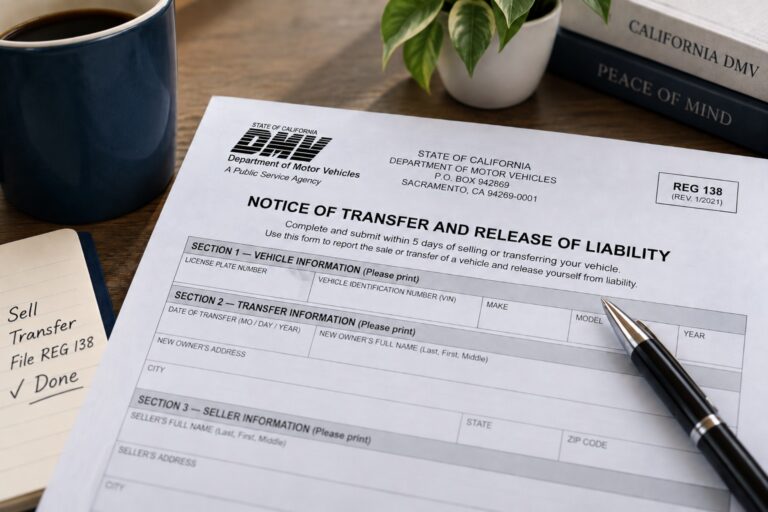
A California seller should submit the Notice of Transfer and Release of Liability within five calendar days. The DMV asks for the new owner’s name and address, license plate number, the last five digits of the VIN, and the odometer reading at the time of sale.
Save the confirmation with your bill of sale and payment records.
The NRL protects you against qualifying liability arising after the reported sale date, but the DMV makes an important distinction: filing the NRL does not itself transfer ownership. The buyer must still complete the applicable transfer or dismantler reporting requirements. California DMV NRL guidance
A licensed dismantler has separate reporting duties. California requires the dismantler to report an acquired vehicle using the applicable Notice of Acquisition process and submit the evidence of ownership and license plates, or the required plate-destruction documentation, before dismantling under the applicable timeline. California DMV dismantler acquisition procedure
Do not remove standard California plates before pickup unless the transaction or plate type requires different handling. Personalized and certain special plates may follow separate rules, so confirm before surrendering them.
How to Get the Highest Legitimate Junk-Car Offer
Use this checklist before scheduling pickup:
- Find the title. If it is missing, determine whether REG 227 applies.
- Check for a lien. Obtain the necessary release before pickup.
- Leave the car complete. Do not remove the converter, engine, transmission, or factory wheels.
- Remove personal belongings. Check the trunk, glovebox, seat pockets, sun visors, and underneath the seats.
- Remove personal devices. Take toll transponders, garage remotes, documents, and connected accessories.
- Describe the car honestly. Mention missing keys, flat tires, collision damage, mechanical problems, and access limitations.
- Get at least three written quotes. Compare the amount you will actually receive after every deduction.
- Confirm free towing. Ask about distance, winching, missing wheels, and difficult access.
- Verify the buyer. Check the relevant California license and business identity.
- Confirm payment before removal. Do not release the vehicle based on a promise of later payment.
- Avoid growing storage costs. If the car is at a repair shop or storage facility, coordinate the release before another charge accrues.
- File the NRL. Submit it within five days and retain the confirmation.
The Bottom Line
So, how much can you get for a junk car in California?
A stripped shell may bring around $100 to $250, while a complete compact or midsize car may fall somewhere between $200 and $500. Larger SUVs and pickups may bring $450 to $900, and a complete running or repairable vehicle can reach $900 to $1,500 or more.
However, those numbers are only starting points.
The final offer depends on the car’s weight, condition, reusable parts, converter, title status, location, accessibility, buyer demand, and current material market. Hence, the best way to find your car’s real value is to describe it accurately, leave it complete, collect several written net offers, verify the buyer, and confirm that payment and towing terms will not change at pickup.
Because when you ask, “How much can I get if I junk my car?”, the highest number on the phone is not necessarily the best offer.
The best offer is the amount you actually receive after the vehicle, paperwork, and legal responsibility have all left your hands.