Can You Sell an Unregistered Car?
Learn how to sell an unregistered car, prove ownership, handle a missing title, arrange towing, and complete the DMV transfer safely.
In This Article
An unregistered car can usually be sold in California, but the seller must still prove ownership, clear any lien, use the right transfer documents, and arrange lawful transportation.
Can you sell an unregistered car in California if it has no current registration, a missing title, an unavailable DMV record, or an owner who has died?
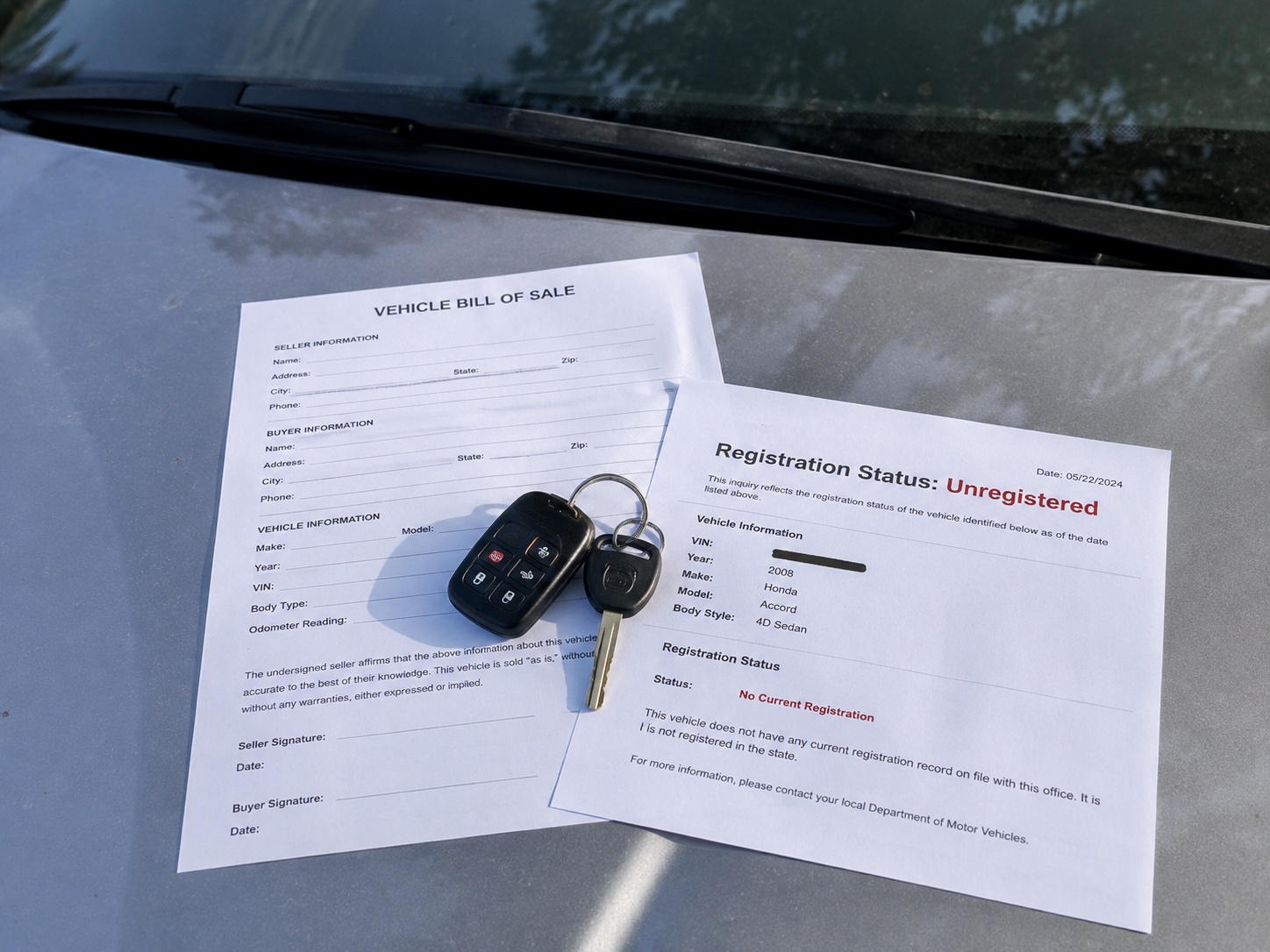
Yes, you can sell an unregistered car in California in many situations. However, registration is only one part of the transaction. Before anyone pays for or removes the vehicle, you still need to establish who owns it, whether that person has authority to sell it, whether a lien remains, and which documents the California DMV will require.
That distinction matters because “unregistered” can describe several very different situations. One car may simply have been parked after an elderly owner stopped driving. Another may belong to someone who died years ago. A third may have changed hands without ever being transferred into the buyer’s name. You may also be dealing with a missing title, an out-of-state vehicle, a homemade car, or a vehicle so old that its electronic DMV record is no longer available.
You may be able to sell it, but possession of the car is not enough. You need a lawful ownership trail, the correct transfer documents, and a legal way to remove it from the property.
Unregistered Is Not the Same as Expired Registration
It helps to separate this subject from an ordinary expired-registration sale.
With expired registration, the vehicle normally still has an identifiable registered owner, an established California title record, and a registration account that has simply fallen behind.
An unregistered vehicle may present a more fundamental ownership problem. For example:
- The registered owner has died.
- The physical title has been lost.
- Someone bought the car but never transferred it into their name.
- The vehicle came from another state and was never registered in California.
- The DMV no longer has an electronic record for it.
- The vehicle was assembled from separately purchased parts.
- The person holding the keys cannot prove how they acquired it.
That is why the first question should not be, “How much are the registration fees?” The first question is, “Who has the legal authority to sell this car?”
Why Cars Become Unregistered in the First Place
In our experience, many of these situations begin quietly.
An aging or ill owner stops driving, parks the car in a garage, and no one renews the registration because the vehicle is no longer being used. In other cases, an engine or transmission fails and the repair would cost more than the car appears to be worth. The owner parks it and keeps postponing the decision.
Lost paperwork creates another common problem. Once the title disappears, the owner puts off dealing with the DMV. Months become years, and the vehicle remains frozen in place until a death, property sale, inheritance, or cleanup finally forces someone to deal with it.
The result may look simple from the outside: an old vehicle and a set of keys. Legally, however, the situation can involve an estate, a lienholder, an unavailable record, or an ownership chain that was never completed.
Who Can Legally Sell an Unregistered Car?
A person does not gain authority to sell a car merely because it is parked on their property or they possess its keys. The correct seller depends on the title and, when the owner has died, the way the estate is being handled.
| Ownership situation | Who may need to act |
|---|---|
| Sole living owner | The owner named on the title or DMV record. |
| Co-owners joined by “or” or “and/or” | California generally accepts one owner’s signature for an ordinary transfer. |
| Co-owners joined by “and” or a slash | California generally requires each owner’s signature. |
| Deceased sole owner in probate | The court-appointed executor or administrator using the required estate documents. |
| Qualifying estate outside probate | A qualifying heir using the applicable DMV affidavit and supporting documents. |
| Vehicle held in a trust | The acting trustee, subject to the title wording and required trust documentation. |
When a joint owner has died
The connector between the names matters. California’s ordinary transfer rules generally require one signature when co-owners are joined by “or” or “and/or,” while every owner normally signs when the names are joined by “and” or a slash. A death can add separate documentation requirements, so the surviving owner should confirm the deceased-owner procedure before signing the car directly to a buyer.
When the estate is in probate
If the car was solely owned by the deceased and the estate is in probate, the court-appointed executor or administrator can generally sign on behalf of the estate. The DMV may require certified court-issued Letters Testamentary or Letters of Administration with the applicable title and transfer documents.
A beneficiary named in a will should not assume that the will alone allows them to sell the car. Until the estate representative distributes the vehicle or completes the appropriate transfer, the beneficiary may not have authority to sign it over.
When the estate may qualify to transfer without probate
California has a vehicle-specific Affidavit for Transfer Without Probate, REG 5. It may be available to a qualifying heir after at least 40 days have passed since the owner’s death, subject to the current estate requirements and value limits.
Because probate limits can change, families should check the current requirements instead of relying on an old dollar amount found online. REG 5 is for California-titled vehicles, so an out-of-state title may require a different process.
When the vehicle is associated with a trust
If the vehicle was properly held in a living trust, the acting successor trustee may be able to transfer it using the trust and DMV documentation applicable to the situation. Depending on how the vehicle was titled, the DMV may request trust documents, a Statement of Facts, or additional evidence completing the ownership chain.
Being family, having the keys, or storing the vehicle does not by itself create the legal right to sell it.
What If the Physical Title Is Missing?
A missing paper title does not always make the car impossible to sell.
For many California-titled vehicles, the registered owner can use an Application for Replacement or Transfer of Title, REG 227. A properly completed REG 227 may allow the replacement-title request and ownership transfer to be handled together.
However, REG 227 is not a substitute for ownership itself. The person signing it must have legal authority to release the vehicle. The form may also be insufficient by itself when:
- An unreleased lienholder appears on the record.
- Special lien-release rules apply to a newer vehicle.
- The person possessing the car is not the owner of record.
- The DMV record is no longer available.
- The vehicle was last titled outside California.
- The VIN or supporting documents do not match.
That is why a legitimate buyer may purchase a car without the physical title while still refusing a car with no verifiable ownership documents. If this is your situation, read how Cash Cash Cars may buy a car without registration and which information you should gather before requesting an offer.
What If the Car Is No Longer in the DMV’s Records?
The California DMV states that when a California-titled vehicle has not been registered for four years or more, its digital record may no longer be available.
That does not mean the vehicle has become ownerless. It means the DMV record may have to be re-established. The process can require:
- An Application for Title or Registration, REG 343
- A Verification of Vehicle, REG 31
- The old California title or registration card, if available
- REG 227 when the title is unavailable
- An odometer disclosure when applicable
- A lien release when an old legal owner appears
- Additional evidence of ownership
- A motor vehicle ownership bond in certain cases
A physical VIN verification is normally required when the DMV has no record of the vehicle. Depending on the car and its history, the inspection may need to be completed by the DMV, CHP, or another authorized verifier.
A California vehicle may disappear from the DMV’s digital records after four or more years without registration. It does not automatically happen to every vehicle on its fourth anniversary.
Four Special Unregistered-Car Situations
1. A vehicle titled in another state
A valid out-of-state title can establish ownership even when the vehicle has never been registered in California. The seller must be the titled owner or have a complete and acceptable transfer trail.
If a California buyer plans to register it here, a VIN verification and other nonresident-vehicle requirements may apply. However, a seller should not represent themselves as the owner when the out-of-state title still belongs to someone else.
2. A car that was purchased but never transferred
This is where title jumping becomes a real concern. Suppose someone bought a car years ago, received a signed title, and never submitted the transfer. They then try to sell the same vehicle to another person without ever becoming the owner of record.
That person may need the original title and a complete chain of bills of sale or other acceptable documents. California procedures sometimes recognize intermediate transfers, but every link must be documented. A handwritten receipt with missing names or an unexplained gap may leave the final buyer unable to obtain a title.
3. A homemade or specially constructed vehicle
A kit car or vehicle assembled from parts needs more than an ordinary bill of sale. California requires evidence of ownership for major components, which may include the body, frame, engine, and transmission. A VIN inspection or assignment and additional registration or emissions procedures may also apply.
4. A mystery vehicle with no reliable paperwork
A barn find with no title, no registration, no clear ownership history, and a questionable or missing VIN is the most difficult category.
The DMV may require evidence that the applicant made a diligent effort to establish ownership. A motor vehicle ownership surety bond may also be required when normal evidence is unavailable and the applicable conditions are met. A bond does not turn a suspicious car into a legitimate one. The VIN and ownership history still have to survive the required review.
A landlord dealing with a tenant’s abandoned car
A vehicle left behind by a tenant is not the same as an unwanted sofa or box of household items. The property owner should not assume that owning the land gives them ownership of the car.
Depending on the facts, the vehicle may need to be reported, removed through an authorized towing or abatement process, and handled under California’s abandoned-vehicle or lien-sale procedures. Because these cases are fact-specific, a landlord should contact the appropriate local agency or authorized towing provider instead of signing a bill of sale for property they do not own.
Owning the Car and Driving It Are Separate Questions
A vehicle may sometimes change ownership even though it cannot yet receive active registration. However, that does not mean every unregistered car automatically qualifies for a title-only or transfer-only transaction.
California’s transfer-only procedure generally requires the record to reflect Planned Nonoperation status and requires that the vehicle not have been moved in a way that caused registration fees to become due.
PNO does not automatically solve the smog requirement
In a typical California private-party sale, the seller remains responsible for providing a valid smog certification when one is required. Calling the vehicle “as-is,” putting it on PNO, or allowing the buyer’s registration application to remain incomplete does not automatically remove that obligation.
A transaction with an appropriate professional buyer may be handled differently, which is one reason a non-running vehicle can be easier to sell to a business than to an individual.
Do not test-drive it on public roads without authorization
A signed title or bill of sale proves that a transaction occurred. It does not create a grace period during which the buyer can legally drive an unregistered car home. Without valid registration or an appropriate permit, public-road test drives should remain off the table.
California offers several permit types, but they are not interchangeable:
- A one-day Vehicle Moving Permit, REG 172, may be issued without a fee for an authorized one-day movement.
- A One Trip Permit covers one continuous trip and carries a fee.
- A Temporary Operating Permit is available only in particular incomplete-registration situations and generally requires applicable fees and other conditions to be satisfied.
A permit must be obtained through the DMV or another authorized issuer. It is not something a seller can simply print at home and declare valid. When no permit applies, the safest option is professional transport that carries the entire vehicle, such as a flatbed.
What Buyers Should Verify Before Paying
A buyer should never treat possession of the keys as proof of ownership. Before paying for an unregistered car:
- Confirm the seller’s identity. Compare their identification with the title or other ownership documents.
- Inspect the VIN personally. Match the paperwork with the dashboard and door-jamb identifiers and look for signs of tampering.
- Check for liens. If a lienholder appears, require acceptable evidence that its interest has been released or will be cleared through the transaction.
- Review the ownership chain. When the seller is not named on the last title, every intermediate transfer should be supported by acceptable documents.
- Check the vehicle’s history. Use reputable theft and vehicle-history resources before handing over money.
- Investigate the DMV status. Determine whether the record is active, unavailable, or affected by fees and other requirements.
- Calculate the complete cost. Consider transfer fees, registration, smog, repairs, transportation, and any documentation work still required.
Walk away if the seller offers only keys and a handwritten receipt, refuses reasonable identity and VIN verification, or cannot explain a break in the ownership chain.
The Risks of Selling Informally for Cash
An informal buyer may pay cash, take the car, and never transfer it. They may pass your signed title to someone else, drive the vehicle illegally, or abandon it. Meanwhile, the DMV record may continue pointing back to you or the deceased owner’s estate.
That can lead to notices involving:
- Parking citations
- Toll violations
- Towing and storage
- Vehicle abandonment
- Law-enforcement inquiries
- Disputes about when possession changed
A properly documented buyer should verify the VIN and ownership papers, identify the purchasing person or business, provide clear payment terms, and create a traceable record of the transaction.
Do not rely on the buyer’s promise to transfer the car later. Complete your paperwork, file the NRL, and retain evidence showing exactly when and to whom the vehicle was delivered.
How Cash Cash Cars Handles an Unregistered Vehicle
When a vehicle is unregistered, non-running, tied to an estate, or missing its physical title, Cash Cash Cars begins by determining whether there is a legitimate path to transfer ownership.
Depending on the circumstances, that may involve reviewing:
- The California title
- REG 227
- A certified death certificate
- Court-issued probate Letters
- REG 5 for a qualifying transfer without probate
- Trust documentation
- A lien release
- Old registration documents
- Identification from the person authorized to sell
We may be able to purchase a vehicle without the physical title, but that does not mean we can buy from someone who cannot prove ownership or legal authority. We cannot move forward when the VIN is reported stolen, an active lien cannot be cleared, or the person offering the car has only the keys and no defensible ownership trail.
When the documents check out, we can coordinate the transaction, arrange free vehicle pickup, and pay the seller before the vehicle is taken. This can be particularly useful when the car cannot legally be test-driven or driven to a buyer.
Eight Steps to Sell an Unregistered Car Safely
- Identify the lawful seller. Determine whether that person is the titled owner, a co-owner, executor, administrator, trustee, or qualifying heir.
- Gather the ownership documents. Locate the title or determine whether REG 227 applies. For an estate, collect the death certificate and the probate, trust, or heir documents required for that situation.
- Check for surprises. Look for an unreleased lien, unavailable DMV record, conflicting VIN, broken ownership chain, or fees that could materially affect the deal.
- Choose the right buyer. A desirable running vehicle may earn more through a private sale. A non-running car, estate vehicle, missing-title case, or complicated DMV history may be easier to sell through a professional buyer.
- Arrange legal transportation. Do not allow an unauthorized public-road test drive. Obtain the proper permit when eligible or arrange flatbed transportation.
- Verify payment. In a private sale, verify cash or a cashier’s check before surrendering the documents and keys. With Cash Cash Cars, payment is made at pickup before the vehicle is removed.
- Complete the transfer documents. Properly endorse the title or REG 227, complete any required odometer disclosure, and prepare a detailed bill of sale showing the vehicle, buyer, seller, date, price, and mileage.
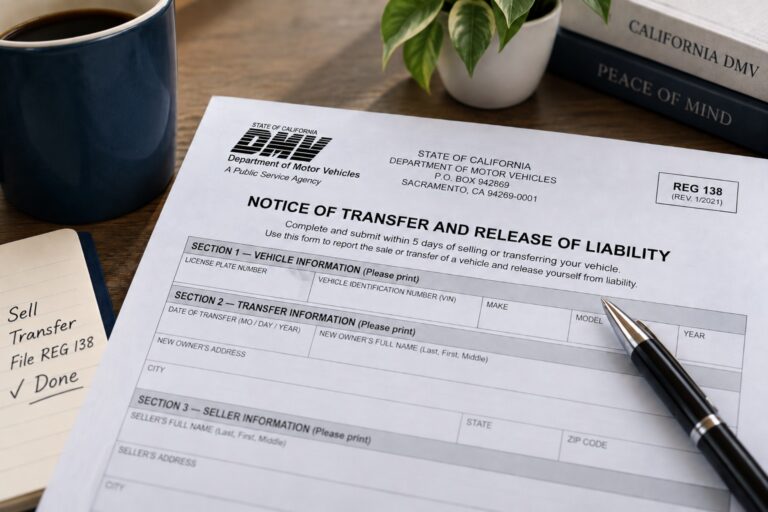
- File the NRL within five days. Submit the California Notice of Transfer and Release of Liability within five calendar days and keep its confirmation with your sale records.
The NRL is an important protection, but it should not be treated as a substitute for a properly documented transfer. Keep the confirmation, bill of sale, payment evidence, and copies or photographs of the relevant transfer documents together.
Official California Sources
- California DMV: Title Transfers and Changes
- California DMV: Handling a Deceased Person’s DMV Matters
- California DMV: Vehicles No Longer in DMV Records
- California DMV: Transfer-Only Requirements
- California DMV: Temporary Operating Permits
- California DMV: Notice of Transfer and Release of Liability