How Much Will the Junkyard Give Me for My Car?
Wondering how much a junkyard will give you for your car? See typical California price ranges, value factors, deductions, and how to estimate your payout.
If you are looking at an old, damaged, or non-running vehicle and wondering, “How much will the junkyard give me for my car?”, the frustrating answer is that there is no single California junk-car price.
As a rough starting point, many ordinary junk vehicles may bring somewhere around $150 to $500, while larger trucks, SUVs, hybrids, complete vehicles, and cars with desirable reusable parts can sell for considerably more.
The number depends on much more than whether the car starts.
A junkyard may look at:
- Vehicle weight
- Year, make, and model
- Whether the car is complete
- Catalytic converter condition
- Engine and transmission condition
- Reusable parts
- Collision, fire, or flood damage
- Current scrap-metal market
- Your location
- Towing difficulty
- Ownership paperwork
That is why two cars that both “don’t run” can receive completely different offers.
If your vehicle is at the end of its usable life and you want to see what a buyer may pay for it, you can also review CashCashCars’ page for junk cars, trucks, SUVs, and minivans before comparing offers.
How Much Does a Junkyard Give You for a Car in California?
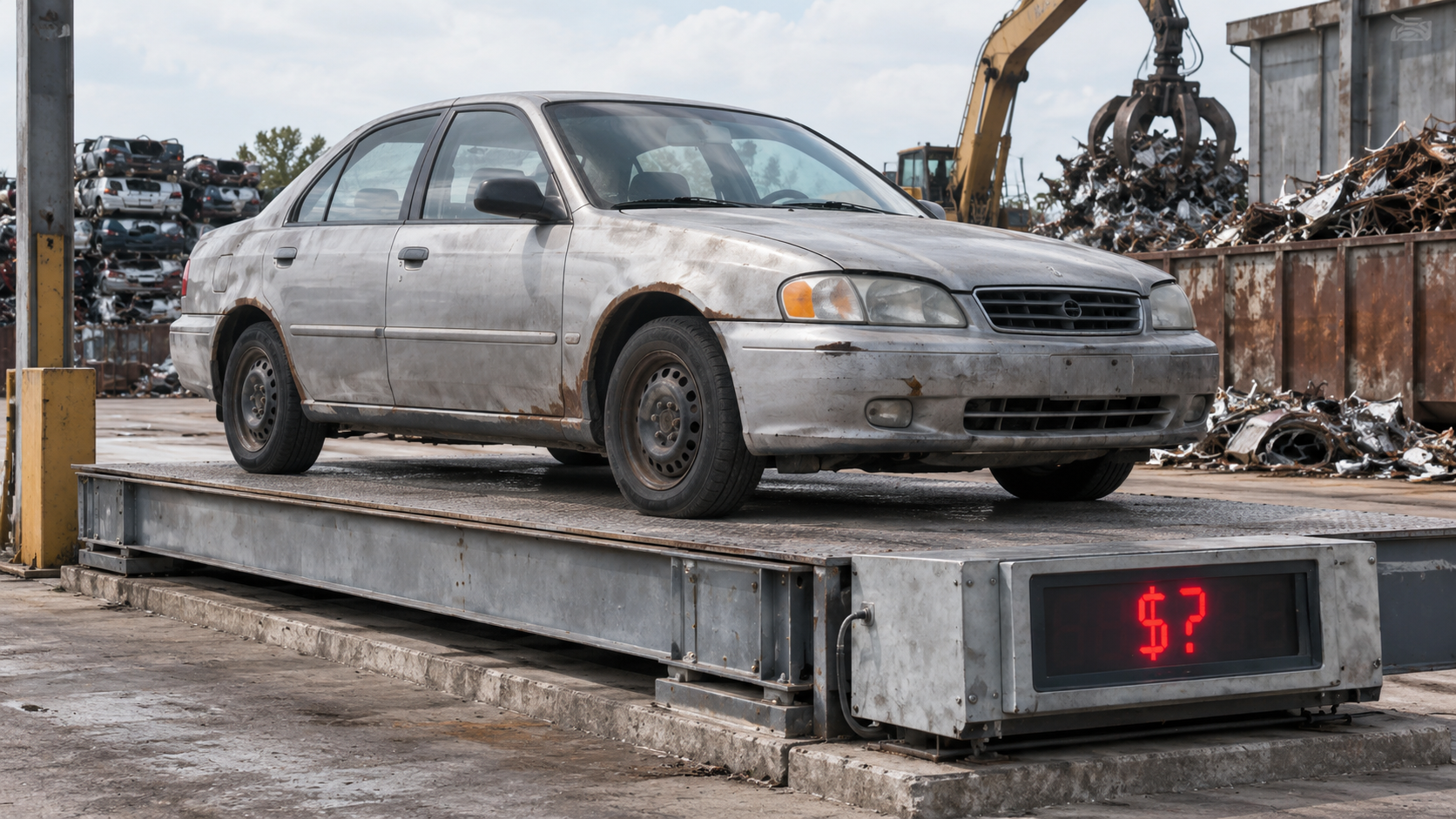
For a typical older passenger car that is no longer worth repairing, $150 to $500 is a useful starting range rather than a guaranteed price.
A small, lightweight, badly stripped car may fall toward the bottom of that range. A complete midsize vehicle may land higher.
A heavy truck, SUV, hybrid, newer damaged vehicle, or model with sought-after components may be worth $500, $1,000, or more if the yard sees value beyond the raw metal.
The biggest mistake is assuming that every junkyard calculates value using nothing but the vehicle’s weight.
Most dismantlers have two basic ways to make money from a vehicle:
- Recover its metal and other recyclable materials.
- Remove usable components and resell them.
If your vehicle has valuable reusable parts, its dismantling value may be substantially higher than its metal value alone.
1. Vehicle Weight Creates the Starting Point
Weight matters because even a vehicle with very little reusable value contains recyclable material.
A compact car generally contains less material than a full-size SUV or pickup truck, so its basic scrap value tends to be lower.
That means an old compact might receive a relatively modest offer while a heavy work truck in comparable condition can be worth considerably more.
However, you should not assume that a yard will simply take the curb weight and multiply it by a published scrap price.
A vehicle’s total weight is not made up entirely of one grade of recyclable steel. Cars contain glass, rubber, plastics, fluids, upholstery, wiring, aluminum, electronics, and other materials. The yard also has processing, transportation, storage, labor, and disposal costs.
So weight provides a floor for thinking about value, not a guaranteed payout formula.
2. A Complete Junk Car Is Usually Worth More
A complete vehicle normally gives a dismantler more options.
Consider two identical cars.
Car A has:
- Engine
- Transmission
- Catalytic converter
- Battery
- Four wheels
- Doors
- Lights
- Interior
- Electronics
Car B has already had several of those items removed.
Even if both vehicles weigh roughly the same originally, the yard can potentially recover considerably more from Car A.
This is why stripping a junk car before asking for quotes can backfire. The money you make selling one or two components yourself may be offset by a lower offer for the remaining vehicle.
Before removing anything, find out what the complete car is worth.
3. The Catalytic Converter Can Make a Major Difference
Catalytic converters contain precious metals including platinum, palladium, and rhodium.
Because of that, whether the original converter is still installed can significantly influence the value of some junk vehicles.
The effect is not identical on every car.
A missing converter on one vehicle might have a relatively modest impact, while an original converter from another model can represent a much more valuable component.
You should tell the buyer whether the converter is:
- Original
- Aftermarket
- Damaged
- Missing
Do this when requesting the quote, not when the tow truck arrives.
California also has extensive rules surrounding catalytic-converter theft and lawful sales, so reputable dismantlers pay attention to where these components came from.
4. Usable Parts Can Push the Offer Above Scrap Value
This is where the question “how much will junkyard pay for car?” becomes more complicated.
A junkyard isn’t necessarily buying just a shell.
If the vehicle has a usable:
- Engine
- Transmission
- Alternator
- Starter
- Doors
- Hood
- Tailgate
- Bumpers
- Mirrors
- Headlights
- Wheels
- Interior
- Electronic modules
the dismantler may see considerably more value in it.
Popular vehicles have an advantage because there are more people looking for replacement parts.
A clean door from a common commuter car can have real resale demand. So can a pickup tailgate, factory headlight, transmission, axle, or undamaged body panel.
That is one reason a mechanically dead but complete car may receive a surprisingly good offer.
5. Running Versus Non-Running Is Not the Whole Story
People often assume a running junk car must be worth more than any non-running car.
Not always.
Suppose one vehicle has a blown engine but still has its original catalytic converter, transmission, body panels, interior, wheels, electronics, and other components.
Now compare it with a running vehicle that has been partially stripped and is missing valuable components.
The non-running car could potentially be more attractive to a dismantler.
The better question is not simply:
Does the car run?
It is:
How much usable value is still left in the car?
Non-running but complete
This can actually be an excellent junkyard candidate because the yard has multiple components to recover.
Blown engine
A failed engine hurts value, but it does not automatically make the rest of the vehicle worthless.
Missing wheels
A vehicle that cannot roll may require additional loading equipment. Some buyers account for that when quoting the vehicle.
Major collision damage
A badly twisted structure can destroy the usefulness of suspension, steering, body, and mechanical components.
Fire damage
A severely burned vehicle may have very little usable parts value left.
Flood damage
Flood exposure can compromise electrical components, modules, wiring, interior materials, and mechanical systems. The extent of the damage matters.
In serious fire, flood, or stripping cases, the vehicle may effectively be valued primarily for recyclable material.
6. What Different Types of Junk Cars May Be Worth
The following figures should be treated as general examples rather than guaranteed California prices.
Compact cars
Older lightweight compacts often occupy the lower end of junk-car pricing.
A severely worn or damaged compact could fall around:
$150 to $300
A popular model with usable components can do better.
Midsize cars and crossovers
Popular vehicles such as mainstream sedans and crossovers can benefit from stronger parts demand.
A rough range may be:
$250 to $500+
Condition and completeness can move the price considerably.
Trucks and large SUVs
These can be particularly valuable because they combine substantial vehicle weight with demand for components such as:
- Beds
- Tailgates
- Axles
- Differentials
- 4WD components
- Engines
- Transmissions
Depending on the vehicle, $400 to $1,000+ is possible.
Luxury vehicles
Luxury cars are difficult to generalize.
An old luxury car with weak parts demand may not be worth as much as its original retail price suggests. Conversely, a newer damaged luxury vehicle may contain expensive headlights, electronics, sensors, mirrors, interior components, or drivetrain parts.
That can create an extremely wide value range.
Hybrids
Some hybrids can be worth more than their size would suggest because of demand for components such as hybrid battery cores and certain emissions-system parts.
Again, the value depends heavily on model, age, battery condition, and what remains on the vehicle.
7. Location Can Affect How Much a Junkyard Pays
The same car can receive different offers in different parts of California.
Why?
Because the buyer also has to consider the cost of getting the vehicle.
Los Angeles and other dense markets
Areas with numerous dismantlers, recyclers, salvage buyers, and used-parts customers can create stronger competition for vehicles.
In a market such as Los Angeles, several buyers may be competing for the same inventory.
That can work in the seller’s favor.
Sacramento and the Central Valley
Trucks, SUVs, work vehicles, and utility vehicles may attract strong interest where there is significant demand for their replacement parts.
Bay Area
Operating expenses, property costs, labor, traffic, and towing logistics can affect what individual buyers are willing to offer.
Rural California
Distance becomes increasingly important.
If a tow truck must travel a long way to pick up a $250 vehicle, transportation costs can consume much of the buyer’s potential margin.
This is why someone in a dense Los Angeles neighborhood and someone with the same vehicle in a remote part of California should not automatically expect identical offers.
8. Does a Missing Title Lower a Junkyard Offer?
A missing title does not automatically mean your car cannot be sold to a California dismantler.
California DMV procedures specifically provide a route for a licensed dismantler acquiring a California-titled vehicle when the certificate of title has been lost. Depending on the situation, an Application for Replacement or Transfer of Title (REG 227) may be part of the process.
What you should not assume is that every buyer will deduct the same amount.
There is no universal California rule saying a missing title must reduce an offer by $50, $100, or $150.
Some buyers may adjust their offer because of additional paperwork or risk. Others may simply require the necessary documents before completing the transaction.
If your title, registration, lien, or ownership situation is unusual, reviewing the site’s California vehicle paperwork information before arranging pickup can save you from discovering a problem at the last minute.
9. A Lien Can Stop the Sale
A vehicle with an active legal owner or lienholder requires more attention than an ordinary clean-title car.
A dismantler needs acceptable evidence of ownership, and when a legal owner or lienholder still has an interest in the vehicle, the necessary release must be dealt with before the ownership paperwork can be completed.
Similarly, if you bought a car but never properly completed the ownership chain, you may need bills of sale or other documentation connecting the registered owner to you and ultimately to the buyer. California DMV dismantler procedures specifically contemplate bills of sale being used to establish that chain of ownership.
Do not wait until pickup day to disclose this.
Tell the buyer about any title or lien issue while you are getting the quote.
10. Watch for Deductions After You Get the Quote
The highest quote is not always the highest payout.
Suppose:
Yard A
Quoted price: $425
Towing deduction: $75
Other fee: $30
Actual amount: $320
Yard B
Quoted price: $375
Towing: Included
Other deductions: None
Actual amount: $375
Yard B is the better offer.
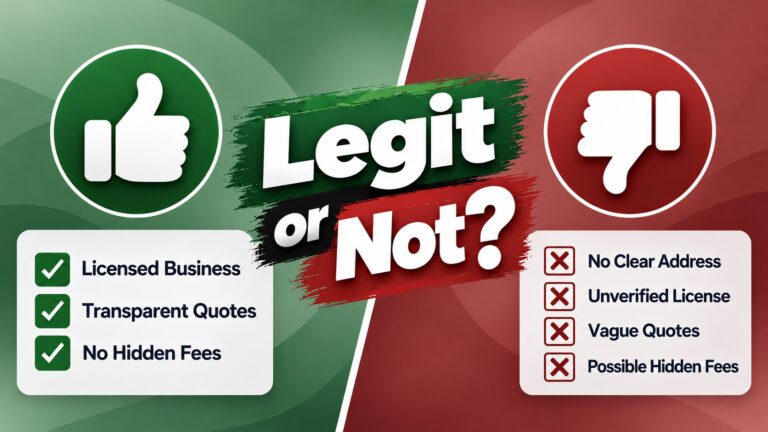
Before accepting a quote, ask:
Is towing really free?
Do not assume that “free pickup” and “free towing” mean the same thing under every company’s terms.
Ask:
“Will any towing charge be deducted from the quoted amount?”
Are there loading charges?
Tell the buyer if the vehicle:
- Cannot roll
- Has seized wheels
- Is parked on dirt or grass
- Is blocked by another vehicle
- Is underground
- Is in a narrow driveway
- Is missing wheels
That lets the buyer account for access before sending a truck.
Are there paperwork or administrative deductions?
Ask directly whether the quoted price is the amount you will actually receive.
Can the offer change at pickup?
A legitimate adjustment can make sense if the vehicle is materially different from what you described.
For example, you said the catalytic converter was present but it isn’t.
What should concern you is a major unexplained reduction after you accurately disclosed everything beforehand.
If the number suddenly changes, ask exactly why.
And remember: until you have agreed to the revised transaction, you do not have to accept a dramatically lower offer simply because the truck has arrived.
11. How to Compare Junkyard Quotes Properly
Do not call one yard Monday, another one two weeks later, and then compare the numbers as though nothing changed.
Market conditions and buyer inventory can change.
A better approach is to get three or four quotes on the same day.
More importantly, give every buyer exactly the same information.
Provide:
- Year
- Make
- Model
- Trim
- Mileage
- Whether it starts
- Whether it drives
- Engine condition
- Transmission condition
- Catalytic converter status
- Accident damage
- Fire or flood damage
- Missing components
- Number of wheels
- Whether the car rolls
- Title status
- Lien status
- Pickup city
- Exact access conditions
Then ask each buyer:
- Is towing completely free?
- Will any administrative or other charges come out of this amount?
- Is this the amount I should expect to receive if the vehicle matches my description?
- What paperwork will I receive when you take the vehicle?
Now you are comparing actual offers rather than advertising numbers.
If you want another reference point before calling yards, you can request an offer for your junk car, truck, SUV, or minivan through CashCashCars and compare the net amount against the other quotes you receive.
12. How to Estimate What a Junkyard Might Give You
You can make a rough estimate before calling buyers, but do not treat it as an exact valuation formula.
Step 1: Find the vehicle’s approximate curb weight
Do not confuse curb weight with the vehicle’s GVWR.
The certification label inside the door area commonly contains weight ratings, but it does not necessarily give you the car’s actual curb weight.
Use a reliable vehicle specification source, owner’s documentation, or manufacturer information to determine curb weight.
Suppose your midsize sedan weighs approximately 3,500 pounds.
That equals:
3,500 ÷ 2,000 = 1.75 tons
Step 2: Check current local scrap conditions
Assume, purely for illustration, that you are using $170 per ton as a market reference.
Then:
1.75 × $170 = $297.50
That does not mean the junkyard owes you $297.50.
It simply gives you a rough metal-value reference.
Actual vehicle recovery economics are more complicated because the vehicle is made from multiple materials and the yard incurs towing, processing, labor, storage, fluid handling, and other costs.
Step 3: Look for value above scrap
Ask yourself:
- Is the original catalytic converter present?
- Is the engine reusable?
- Is the transmission usable?
- Does it have factory alloy wheels?
- Are the doors and body panels straight?
- Are the headlights intact?
- Is the interior usable?
- Is the model common enough that parts sell regularly?
- Is it a truck, SUV, or hybrid with desirable components?
These can push the offer above a basic scrap-only valuation.
Step 4: Look for factors that reduce value
Consider:
- Missing converter
- Missing engine
- Missing transmission
- Missing wheels
- Severe fire damage
- Severe flood damage
- Major structural collision damage
- Stripped interior
- Difficult towing access
- Remote pickup location
Do not automatically subtract a fixed dollar amount for each problem because each buyer values components differently.
Step 5: Get real bids
Your calculation tells you whether an offer looks plausible.
Actual same-day bids tell you what the market will pay.
That distinction matters.
13. When You Should NOT Sell Your Car to a Junkyard
Sometimes the answer to “how much does a junkyard give you for a car?” reveals something more important:
You may have the wrong buyer.
Common car with one repairable problem
Suppose you have a popular commuter vehicle with a major mechanical failure but a good body, interior, title, and other components.
A mechanic, rebuilder, or private buyer might see a repair opportunity where the junkyard sees dismantling inventory.
It may be worth advertising the entire car before scrapping it.
Newer vehicle with major collision damage
A late-model totaled vehicle can still contain thousands of dollars’ worth of:
- Electronics
- Cameras
- Radar units
- LED lighting
- Interior parts
- Drivetrain components
- Wheels
- Body components
A specialist salvage buyer or auction channel may value that inventory differently from a local scrap-focused yard.
Classic or enthusiast vehicle
An old Miata, Jeep, BMW, pickup, sports car, or other enthusiast vehicle may have little meaning as commodity scrap but considerable value to someone looking for a project or parts donor.
Check enthusiast demand before crushing it.
Car with expensive aftermarket equipment
Junkyards generally do not value every modification at what you paid for it.
If your car has desirable aftermarket:
- Wheels
- Audio equipment
- Suspension
- Performance parts
- Accessories
and you have the time and ability to remove and sell them lawfully, selling selected components separately may make more financial sense.
The important question is whether the additional money is worth your time, labor, storage, and effort.
14. What to Do After the Junkyard Takes Your Car in California
Getting paid is not the final step.
Protect yourself after the transfer.
File the California NRL within five days
California DMV instructs sellers to submit a Notice of Transfer and Release of Liability (NRL) within five days of the transaction. The DMV also recommends retaining the filing confirmation for your records.
You will need information including:
- Vehicle details
- New owner’s name and address
- Date of sale or transfer
- Your information
- Odometer reading
Filing online also gives you an immediate record that you submitted the notice.
Keep proof of the transaction
Retain whatever transaction documents apply, such as:
- Bill of sale
- Purchase receipt
- Buyer information
- VIN
- Date
- Amount paid
- Copies or photos of signed ownership documents
Do not let the paperwork disappear along with the tow truck without keeping a record for yourself.
What happens to the license plates?
California generally treats standard license plates as remaining with the vehicle.
Personalized plates are different. California DMV allows the registered owner to retain personalized plates, subject to the applicable REG 17 process and retention requirements.
If you have personalized or special-interest plates, check the rules for that specific plate type rather than assuming they should remain on the junk vehicle.
So, How Much Will the Junkyard Pay for My Car?
For many ordinary junk cars in California, a few hundred dollars is a reasonable place to begin thinking about value.
But the real answer depends on the vehicle.
A small stripped car with major damage may be worth little beyond its recoverable material.
A complete non-running car may be worth considerably more.
A truck, SUV, popular commuter model, hybrid, newer damaged car, or vehicle full of desirable components can potentially command a much stronger offer.
So when you ask “how much will the junkyard give me for my car?”, don’t judge the answer from one phone quote.
Do this instead:
- Identify your exact vehicle.
- Check whether it is complete.
- Confirm the catalytic converter status.
- Note all major damage.
- Gather your ownership paperwork.
- Describe pickup access accurately.
- Get three or four quotes on the same day.
- Ask about every deduction.
- Compare the net amount you will actually receive.
- Consider whether the vehicle has more value to a repairer, salvage buyer, or enthusiast before committing to scrap.
The junkyard offering the biggest headline number is not necessarily offering you the most money.
The best offer is the one that accurately reflects your vehicle, includes the pickup terms you agreed to, and leaves you with the highest legitimate net payout once the transaction is complete.