How Does Cash Cash Cars Compare to Other Car Buying Services?
See how Cash Cash Cars compares with national car buyers, private sales, dealerships, and junkyards for damaged, non-running, and problem vehicles.
Selling a car today gives you a lot more options than simply trading it in at a dealership or putting a “For Sale” sign in the window.
You can use CarMax or Carvana. You can list the car privately. You can call a junkyard. You can use a nationwide cash-for-cars company. Or, if you’re in the Los Angeles region, you can work with a local buyer such as Cash Cash Cars.
So, how does Cash Cash Cars compare to other car buying services?
The biggest difference becomes clear when the vehicle isn’t an easy, straightforward sale.
Cash Cash Cars buys vehicles in a wide range of conditions, including running used cars, damaged vehicles, wrecked cars, salvage vehicles, cars needing expensive repairs, incomplete vehicles, junk cars, old unwanted cars, and non-running vehicles.
The company also works with sellers dealing with missing titles, registration problems, failed smog, liens, mechanic-shop vehicles, tow-yard vehicles, and other situations that may need more attention than simply entering a VIN into an online form.
That combination of local knowledge, problem-vehicle experience, personal service, paperwork guidance, and free towing is where Cash Cash Cars differs most from many other ways of selling a vehicle.
The Short Answer
Large national car-buying companies are designed to process a huge number of transactions.
That scale can make them convenient. You enter information about the car, receive an offer, provide the required documents, and follow the company’s process for completing the sale.
Cash Cash Cars takes a more local and individualized approach.
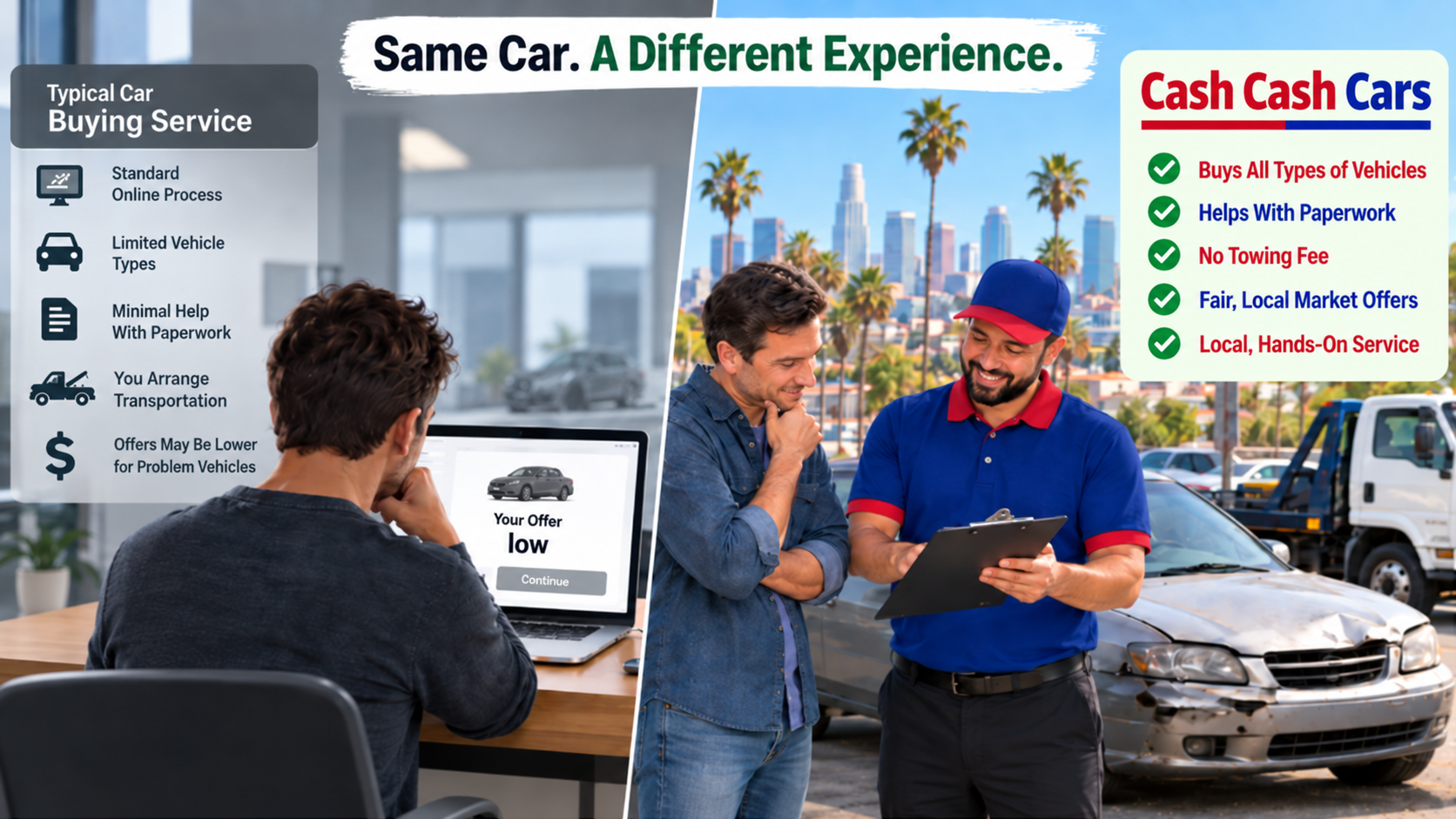
Because the company focuses on Los Angeles and surrounding communities, it can look at more than just the standard year, make, model, and mileage.
The team can consider the vehicle’s actual condition, its remaining usable value, local market demand, paperwork, location, and what will be required to physically remove the car.
That distinction becomes especially important when you’re selling a vehicle that is damaged, non-running, incomplete, stuck somewhere inconvenient, or difficult to transfer because of paperwork.
Cash Cash Cars vs. Large National Car Buyers
Large national car buyers have an obvious advantage: scale.
Their systems are built to provide offers and process transactions across many cities and states.
For sellers with straightforward vehicles, that can work well.
But standardization has another side.
When your vehicle doesn’t fit neatly into a normal used-car transaction, you may need more than a pricing algorithm and a standard document checklist.
Maybe the car won’t start.
Maybe the transmission is gone.
Maybe it has accident damage.
Maybe parts are missing.
Maybe it failed smog and the registration has now expired.
Maybe there is still a lien on it.
Maybe the vehicle isn’t even sitting at your house.
These are the situations where Cash Cash Cars’ local, hands-on approach becomes more relevant.
Rather than treating the car as an unusual exception to the normal process, problem vehicles are a major part of the business.
Local Pricing Instead of Looking at Just a Few Numbers
Every serious car buyer considers basic information such as:
- Year
- Make and model
- Mileage
- Condition
- Vehicle history
- Market demand
But those numbers don’t always tell the full story.
Two identical cars with the same mileage can have completely different values.
One may be running well.
The other may need a transmission.
One may have a clean body but a failed engine.
Another may be wrecked but still contain valuable usable components.
Cash Cash Cars looks at the vehicle’s broader circumstances.
If you’re selling a car that needs expensive repairs, for example, the team can consider the nature of the mechanical problem, repair economics, remaining vehicle value, usable components, and local demand.
The goal isn’t to promise that Cash Cash Cars will always beat every competing offer.
No buyer can honestly guarantee that for every vehicle.
The goal is to make an offer that reflects the actual car you own and its condition in the local market.
Damaged Cars Are Evaluated as Damaged Cars
A car doesn’t suddenly become worthless because someone backed into it, the airbags deployed, the body was damaged, or it was involved in a collision.
Cash Cash Cars specifically buys damaged cars and evaluates them in their current condition.
That could include:
- Body damage
- Accident damage
- Frame issues
- Mechanical damage
- Airbag deployment
- Non-running condition
- Missing parts
- Insurance-related damage
You don’t need to repair the vehicle just to ask what it is worth.
That’s important because putting thousands of dollars into a damaged vehicle solely to make it easier to sell may not make financial sense.
What About Wrecked and Salvage Vehicles?
A wrecked vehicle can be difficult to sell privately because the average buyer wants transportation, not a repair project.
Cash Cash Cars regularly reviews wrecked cars based on the type of damage, title status, remaining components, vehicle demand, and pickup requirements.
The same applies to salvage vehicles.
A salvage or rebuilt title affects value, but it doesn’t automatically mean the vehicle has no market.
The key is evaluating what is actually there rather than treating every salvage vehicle exactly the same.
Non-Running Cars Are Part of the Business, Not an Exception
A non-running car creates an immediate problem with many selling methods.
You can’t simply drive it to a dealership.
A private buyer may not want to arrange transportation.
And you may not want to spend money repairing a vehicle you already intend to sell.
Cash Cash Cars specifically helps people sell non-running cars.
The team will want to know things such as whether the vehicle:
- Starts
- Cranks but won’t start
- Rolls
- Steers
- Has working brakes
- Has all four wheels
- Is blocked
- Is inside a garage
- Has missing parts
- Needs special towing equipment
Those details matter because buying the car and physically removing it are two parts of the same transaction.
And importantly, Cash Cash Cars does not charge the seller a towing fee.
You don’t need to hire a separate towing company just to get the vehicle to Cash Cash Cars.
Vehicles With Missing Parts Can Still Have Value
Another area where automated valuations can become difficult is incomplete vehicles.
What happens if the engine has been removed?
Or the transmission?
Or the catalytic converter?
What if someone started dismantling the car for parts?
What if the wheels are missing?
Cash Cash Cars specifically reviews vehicles with missing parts.
The offer depends on what remains, what is missing, the condition of the vehicle, paperwork, local parts demand, and the logistics required to move it.
A vehicle missing a battery is obviously very different from a vehicle missing its engine, transmission, and wheels.
That’s why accurately describing the car upfront matters.
Junk Cars Aren’t Valued Solely by Appearance
If a car is genuinely near the end of its useful life, its value may come from several places.
There may be recyclable material.
There may be reusable parts.
There may be components that still have demand.
The make, model, completeness, title status, location, and overall condition can all matter.
Cash Cash Cars buys junk cars, trucks, SUVs, vans, and minivans throughout its Los Angeles-area service region.
That gives sellers another option before assuming the vehicle is worth nothing more than whatever a scrap yard offers by weight.
Cash Cash Cars vs. CarMax
CarMax is a major national used-car retailer and car buyer.
Its process is designed to handle vehicles at enormous scale.
Cash Cash Cars operates differently.
It is not simply trying to replicate a national used-car buying model on a smaller scale.
The business has built specific services around conditions that often make a vehicle harder to sell normally.
That includes damaged cars, salvage vehicles, major repair problems, junk vehicles, missing parts, non-running vehicles, title issues, registration issues, failed smog, liens, and vehicles sitting at outside facilities.
So the question isn’t necessarily:
“Is Cash Cash Cars better than CarMax?”
A more useful question is:
“Which buyer’s process better fits the car I’m actually trying to sell?”
If you’re explaining a complicated vehicle situation, a buyer that routinely handles those situations may offer a more practical path.
Cash Cash Cars vs. Carvana
Carvana has built much of its selling experience around an online process.
That works well for people who like completing much of a transaction digitally.
Cash Cash Cars combines online and phone contact with a more locally coordinated process.
This can matter when the problem can’t be fully explained by checking a few condition boxes.
For example:
“My transmission failed” is straightforward.
“My transmission failed, the mechanic has the car, I haven’t decided whether to pay the diagnostic bill, the registration expired while the car was sitting there, and there’s still a lender on the title” is not.
That second situation needs a conversation.
Cash Cash Cars is built to have that conversation.
Cash Cash Cars vs. Nationwide Junk-Car Buyers
It is also important to be fair about another category of competitor.
Some national buyers specialize in damaged, junk, and non-running vehicles too.
So Cash Cash Cars cannot honestly claim to be the only company willing to purchase problem cars.
The distinction is the local LA focus and hands-on coordination.
A national network may arrange a transaction through centralized systems and transportation partners.
Cash Cash Cars works specifically within the Los Angeles market and can evaluate the vehicle, paperwork, and pickup situation together.
That local involvement can become especially useful when the vehicle is somewhere other than an ordinary driveway.
Cash Cash Cars vs. Selling Privately
Selling privately can work well for a clean, desirable car.
But a problem vehicle changes the experience quickly.
Imagine writing this listing:
2010 sedan. Transmission failed. Registration expired. Failed smog last year. Car doesn’t move. Buyer must arrange towing.
Now imagine answering twenty messages about it.
“What’s your lowest price?”
“Can I drive it home?”
“What’s wrong with the transmission?”
“Will it pass smog?”
“Can you deliver it?”
“Do you have the title?”
“Will you take half your asking price?”
Even if a private sale eventually works, you have invested time into advertising, answering messages, negotiating, meeting strangers, and hoping the buyer actually shows up.
Cash Cash Cars turns that into a much simpler transaction.
Explain the car once.
Get it evaluated.
Review the offer.
If you accept, move on to the paperwork, payment, and pickup.
Cash Cash Cars vs. a Dealership Trade-In
Trading in a vehicle at a dealership can be very convenient when you’re already purchasing another car.
You hand over your old vehicle and apply its trade-in value toward the replacement.
But that model isn’t designed around everyone.
Maybe you aren’t buying another vehicle.
Maybe the current car doesn’t run.
Maybe it needs thousands of dollars in repairs.
Maybe it is heavily damaged.
Maybe the vehicle has become more valuable as parts or salvage than as dealership inventory.
Cash Cash Cars evaluates the vehicle as a standalone purchase.
You don’t have to buy anything in return.
Cash Cash Cars vs. a Traditional Junkyard
A traditional junkyard may make perfect sense for a true end-of-life vehicle.
But not every old, damaged, or non-running car should automatically be viewed as nothing more than scrap.
Some vehicles still have repair potential.
Others contain desirable components.
Some models have stronger local parts demand.
And sometimes the real problem isn’t the car at all.
It’s the paperwork.
Or the location.
Or the fact that the vehicle can’t be moved.
Cash Cash Cars considers those factors together rather than assuming from the start that every problem vehicle should be valued in exactly the same way.
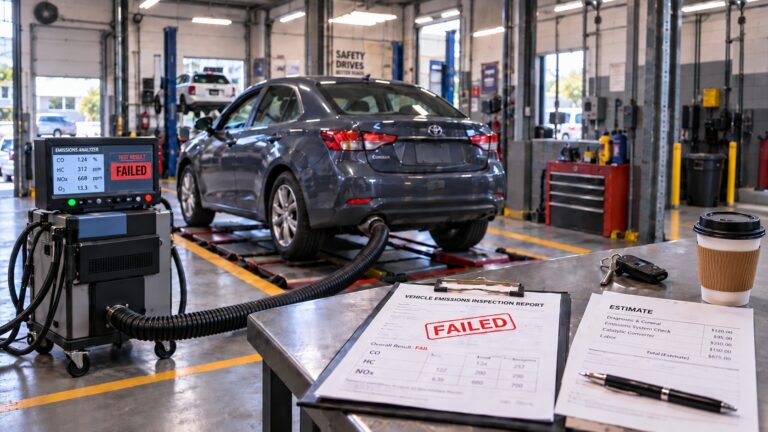
What Happens If the Car Failed Smog?
California sellers know how quickly a failed smog test can turn into an expensive repair decision.
Maybe the check-engine light is on.
Maybe the catalytic converter needs work.
Maybe there is an engine or emissions problem.
Maybe you’ve already spent money trying to get the car to pass.
Before paying for another repair, you can ask Cash Cash Cars about selling a car that failed smog.
The car can be reviewed in its current condition.
That doesn’t erase California’s legal requirements, but it does mean you can explore your selling option before automatically spending more money on a vehicle you’re ready to let go.
What If the Registration Is Expired?
Expired registration can create another layer of uncertainty.
Some sellers assume they must first pay everything required to bring the registration current before they can even talk to a buyer.
That’s not necessarily the smartest first step.
Cash Cash Cars has a dedicated process for people looking to sell a car with expired registration.
The team can look at the title status, registration issue, vehicle condition, smog status, ownership, and other circumstances before you decide what money, if any, should be spent preparing the car for sale.
What If You Don’t Have the Title?
A missing title doesn’t mean ownership requirements disappear.
Cash Cash Cars can’t buy a vehicle from someone who has no legal right to sell it.
But a lost or unavailable title is different from not owning the vehicle.
If you’re trying to sell a car without the title in hand, Cash Cash Cars can review the ownership situation and help you understand what documentation or California DMV steps may be relevant before the transaction can proceed.
The point isn’t to bypass the rules.
It’s to identify the correct path instead of assuming the car is impossible to sell.
What If There’s Still a Lien?
A lien means another party still has a financial interest in the vehicle.
That could be a lender that financed the car.
The payoff amount matters because the lien generally has to be resolved before ownership can be transferred cleanly.
Cash Cash Cars specifically works with sellers who need to understand how to sell a car with a lien.
If the car is worth more than the payoff, the transaction may be relatively straightforward.
If you owe more than the vehicle is worth, the negative-equity difference does not simply disappear.
That’s why the payoff information needs to be discussed before everyone assumes the sale can proceed normally.
What If Your Car Is at a Mechanic Shop?
This is one of the situations where local coordination can make a substantial difference.
Maybe your engine failed.
You had the vehicle towed to a shop.
The mechanic diagnosed the problem.
Then the estimate came back at $4,000.
Now you don’t want the repair, but the car is sitting on somebody else’s property.
You do not necessarily need to pay another towing company to bring the vehicle home simply so you can sell it.
Cash Cash Cars specifically helps people sell cars sitting at mechanic shops.
The shop still has to be able to release the vehicle, and any outstanding invoice, storage, authorization, or access issue needs to be understood.
But once the release requirements are clear, pickup can be coordinated directly from the shop.
And again, there is no towing fee charged by Cash Cash Cars.
What If the Vehicle Is at a Tow Yard?
A tow yard adds another layer of urgency because fees can continue accumulating while the vehicle sits.
Before pickup, the yard may require:
- Proof of ownership
- Identification
- Release authorization
- Payment of amounts owed
- Specific pickup times
- Other facility documentation
Cash Cash Cars has a dedicated process for sellers trying to sell a car at a tow yard.
The team can review the facility information, vehicle condition, paperwork, release situation, and pickup access before attempting to move the car.
The tow yard’s own charges still have to be dealt with where applicable, but Cash Cash Cars does not add a towing fee for transporting the purchased vehicle.
That distinction is important.
How Reliable Is the Offer?
This is one of the biggest concerns people have with cash-for-car buyers.
You don’t want to be quoted one number over the phone and then discover that the price suddenly drops when the tow truck arrives.
Cash Cash Cars’ approach is straightforward:
Give accurate information about the vehicle from the beginning.
That includes:
- Whether it runs
- Mechanical problems
- Accident damage
- Missing components
- Mileage
- Title status
- Lien status
- Registration issues
- Pickup-access problems
The offer is based on that information.
If the car substantially matches what you described, normal scratches, age, or expected wear shouldn’t suddenly become a reason to treat it like a completely different vehicle.
An offer may need to be reconsidered when something material is different.
For example, a vehicle described as running turns out to have a seized engine.
Or a complete vehicle turns out to be missing its engine or transmission.
That’s not a minor cosmetic discrepancy.
It’s a different vehicle condition.
The best way to avoid surprises is simple: describe the car honestly before the offer is made.
Free Towing Is Part of the Convenience
A cash offer isn’t very useful if you then have to spend hundreds of dollars figuring out how to transport the vehicle.
That’s particularly true for:
- Non-running cars
- Wrecked cars
- Cars with blown engines
- Cars with failed transmissions
- Vehicles at mechanic shops
- Tow-yard vehicles
- Vehicles with missing parts
Cash Cash Cars does not charge a towing fee when transporting the vehicle as part of the completed purchase.
The seller should still explain the exact pickup situation in advance.
A car parked normally in a driveway is different from one with no wheels sitting inside a low-clearance parking garage.
Access, equipment, facility release rules, and scheduling can all affect how the pickup is arranged.
But they do not turn into a towing charge from Cash Cash Cars.
How the Selling Process Works
The process is intentionally straightforward.
1. Tell Cash Cash Cars About the Vehicle
Provide the year, make, model, mileage, location, and general condition.
Then explain anything unusual.
If it doesn’t run, say so.
If it failed smog, mention it.
If the registration is expired, mention that.
If the title is missing or there is a lien, explain the situation.
If it’s at a shop or tow yard, provide the location.
2. Get the Vehicle Evaluated
Cash Cash Cars considers the vehicle’s condition, remaining value, paperwork, local demand, usable components, and other relevant factors.
3. Review the Offer
You decide whether the offer works for you.
Accurate information upfront helps make the agreed amount more reliable.
4. Arrange Pickup
Cash Cash Cars coordinates pickup based on the vehicle’s location and access.
There is no towing fee.
5. Complete the Paperwork and Payment
The vehicle and documents are verified, the required transaction paperwork is completed, and payment is handled according to the agreed transaction terms.
Then the vehicle is picked up.
In plain English:
Tell us about the car → get an offer → accept it → complete the paperwork and payment → free towing removes the vehicle.
How the Main Options Compare
| Feature | Cash Cash Cars | Large National Car Buyers | Private Sale | Traditional Junkyard |
|---|---|---|---|---|
| Local LA focus | Yes | Usually nationwide | Depends on buyer | Usually local |
| Clean running cars | Yes | Strong fit | Strong fit | Usually not the main focus |
| Damaged vehicles | Yes | Depends on buyer and vehicle | Harder to sell | Often |
| Wrecked cars | Yes | Depends on service | Difficult | Yes |
| Non-running vehicles | Yes | Depends on service | Difficult | Often |
| Vehicles needing major repairs | Yes | Depends on buyer | Harder to sell | Often |
| Missing-parts vehicles | Yes | May be restricted | Difficult | Often |
| Failed-smog situations | Yes | Process varies | Can complicate sale | Depends |
| Missing-title situations | Reviewed individually | Documentation rules apply | Difficult | Rules vary |
| Liens | Can help review payoff process | Standard lender procedures | Seller handles much of process | Depends |
| Mechanic-shop pickup | Specifically handled | Not typically a central selling feature | Seller coordinates | Varies |
| Tow-yard situations | Specifically handled | Not typically a central selling feature | Difficult | Varies |
| Towing fee | No towing fee | Depends on service | Seller often arranges | Depends |
| Paperwork guidance | Hands-on local assistance | Standardized process | Seller manages | Varies |
| Local market evaluation | LA-focused | National pricing systems | Buyer-specific | Local salvage focus |
Who Is Cash Cash Cars Best Suited For?
Cash Cash Cars buys ordinary used cars too, but its differences become most valuable when the vehicle is difficult to sell.
That includes cars that:
- Don’t run
- Need an engine or transmission
- Have accident damage
- Have salvage history
- Failed smog
- Have expired registration
- Are missing paperwork
- Have an active lien
- Are missing major parts
- Are sitting at a mechanic
- Are sitting at a tow yard
- Are old, unwanted, or no longer worth repairing
The common thread is simple.
The car has become a problem, and solving that problem requires more than posting an online classified ad.
Trust Matters Too
The highest number on your phone screen isn’t the only thing that matters.
Before handing over a vehicle, you should understand:
- Who is buying it
- How much you are being paid
- How payment will be handled
- What documents are being signed
- What happens with the title
- Whether a lien or payoff is involved
- What records you should keep
- What California DMV responsibilities remain after the transaction
A professional car sale should leave you with a clear record of what happened.
That matters whether you’re selling a $20,000 running car or a $500 non-running project vehicle.
So, How Does Cash Cash Cars Compare Overall?
Cash Cash Cars isn’t trying to be a nationwide automated car-buying platform.
Its advantage is being local, flexible, and comfortable with vehicles and situations that aren’t straightforward.
A seller may contact Cash Cash Cars because the engine failed.
Another may have a wrecked SUV.
Someone else may have a salvage vehicle with missing parts.
Another seller may simply have an old car that has been sitting unused for years.
And another may be staring at storage charges from a mechanic or tow yard and need a practical way forward.
Those sellers don’t just need someone willing to say, “Yes, we buy cars.”
They need someone to look at:
the vehicle + the condition + the paperwork + the location + the pickup requirements + the local market.
That’s the space Cash Cash Cars is designed to serve.
Final Verdict
If you’re in the Los Angeles region and your car has become difficult to sell, Cash Cash Cars is worth comparing with the other car-buying services available to you.
The company buys a broad range of vehicles, including damaged, wrecked, salvage, non-running, incomplete, junk, old, unwanted, and repair-problem cars.
It also works with sellers facing title issues, expired registration, failed smog, liens, mechanic-shop situations, tow-yard situations, and complicated pickup requirements.
And you do not pay a towing fee to Cash Cash Cars for removing the vehicle as part of the completed purchase.
The point isn’t to claim that every car should be sold the same way or that one buyer can always offer the highest number.
The point is to find the selling process that actually fits the vehicle you have.
If your car has become more of a headache than an asset, you can request a Cash Cash Cars offer, explain the situation as accurately as possible, and find out what the vehicle is worth in its current condition.
Sometimes the smartest move isn’t putting another few thousand dollars into a car you’re already ready to sell.
Sometimes it’s finding a buyer that understands the problem you’re trying to solve.