How to Dispose of Old Cars?
Learn how to dispose of old cars legally, from selling and scrapping to donation, DMV paperwork, smog rules, and state retirement programs.
An old car does not have to be completely dead before it becomes a problem.
Sometimes it still runs but cannot pass smog. Sometimes a transmission repair costs more than the vehicle is worth. In other cases, the car has been sitting so long that registration penalties, a missing title, or even local code-enforcement concerns have become bigger issues than the car itself.
So, how do you dispose of old cars legally in California?
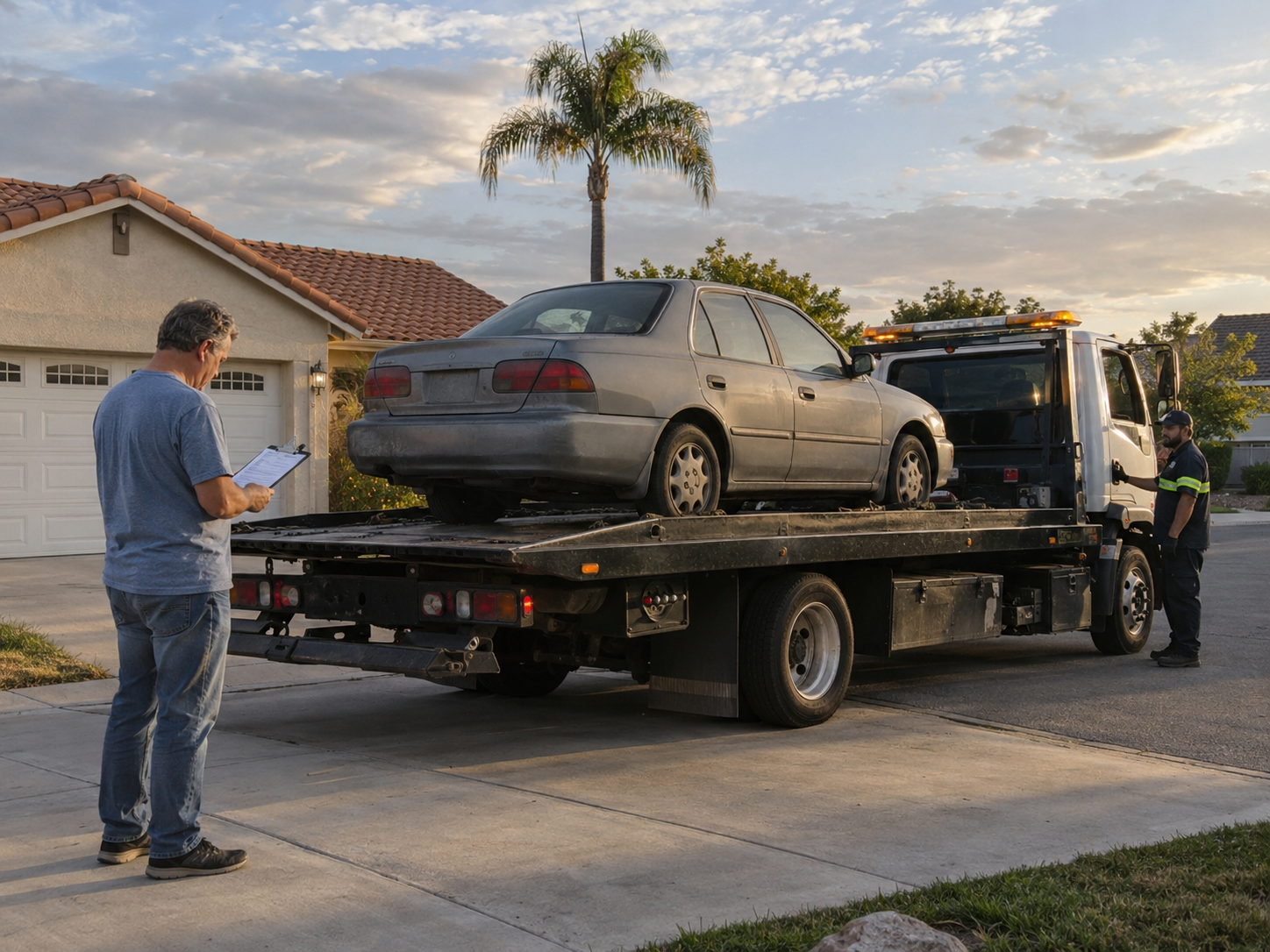
The answer depends on the car’s condition, paperwork, registration status, value, and what you want from the disposal. You may be able to sell it privately, trade it in, donate it, retire it through a California incentive program, or sell it directly to a licensed dismantler or vehicle buyer.
The important part is choosing the route that fits the car instead of assuming every old vehicle belongs in a scrapyard.
Why Do People Dispose of Old Cars in California?
There is usually a practical reason behind the decision.
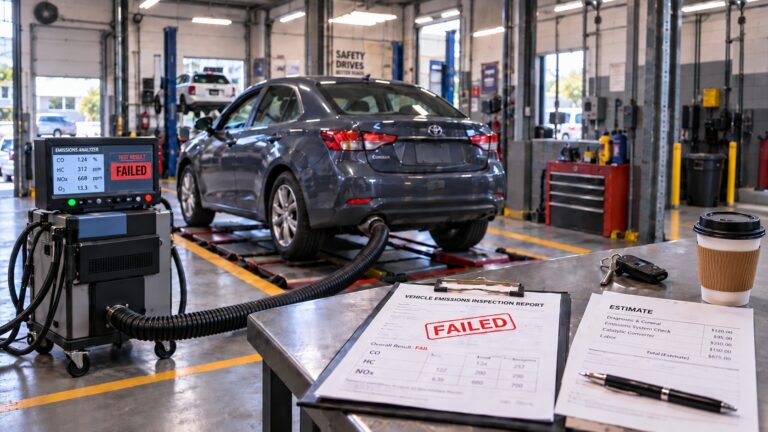
The car will not pass smog
A vehicle can drive perfectly well and still become difficult to sell because of emissions problems.
For most California private-party sales where a Smog Check is required, the seller must provide the buyer with a valid smog certification. California DMV specifically states that sellers generally need to provide the new owner with valid smog certification, subject to applicable exemptions.
That can leave the owner deciding whether another round of emissions repairs is worth the money.
Repairs cost more than the car makes sense to keep
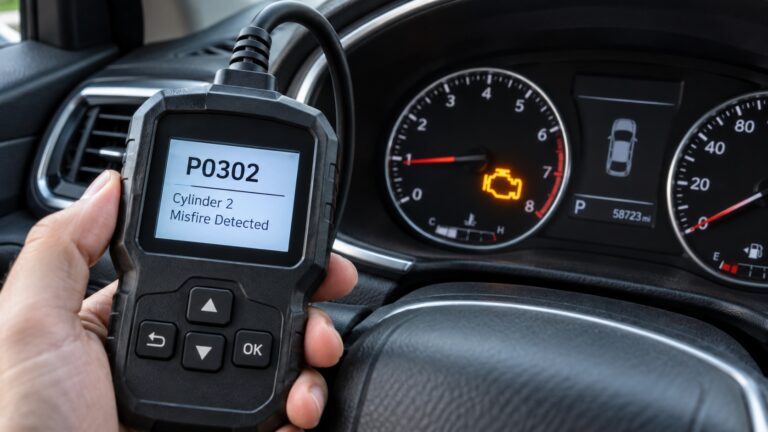
A transmission, head gasket, engine, catalytic converter, major electrical problem, or repeated overheating issue can easily change the economics of an older car.
What matters is not simply whether the car can be repaired. The better question is whether repairing it leaves you financially better off than disposing of it now.
The vehicle has become a property problem
A non-running car that has been sitting for months can attract complaints from neighbors, an HOA, a landlord, or local code enforcement.
Once deadlines or fines enter the picture, speed can become more important than squeezing every possible dollar out of the car.
Registration and paperwork have become complicated
Older cars frequently come with problems such as:
- Years of expired registration
- A lost title
- An old lien
- Registration from another state
- A deceased registered owner
- A car left at a repair shop or tow yard
- Planned Non-Operation complications
If the car has reached the point where fixing both the vehicle and the paperwork no longer makes financial sense, disposing of it may be the cleaner option.
What Are the Best Ways to Dispose of an Old Car?
There is no single best method for every car.
The main options in California are:
- Sell it privately
- Trade it in
- Sell it to a licensed dismantler or vehicle buyer
- Donate it
- Use a state or regional vehicle-retirement program
The right choice depends on whether your priority is maximum money, speed, convenience, or simply getting the vehicle legally out of your name.
1. Sell the Car Privately if It Still Has Real Market Value
If the car runs reasonably well, has a clear ownership history, and can satisfy California transfer requirements, a private sale may produce the highest price.
That is especially true for older vehicles that still have strong enthusiast or used-car demand.
An old Toyota pickup, Honda Civic, Mazda Miata, Jeep Cherokee, or another desirable older vehicle could be worth considerably more to an enthusiast or mechanic than its scrap value suggests.
But private selling becomes much less attractive when the car:
- Cannot pass a required smog inspection
- Has significant DMV paperwork problems
- Has major mechanical damage
- Is not safe to drive
- Has accumulated substantial registration issues
- Has an unresolved lien
Before accepting a scrap offer, check whether the car has a realistic private-party market.
2. Trade It In if Convenience Matters More Than Maximum Value
A dealership trade-in is useful when the old car still has enough value to be accepted and you are already purchasing another vehicle.
You will often receive less than you might through a private sale, but the dealer handles much of the transaction process.
For an old car with major mechanical problems, however, the trade-in value may be low enough that another disposal method makes more sense.
3. Sell It to a Licensed Dismantler or Old-Car Buyer
For vehicles that are dead, severely damaged, expensive to repair, stuck with registration problems, or simply no longer worth keeping, selling directly to a buyer that handles old and unwanted vehicles can be one of the quickest options.
If you are looking for a direct sale rather than repairing or privately listing the vehicle, CashCashCars has a dedicated service for selling old and unwanted cars.
This route is particularly useful when:
- The car does not run
- Towing is necessary
- Repair costs exceed practical value
- The vehicle has been sitting for a long time
- You want to avoid dealing with private buyers
- The car has registration complications
- You need the vehicle removed quickly
California DMV says businesses that buy or deal in nonrepairable vehicles for dismantling generally require a dismantler license. DMV also provides an Occupational License Lookup that allows consumers to verify businesses by category, name, location, or license number.
That verification step is worth doing before surrendering the vehicle.
4. Donate the Old Car
Donation can make sense when cash is not your main objective.
Many qualifying charities accept older vehicles and arrange pickup. Depending on what happens to the vehicle and your tax situation, you may qualify for a charitable deduction.
But a donation is not automatically financially better than selling.
The tax benefit depends on factors such as:
- Whether the charity qualifies under IRS rules
- Whether you itemize deductions
- What the charity ultimately does with the car
- The amount the organization receives if it sells the vehicle
Compare the likely tax benefit with an actual cash offer before deciding.
5. Check California Vehicle-Retirement Programs Before Scrapping
This is one step many owners skip.
California has programs that may make an eligible old vehicle considerably more valuable than an ordinary scrap offer.
Consumer Assistance Program
The Bureau of Automotive Repair’s Consumer Assistance Program, commonly called CAP, provides incentives for qualifying owners who retire eligible operational vehicles.
As of September 2026, BAR lists:
- $1,350 for qualifying applicants who do not meet the income requirement, with a vehicle that meets the applicable failed-Smog-Check requirement
- $1,500 or $2,000 for qualifying income-eligible applicants, depending on the vehicle and program requirements
The vehicle must meet the program’s eligibility conditions and be surrendered to a BAR-contracted dismantler.
That means you should check CAP eligibility before accepting a few hundred dollars from an ordinary scrap buyer.
Clean Cars 4 All
Clean Cars 4 All provides larger incentives for income-qualified Californians who retire an eligible older vehicle and replace it with cleaner transportation.
Current California Air Resources Board figures show incentives that can reach $12,000 toward an eligible zero-emission vehicle for qualifying participants in disadvantaged communities, with additional charging assistance potentially available. A mobility option with a face value of $7,500 is also available in qualifying circumstances.
Driving Clean Assistance Program
The Driving Clean Assistance Program expands similar assistance into areas that do not already have a district-operated Clean Cars 4 All program.
CARB currently lists vehicle-purchase grants of up to $10,000 for qualifying non-DAC applicants scrapping a vehicle and up to $12,000 for qualifying applicants in designated disadvantaged communities, plus potential charging incentives.
These programs have detailed income, vehicle, registration, residency, and replacement-vehicle requirements, so do not assume an old vehicle qualifies based on age alone.
How to Decide Whether to Sell, Scrap, Donate, or Retire Your Car
A simple decision tree helps.
Step 1: Is there a lien on the vehicle?
If yes, deal with that first.
A lender or other legal owner still has an interest in the vehicle. You generally cannot treat it like a normal clean-title car until the lien and payoff requirements are resolved.
If you are dealing with this situation, review the process for selling a car with a lien before arranging disposal.
Step 2: Does the car run and can it legally be transferred?
If it runs, has meaningful market value, and can satisfy the required transfer and smog requirements, compare:
- Private-sale value
- Trade-in value
- Cash buyer offers
- Repair costs
Do not automatically junk a functioning old car.
Step 3: Does it fail smog but still run?
Check CAP and other applicable retirement programs before spending heavily on repairs or selling it for scrap.
Step 4: Is the car essentially dead?
If it has a failed engine, transmission, serious collision damage, major missing parts, or repair costs that overwhelm its value, a licensed dismantler or specialized vehicle buyer may be the simplest route.
Step 5: Are DMV fees or paperwork making a normal sale impractical?
A dismantler may provide another route.
California DMV’s dismantler procedures state that a licensed dismantler is not required to pay fees or penalties on a vehicle being acquired for dismantling.
That does not mean every buyer or every type of transfer automatically wipes out your DMV obligations. It means the dismantler transaction is treated differently from an ordinary registration and resale transaction.
What if the Title Is Missing?
A lost California title does not necessarily mean the car is impossible to dispose of.
California’s Application for Replacement or Transfer of Title, REG 227, can be used when a California Certificate of Title has been lost, stolen, damaged, or is otherwise unavailable in qualifying circumstances. DMV procedures specifically allow REG 227 to be used in a transfer when properly completed and endorsed.
If your old car has a title problem, it is better to figure out the ownership path before scheduling pickup. CashCashCars also has information specifically for selling a car without a title.
Be more cautious if:
- The car is not actually titled in your name
- Another owner appears on the title
- A lienholder remains listed
- The vehicle came from another state
- You purchased the car but never completed the transfer
A missing piece of paper is different from an unclear ownership chain.
What if the Registration Has Been Expired for Years?
Registration problems are common with old cars because owners often stop renewing the vehicle once it stops running.
If you are considering putting the car back on the road or selling it normally, determine what fees, penalties, smog requirements, and registration steps apply first.
For a car that is being permanently dismantled, California’s dismantler procedures can be different. As noted above, DMV states that licensed dismantlers do not pay the registration or transfer fees and penalties otherwise due on vehicles acquired for dismantling.
If expired registration is the main issue, see the guide to selling a car with expired registration before spending money simply to make the car sale-ready.
What if the Registered Owner Has Died?
Do not simply sign the deceased person’s name or sell the vehicle as though nothing changed.
California provides an estate-transfer procedure for qualifying situations.
For an eligible California-titled vehicle, an heir may be able to use REG 5, Affidavit for Transfer Without Probate, together with the required death certificate and other supporting documentation. REG 5 has specific probate, timing, estate-value, and entitlement requirements.
Inherited vehicles should therefore be treated as an ownership issue first and a disposal issue second.
Do Not Abandon an Old Car
Leaving a dead vehicle on a public street is not a legitimate disposal strategy.
The car remains traceable by its VIN and registration record. Towing, storage, parking, and abandonment consequences can continue to follow the person associated with the vehicle.
If you cannot afford to repair the car, arrange a legal transfer, retirement, donation, or dismantling instead.
Check the Car’s Value Before You Scrap It
One of the biggest mistakes people make is assuming:
old + broken = worthless.
That is not necessarily true.
Before accepting a scrap offer, compare at least three numbers.
1. What is the car worth as it sits?
Get several real offers.
Do not rely entirely on an online scrap-price estimate.
2. What would it be worth after repair?
Use this calculation:
Post-repair market value − repair cost = approximate value after fixing it
For example, imagine:
- Car is worth $1,000 in its current condition
- Repair costs $1,500
- Car would realistically sell for $4,000 once repaired
Your rough value after repair is:
$4,000 − $1,500 = $2,500
In that situation, automatically junking it for $300 could be a poor financial decision.
Of course, you should also consider repair risk, additional hidden problems, selling costs, your time, and whether the repair estimate is reliable.
3. What would a retirement program pay?
If CAP or another California incentive program offers substantially more than a junk buyer, that becomes an important part of the calculation.
Be Careful About Removing Valuable Parts Before Disposal
Selling a car piece by piece sounds like an easy way to make more money.
Sometimes it is. Often it is not.
A buyer’s quote may assume that major components are still present, including:
- Engine
- Transmission
- Catalytic converter
- Battery
- Wheels
- Tires
Removing those components can lower the offer or make pickup more difficult.
A car with four wheels can usually be loaded much more easily than one sitting directly on suspension or brake components.
The catalytic converter is especially important. California tightly regulates catalytic-converter transactions, so removing one in hopes of casually selling it separately is not as straightforward as selling an ordinary used car part.
The safest rule is simple:
Tell the buyer what is missing before accepting the quote.
Do not let the tow truck arrive and discover that major parts disappeared after the price was agreed.
What Should You Remove From an Old Car Before It Leaves?
Once the disposal method is confirmed, clean out more than just the trunk.
Remove personal belongings
Check:
- Glove compartment
- Center console
- Door pockets
- Under the seats
- Seatback pockets
- Sunglasses compartment
- Spare-tire well
- Trunk
- Under the floor mats
Remove insurance cards, registration copies, repair receipts, or anything containing personal information.
Remove your FasTrak transponder
A transponder left in the vehicle may continue interacting with your account if the car is driven before dismantling or resale.
Remove it and update the vehicle information in your FasTrak account.
Clear digital information
Modern cars can contain:
- Paired phones
- Contact lists
- Saved home and work addresses
- Navigation history
- Garage-door codes
Factory-reset the infotainment system when possible and clear HomeLink or other integrated garage controls.
Remove items the buyer is not paying for
If you have aftermarket items that do not affect the agreed vehicle price, consider removing them before pickup.
Examples include:
- Phone mounts
- Portable electronics
- Custom floor mats
- Removable audio equipment
Do not remove major mechanical parts after receiving a quote unless you tell the buyer first.
Take final photographs
Photograph all four sides of the vehicle immediately before handoff.
Also photograph any major existing damage.
Those pictures establish the condition of the car when it left your possession.
How to Sell an Old Car to a Dismantler or Vehicle Buyer Step by Step
If you have decided that selling the car directly is your best option, follow this process.
Step 1: Gather the vehicle information
Have ready:
- Year
- Make
- Model
- Mileage
- VIN
- Running or non-running condition
- Major mechanical problems
- Accident damage
- Missing parts
- Title status
- Registration status
- Lien status
- Pickup location
Honest information produces a more meaningful quote.
Step 2: Get multiple offers
Try to compare at least three buyers.
Ask:
- Is this the final offer based on the condition I described?
- Is towing included?
- What could cause the price to change at pickup?
- What paperwork will I need?
- When and how will I be paid?
A high quote is not useful if half of it disappears when the tow truck arrives.
Step 3: Check licensing when dealing with a dismantler
California DMV provides an Occupational License Lookup where you can verify dismantler businesses.
Check the business name and license status rather than relying only on what appears in an advertisement.
Step 4: Prepare the vehicle
Clean it out, remove personal information and FasTrak equipment, clear stored digital information, and take condition photographs.
Step 5: Review payment before surrendering the car
Make sure the amount matches the agreement.
If you are paid by check, retain the transaction documentation and deposit the check promptly.
Step 6: Sign the proper ownership documents
Depending on the situation, this could involve:
- The California Certificate of Title
- REG 227
- Additional lien-release paperwork
- Estate documentation
- Buyer acquisition documents
Never sign blank ownership forms.
Step 7: Get a receipt
Keep written evidence showing:
- Vehicle
- VIN
- Buyer
- Date
- Amount paid
- Transaction or acquisition details
The car disappearing on a tow truck is not enough documentation by itself.
File the California NRL Within Five Days
This may be the most important post-sale step.
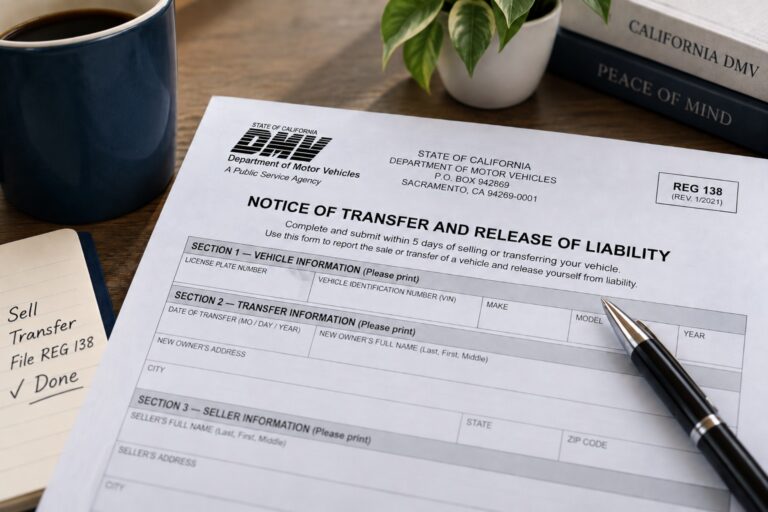
After selling, transferring, or otherwise disposing of the vehicle, submit California’s Notice of Transfer and Release of Liability.
DMV requires the NRL within five calendar days of the transfer. The seller can submit it online and should save the confirmation.
You will generally need information including:
- New owner’s name and address
- License plate number
- Last five digits of the VIN
- Odometer reading
- Date of transfer
The NRL helps protect you from liability associated with parking violations, traffic violations, and other issues arising after the reported date of transfer.
There is one important distinction:
Filing an NRL does not itself transfer title.
DMV specifically explains that the buyer still has to complete the ownership-transfer requirements for your name to be removed from the vehicle record.
So file the NRL yourself rather than simply trusting the buyer to take care of everything.
What About the License Plates?
Do not assume California requires every ordinary plate to be treated the same way.
Personalized and certain special-interest plates have specific retention and transfer rules.
If you want to keep personalized or special-interest plates, California DMV says they should generally be removed before the new owner takes possession, and REG 17 may be used for retention or reassignment depending on the situation.
For ordinary plates on a dismantled vehicle, the dismantler has its own DMV reporting and plate-handling obligations.
What to Do After the Car Is Gone
The vehicle leaving your driveway is not quite the end.
File and save the NRL
Do this immediately if possible rather than waiting until day five.
Save the confirmation.
Update or cancel your insurance
Wait until possession has actually transferred, then notify your insurer that you no longer own the vehicle.
If you prepaid your policy, ask whether a prorated refund applies.
Update FasTrak
Remove the vehicle and any associated plate information from your toll account as appropriate.
Keep your transaction records
Retain:
- Bill of sale or buyer receipt
- NRL confirmation
- Copies of ownership paperwork
- Payment records
- Photographs taken before pickup
- Insurance cancellation confirmation
There is no need to treat an arbitrary retention period as a universal California legal deadline. The practical goal is to keep enough documentation to defend yourself if a toll, parking, ownership, or transfer question surfaces later.
A One-Day Plan for Disposing of an Old Car
If the vehicle is sitting outside right now and you want to start today, use this checklist.
Morning: establish your position
Write down:
- Year, make, model, and mileage
- Whether the car runs
- What is mechanically wrong
- Whether major components are missing
- Title status
- Registration status
- Lien status
Then compare the car’s current value with repair costs and potential California retirement incentives.
If the title is missing, review REG 227.
If a lien exists, contact the lender before arranging disposal.
Midday: choose the disposal route
Runs well and has market value: compare private sale and trade-in.
Runs but fails smog: check CAP or applicable clean-vehicle programs.
Dead or uneconomical to repair: compare licensed dismantler and old-car buyer offers.
Registration problems make an ordinary sale unattractive: ask a licensed dismantler how the vehicle would be processed.
No need for cash: compare legitimate vehicle-donation programs.
Afternoon: compare buyers and prepare the car
Get several offers.
Verify licensing where applicable.
Confirm towing and payment terms.
Remove:
- Personal belongings
- FasTrak
- Documents
- Garage remotes
- Saved digital information
Take photographs.
At handoff: protect yourself
Before surrendering the car:
- Confirm payment.
- Complete the required ownership documents.
- Get a signed receipt or acquisition record.
- Save the buyer’s legal name and address.
After pickup: close the loop
File the California NRL within five days, preferably the same day.
Save the confirmation.
Then update your insurance and toll account and retain your transaction documents.
So, What Is the Best Way to Dispose of an Old Car in California?
The best way to dispose of old cars depends on what is actually wrong with the vehicle.
If it still runs, passes smog, and has real market value, scrapping it may be throwing money away.
If it fails smog but remains operational, check California retirement incentives before accepting an ordinary scrap offer.
If it is dead, severely damaged, expensive to repair, buried in paperwork complications, or simply needs to disappear from your driveway quickly, a licensed dismantler or buyer specializing in unwanted vehicles may be the more practical route.
And regardless of which option you choose, do not treat disposal as simply handing over the keys.
Confirm the ownership paperwork, document who received the vehicle, file your NRL within five days, and keep proof of the transaction.
Getting rid of the physical car is only half the job. Getting rid of your legal responsibility for it is what completes the process.