How to Calculate Scrap Value of Car?
Find out how much your car is really worth as scrap by calculating its weight, local scrap rate, parts value, condition, and pickup costs.
If you’re trying to figure out how to calculate scrap value of car, the basic formula looks almost too easy: find out how much the vehicle weighs, check the local scrap price per ton, and multiply the two.
That calculation is useful, but it only tells you part of the story.
What most California car owners actually want to know is something slightly different:
“If I sell this car to a junk car buyer today, how much money am I really going to get?”
That number depends on more than steel. The catalytic converter, engine, transmission, wheels, usable body parts, towing requirements, title status, registration history, and even where the vehicle is sitting can affect what a buyer is willing to pay.
So, if you’re considering selling a junk car, truck, SUV, or minivan, start with the scrap formula, but don’t stop there.
The Basic Car Scrap Value Formula
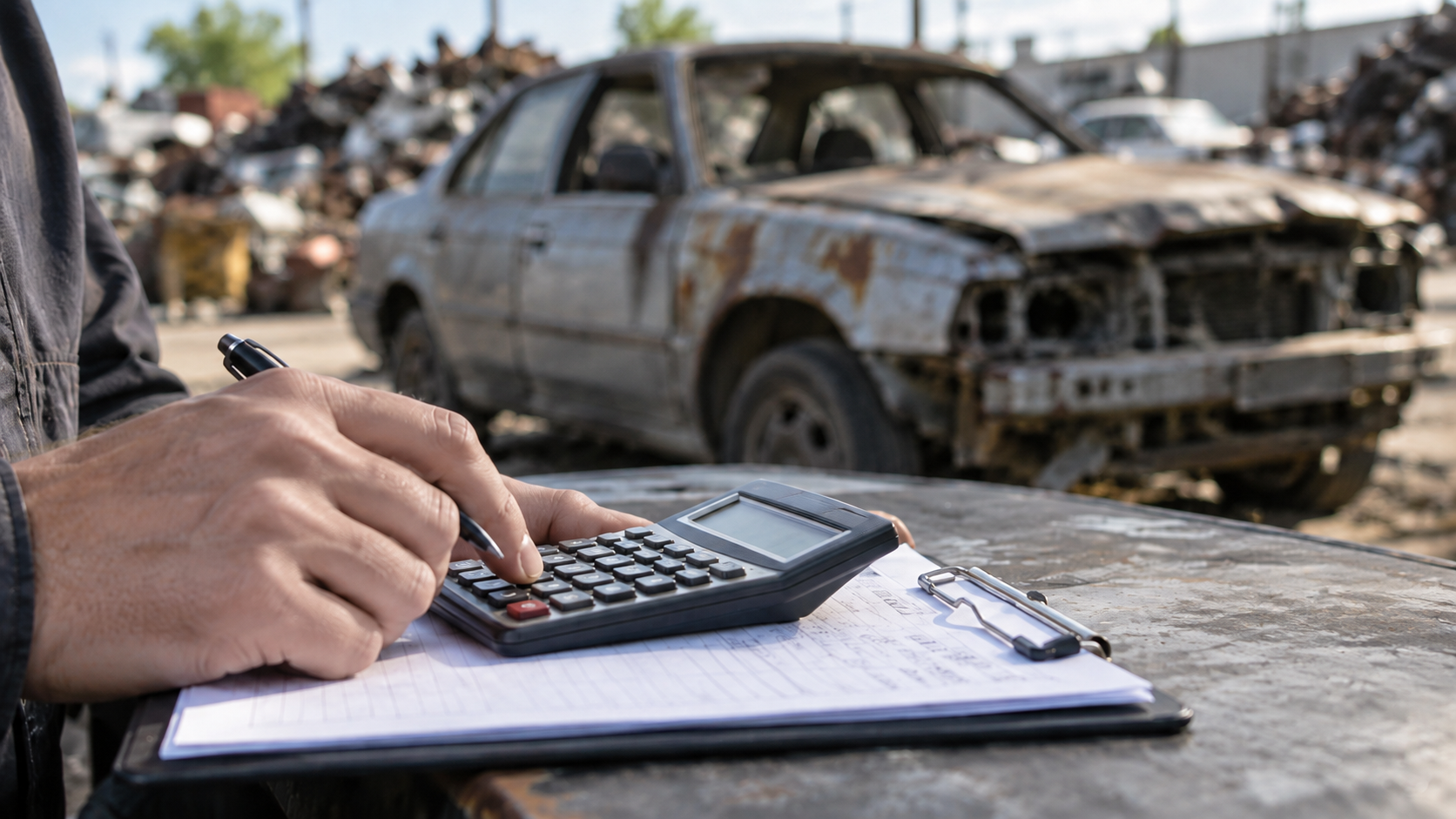
The simplest way to estimate the raw scrap value of a vehicle is:
Base Scrap Value = (Vehicle Weight ÷ 2,000) × Local Scrap Price Per Ton
Why divide by 2,000?
Because scrap prices in the United States are commonly quoted by the short ton, and one short ton equals 2,000 pounds.
Suppose your vehicle weighs 3,200 pounds and a recycler near you is paying $180 per ton for complete vehicles.
First:
3,200 ÷ 2,000 = 1.6 tons
Then:
1.6 × $180 = $288
That gives you an estimated base scrap value of $288.
However, don’t assume a junk car buyer must offer you exactly $288. The calculation is better treated as a benchmark that helps you understand the metal value underneath the vehicle.
Use Curb Weight, Not GVWR
Before doing the calculation, make sure you’re using the right vehicle weight.
You may come across several different numbers.
GVWR
Gross Vehicle Weight Rating, or GVWR, is not the number you want.
GVWR represents the maximum loaded weight the vehicle is designed to handle, including passengers, fluids, cargo, and the vehicle itself.
Using GVWR can therefore make the vehicle appear heavier, and more valuable as scrap, than it actually is.
Curb Weight
For a home estimate, curb weight is usually the better number.
Search for your vehicle’s:
Year + Make + Model + Engine + Curb Weight
Curb weight gives you a reasonable approximation of what the complete vehicle weighs without passengers or cargo.
Actual Scale Weight
Once a vehicle reaches a recycling facility, the physical weight of the car may be different from its factory curb weight.
Maybe the catalytic converter, battery, seats, wheels, or other components have been removed. Or perhaps heavy aftermarket equipment has been added.
Hence, think of curb weight as your estimating weight and actual scale weight as the more precise real-world measurement.
Find a Local Complete-Car Scrap Rate
The second half of the formula is the scrap price per ton.
This is where people often make their biggest mistake.
If you search for the current price of steel, you may find prices for processed industrial scrap and assume that same price applies to your vehicle.
It usually doesn’t.
A complete automobile isn’t a neat pile of prepared steel. It contains steel, aluminum, copper, rubber, plastic, glass, fluids, wiring, electronics, and many different components that have to be dismantled or processed.
That’s why the better question to ask a recycler is:
“What are you currently paying per short ton for a complete vehicle?”
Try calling two or three recyclers, dismantlers, or junk-car buyers in your area.
Local pricing matters because transportation costs, competition between buyers, processing capacity, and market demand can vary throughout California.
A vehicle sitting in the Los Angeles area may therefore produce a different offer than an identical vehicle located far from major recycling facilities.
Complete Car vs. Stripped Car Matters
When asking for a scrap rate, tell the buyer whether the vehicle is complete.
A complete car will generally include major components such as the:
- Engine
- Transmission
- Catalytic converter
- Wheels
- Battery
- Major body components
A vehicle with many valuable components removed may instead be treated as a car body, shell, or hulk.
And that distinction matters because a stripped shell can have a lower value than a complete vehicle.
Don’t Double-Count the Engine, Converter, and Other Parts
This is one of the easiest ways to accidentally inflate a scrap-value estimate.
Suppose you’ve already calculated the vehicle using a complete-car rate.
You shouldn’t then say:
Scrap value + engine value + transmission value + catalytic converter value = total vehicle value
Why?
Because the complete-car rate already assumes those components are present.
You basically have two valuation strategies.
Option 1: Sell the Car Complete
Leave the major components attached and sell the vehicle as a complete junk car.
The buyer determines what can be recycled, resold, rebuilt, or reused.
Option 2: Part the Car Out
You remove selected components and sell them independently.
Your calculation then becomes something closer to:
Value of Parts Sold Separately + Scrap Value of Remaining Shell = Total Part-Out Revenue
However, you also need to subtract your time, labor, selling costs, and any reduction in the remaining vehicle’s value.
You cannot realistically use a complete-car scrap rate after removing everything that made it a complete car.
Your Car Might Be Worth More Than Scrap
The weight-based formula works best when the vehicle’s remaining value is mainly its raw material.
Many cars don’t fit that description.
Before scrapping yours, work down this value ladder:
Can it still be sold as a usable vehicle?
If not:
Does it have meaningful salvage or parts value?
If not:
What is it worth purely as scrap?
That simple order can prevent you from leaving hundreds or even thousands of dollars on the table.
Example: 20-Year-Old Car With Major Damage
Imagine an old sedan with:
- A blown engine
- Severe body damage
- A worn interior
- Limited demand for remaining parts
The weight-based scrap calculation may be a reasonable way to estimate its value.
Example: Seven-Year-Old Car With a Failed Transmission
Now imagine a seven-year-old vehicle with a bad transmission but:
- Good doors
- Clean interior
- Intact lights
- Valuable electronics
- Good wheels
- Original catalytic converter
- Reusable body panels
That vehicle could be much more interesting to a dismantler than its metal weight suggests.
A buyer may be thinking about all the parts that can be put into inventory and sold to people repairing similar vehicles.
Example: An Older Car That Still Runs
If the vehicle starts, drives, and can reasonably be used for transportation, check its used-car value before scrapping it.
Even an ugly, high-mileage running car may be worth substantially more to someone who needs inexpensive transportation than it is to a processor buying metal.
If the problem is that the vehicle no longer runs, our guide to selling a non-running car explains some of the additional California issues that can affect the transaction.
How Valuable Parts Affect Junk-Car Value
Certain components can make a vehicle more attractive to a buyer.
Catalytic Converter
An original catalytic converter may contain platinum, palladium, and rhodium, and some OEM converters are significantly more desirable than others.
That’s one reason two cars with nearly identical weights can receive different offers.
However, California regulates transactions involving used catalytic converters. So don’t automatically cut one off because you’ve seen high converter prices online. Selling it separately can involve requirements that don’t apply in the same way when you sell an intact vehicle to a legitimate dismantler.
Engine and Transmission
A useful engine or transmission may be worth considerably more as a replacement component or rebuildable core than as scrap metal.
Demand depends heavily on the particular vehicle.
Alloy Wheels
Aluminum alloy wheels may have both metal value and used-parts value.
But if you remove all four wheels, you’ve also created a pickup problem. A car sitting on the ground is much more difficult to load than one that can roll onto a flatbed.
Newer Body and Electronic Parts
Headlights, mirrors, doors, computers, infotainment units, interior components, and other parts from relatively recent vehicles can have significant resale demand.
That’s why newer wrecked vehicles often shouldn’t be valued using the scrap formula alone.
Should You Remove Parts Before Scrapping the Car?
Before reaching for your tools, use this calculation:
Part Selling Price − Reduction in Remaining Car Value − Selling Costs − Value of Your Time = Actual Extra Profit
Suppose you can sell a component for $100.
Sounds good.
But what if removing it causes the junk-car buyer to lower the vehicle offer by $75?
And you spend $15 preparing and listing it?
You’ve now made only $10 before accounting for your time.
That’s why it’s a good idea to get a quote for the complete vehicle before removing valuable components.
Then ask the buyer how their offer would change if you removed the particular part.
Towing Can Change What the Car Is Worth
Two identical cars can have identical scrap-metal values but completely different pickup economics.
Imagine one vehicle is:
- In an open driveway
- Sitting on four inflated tires
- Easy to reach
- Located a few miles from the buyer
Now imagine the second vehicle is:
- 40 miles away
- Missing wheels
- Stuck behind another vehicle
- On a steep driveway
- Difficult to access
The buyer has to consider fuel, driver time, equipment, loading difficulty, and transportation costs.
That’s why the second car may produce a lower cash offer even though both vehicles contain approximately the same amount of metal.
Does “Free Towing” Really Mean Free?
Usually, “free towing” means you won’t receive a separate towing invoice.
But transportation still costs the buyer money.
So don’t just ask whether towing is free.
Ask:
“Is the amount you quoted the final amount I’ll receive at pickup?”
Also tell the buyer about flat tires, missing wheels, locked steering, inaccessible parking, or anything else that could complicate pickup.
A clear description beforehand makes it much harder for someone to justify an unexpected deduction when the truck arrives.
California Paperwork Can Affect the Transaction
Once you’ve estimated the car’s physical value, don’t forget about its legal status.
Missing California Title
If the California Certificate of Title has been lost, stolen, mutilated, or is otherwise unavailable, California DMV uses REG 227, Application for Replacement or Transfer of Title, in qualifying circumstances.
A missing title does not necessarily make the vehicle worthless, but you should find out exactly what documentation the buyer requires before arranging pickup.
An active lien creates an additional issue because the lienholder’s interest must be properly handled.
Expired Registration
Expired registration doesn’t automatically mean your car has no junk value.
California treats acquisitions by licensed dismantlers differently from ordinary private vehicle transfers. DMV guidance states that registration and transfer fees are not due from a licensed dismantler when processing a vehicle for dismantling.
However, the details of your transaction still matter.
If registration status is one of the reasons you’re considering getting rid of the vehicle, see our guide to selling a car with expired registration before assuming you need to spend money renewing it first.
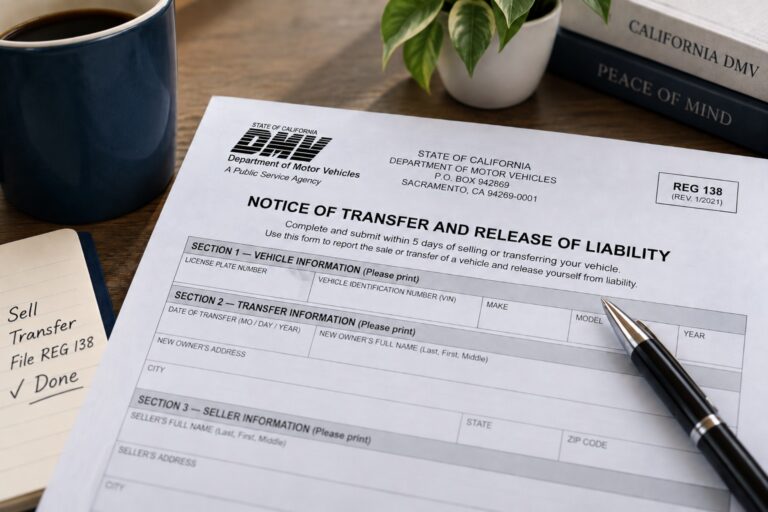
File the Notice of Transfer and Release of Liability
Selling the car isn’t finished when the truck disappears down the street.
California requires the seller or person in possession transferring the vehicle to submit the Notice of Transfer and Release of Liability, REG 138, to DMV within five calendar days of the transfer.
Keep the transaction information and complete the NRL promptly.
Check California Vehicle Retirement Before Accepting Scrap Value
There is another California-specific comparison worth making.
The Bureau of Automotive Repair’s Consumer Assistance Program (CAP) offers vehicle retirement incentives to eligible owners.
As of 2026, BAR’s application information lists:
- $1,350 for other eligible vehicle owners
- $1,500 or $2,000 for qualifying income-eligible vehicle owners
Eligibility isn’t based simply on owning an old or failed-smog vehicle. BAR has registration, ownership, operational, equipment, and other requirements, and funding availability matters.
For example, BAR says the vehicle must be able to drive under its own power to the contracted dismantler and meet additional inspection requirements.
So if your scrap calculation says $300 but your vehicle may qualify for a much higher state retirement payment, check eligibility before junking or transferring the vehicle.
Get Three Actual Offers
Once you’ve done the math, get several real-world quotes.
Give each buyer the same information:
- Year, make, and model
- Running or non-running condition
- Pickup ZIP code
- Title status
- Whether there is a lien
- Whether the catalytic converter is present
- Whether the engine and transmission are present
- Whether all wheels are present
- Accessibility of the vehicle
- Major missing components
Suppose your calculation says the base scrap value is $288.
Then you receive:
Buyer A: $200
Buyer B: $310
Buyer C: $600
You might assume Buyer C automatically wins.
Not necessarily.
Ask why the offer is higher and exactly what assumptions were used.
Then ask:
“Is $600 the guaranteed pickup amount if the vehicle is exactly as I’ve described it?”
A higher offer can be completely legitimate if the buyer sees salvage value that isn’t captured by your scrap calculation.
But a $600 phone quote that becomes $250 in your driveway isn’t really a $600 offer.
Watch for Last-Minute Deductions
The easiest defense against surprises is giving accurate information before receiving the quote.
Tell the buyer about:
- Missing catalytic converter
- Missing battery
- Missing wheels
- Flat tires
- Engine or transmission removal
- Severe collision damage
- Difficult access
- Missing title
- Active lien
Then confirm the amount.
Ask:
“Assuming everything I’ve described is accurate, what exact amount will I receive when you pick up the car?”
Also confirm how and when payment will be made.
Calculate Your Final Net Value
At this stage, the useful formula isn’t simply weight multiplied by scrap price.
It’s:
Quoted Vehicle Value − Agreed Pickup Costs − Agreed Fees or Deductions = Net Amount to Seller
Suppose one buyer offers $400 with no deductions.
Another advertises $550 but requires $175 in charges or adjustments.
The results are:
$400 − $0 = $400 net
versus
$550 − $175 = $375 net
The apparently smaller offer actually pays more.
How to Calculate Scrap Value of Car: The Complete Process
If you want one simple process to follow, use this:
Step 1: Find the vehicle’s curb weight.
Step 2: Divide the weight by 2,000 to convert pounds into short tons.
Step 3: Find the current local complete-vehicle rate.
Step 4: Multiply the tonnage by the rate to calculate base scrap value.
Step 5: Determine whether the car has greater used-car, salvage, or parts value.
Step 6: Check whether removing individual parts would actually increase your net return.
Step 7: Review California title, lien, registration, and transfer issues.
Step 8: Check whether the vehicle might qualify for California’s BAR retirement program before transferring or junking it.
Step 9: Disclose the vehicle’s condition and pickup situation and obtain several firm quotes.
Step 10: Compare the final net amounts, not just the advertised numbers.
So, What Is Your Car’s True Scrap Value?
The mathematical scrap calculation is useful, but it isn’t the final answer.
It tells you what the vehicle may be worth based primarily on weight and the local scrap market.
Your vehicle’s actual market value can be higher because of usable components, parts demand, an intact OEM catalytic converter, or the possibility of selling the car as something other than raw scrap.
It can also be lower because of missing components, difficult pickup, transportation costs, or ownership complications.
So the most useful definition of your car’s real-world scrap value is:
The highest legitimate net amount you can actually receive for the vehicle after its condition, parts, pickup circumstances, paperwork, and agreed deductions have been taken into account.
That’s why your calculation should be a benchmark rather than a promise.
Once you know the benchmark, you can compare offers intelligently and decide whether the vehicle belongs in the used-car market, the salvage market, a California retirement program, or the scrap stream.
And if scrapping or dismantling really is the right route, you can get an offer for your junk car, truck, SUV, or minivan based on the actual vehicle rather than relying only on its estimated weight in steel.