Where Can I Sell My Car That Needs Repairs?
Find out where to sell a car that needs repairs, when to sell it as-is, and how repair costs, smog, liens, and DMV rules affect your options.
A car does not have to be completely dead before repairs stop making financial sense. Maybe the transmission is slipping, the engine keeps overheating, the check engine light will not stay off, or you just received a repair estimate that is getting dangerously close to what the entire car is worth.
That leaves you with a practical question: where can I sell my car that needs repairs?
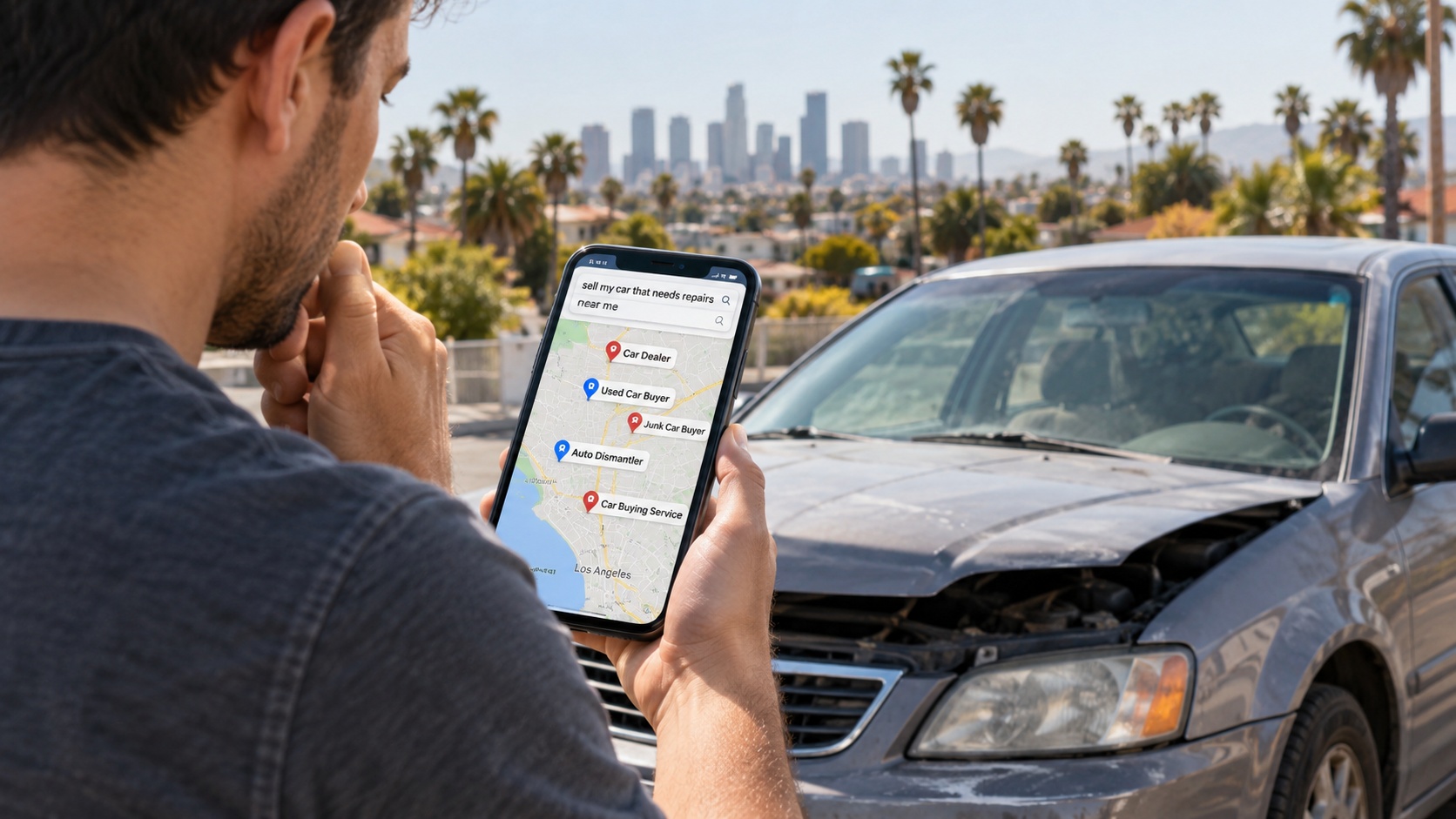
In California, the answer depends on more than the repair bill. Smog requirements, whether the car is safe to drive, its registration status, title issues, and even who buys the vehicle can affect what you are able to do.
Generally, your main choices are a licensed dealer or vehicle dismantler, an online car buyer, a private buyer, or a dealership trade-in. The right option depends on the condition of the car and what you are trying to get out of the sale.
First, What Is Actually Wrong With the Car?
Not every repair problem affects a sale the same way. In California, four categories deserve particular attention.
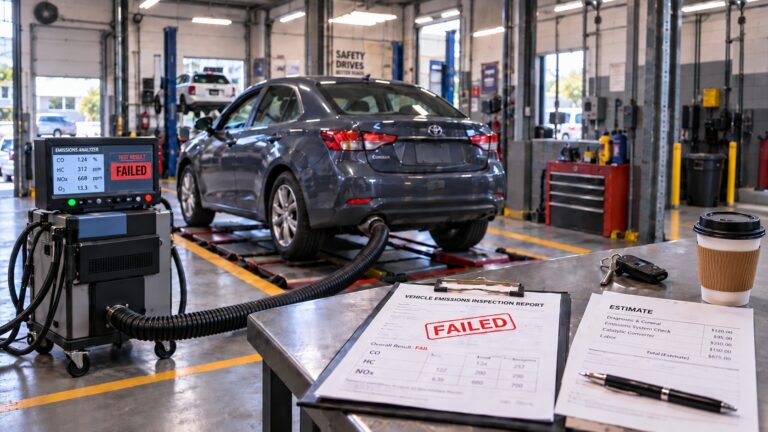
Failed Smog
A failed smog inspection can turn a relatively ordinary repair decision into a legal problem for a private sale.
California’s Bureau of Automotive Repair says that when a Smog Check is required for a change of ownership, the seller generally needs to have the vehicle pass before selling it. A passing certificate is normally valid for 90 days.
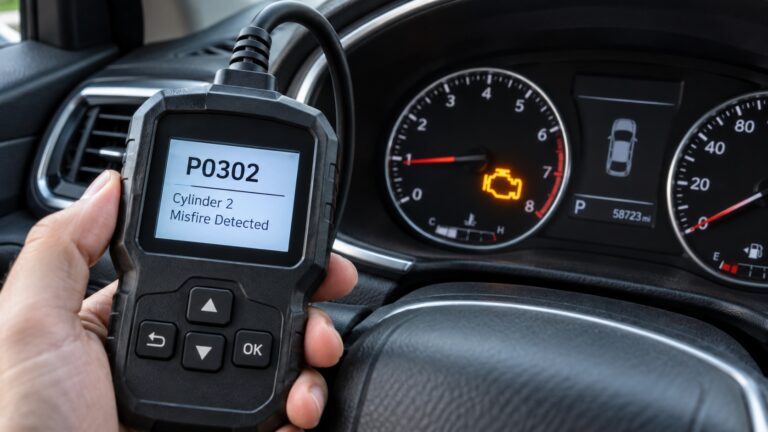
Common causes can include catalytic converter problems, oxygen sensors, check engine light faults, fuel-system issues, and other emissions-related failures.
This matters because repairing a $500 sensor problem may make financial sense, while spending several thousand dollars on emissions-related repairs just to prepare an older car for sale may not.
California law also provides different treatment when a vehicle is being sold to a dealer or for lawful wrecking or dismantling. That means a failed smog inspection does not necessarily mean you must keep repairing the car before you can get rid of it.
If smog is the main reason you are considering selling, our guide to selling a car that failed smog explains that situation separately.
Engine and Transmission Problems
A bad engine or transmission is where the repair-versus-sell decision gets much more serious.
A transmission replacement, engine rebuild, blown head gasket, internal engine failure, or similar major repair can easily consume a large percentage of an older vehicle’s value.
The important question is not simply whether the car can be repaired. Almost anything can be repaired with enough money.
The better question is:
How much additional value will the repair actually create after I pay for it?
That calculation can lead to a very different answer.
Overheating and Cooling-System Failures
California heat and heavy stop-and-go traffic are not friendly to an already weak cooling system.
A cracked hose or thermostat might be relatively inexpensive. But persistent overheating can also point toward radiator failure, water-pump problems, cooling-fan issues, or a damaged head gasket.
Continuing to drive an overheating car can turn a manageable repair into severe engine damage. So if the temperature gauge is repeatedly entering the danger zone, do not keep driving simply because you want to take the car somewhere to sell it.
Electrical Problems
Modern vehicles depend on sensors, modules, computers, wiring, and electronic control systems. That means an apparently small electrical fault can become expensive simply because finding it takes time.
Battery drain, charging-system problems, damaged wiring, failed sensors, control-module faults, intermittent no-start problems, and limp mode can all make a car difficult to value.
This is especially true when the mechanic cannot tell you the final repair cost until more diagnostic work is completed.
Other problems such as worn brakes, suspension damage, accident damage, a dead battery, or a vehicle that will not start should also affect where and how you sell it.
So, Where Can I Sell My Car That Needs Repairs?
There is no single best buyer for every broken vehicle. Start with the actual condition of your car.
1. Sell It to a Professional Vehicle Buyer or Licensed Dismantler
This is usually one of the most practical options when the car has major mechanical problems, severe accident damage, expensive emissions problems, or cannot safely be driven.
Instead of spending money repairing the vehicle first, you can find out what someone will pay for it exactly as it sits.
Cash Cash Cars buys vehicles needing repairs, including cars with engine problems, transmission trouble, overheating, electrical issues, warning lights, failed smog, and repairs that may cost more than the owner wants to put into the vehicle.
This route also makes sense when the vehicle needs to be picked up rather than driven to a buyer.
For a severely damaged or end-of-life vehicle, make sure you know exactly who is purchasing it and that the business is properly licensed for the transaction it is conducting.
2. Try an Online Car Buyer
Online buyers can be worth comparing when the vehicle still runs but needs repairs.
You enter the VIN, mileage, condition, and mechanical issues and receive an offer or preliminary valuation without first meeting a buyer in person.
The important part is disclosure.
Do not describe a car with a bad transmission as simply being in “fair condition” and assume the online offer is guaranteed. Tell the buyer about the warning lights, mechanical symptoms, accident damage, missing parts, or non-running condition.
Different platforms have different acceptance policies. Some may take cars with substantial mechanical problems, while others may reduce the offer or decline the vehicle after reviewing its condition.
3. Sell It Privately
A private buyer can sometimes pay more when the car has relatively minor problems.
This can work particularly well for:
- Cars needing straightforward repairs
- Mechanic specials
- Older enthusiast vehicles
- Classics
- Vehicles with valuable aftermarket or desirable factory equipment
- Cars a hobbyist is willing to repair personally
But California’s smog rules are where private sales become much more complicated.
The California Bureau of Automotive Repair says that if a Smog Check is required for the ownership transfer, the seller must generally provide a vehicle that has passed before the sale. Certain vehicles and transfers are exempt, but you should not assume writing “as-is” on a bill of sale makes the smog requirement disappear.
So if the car needs thousands of dollars of work before it can pass smog, a private sale may stop being the most practical option.
4. Trade It In
If you are already replacing the vehicle, ask the dealership what it will offer as a trade.
The biggest advantage is convenience. You get rid of the old car as part of the same transaction in which you purchase the replacement.
The downside is price.
A dealership knows it may need to repair, wholesale, or auction the vehicle, so those costs and risks usually get reflected in the trade-in offer.
For a car needing significant repairs, compare the trade offer against at least one as-is purchase offer before deciding.
Should I Repair the Car Before Selling It?
This is where doing some simple math helps.
A commonly used gut check is the 50% rule: once a repair approaches half of the car’s realistic post-repair value, you should seriously compare selling it as-is.
But do not treat 50% as an automatic cutoff.
Suppose your car could sell today for $2,000 with its existing problem.
A mechanic wants $2,500 to repair it, and you believe the car would realistically sell for $6,000 after the repair.
Your basic comparison becomes:
Sell as-is:
$2,000
Repair and sell:
$6,000 sale price
minus $2,500 repair
minus smog, inspection, advertising, registration, or other selling expenses
On paper, repairing may leave you with more money.
But that only works if the $2,500 estimate really solves the problem.
Older cars often produce the dreaded phone call halfway through the repair: “We found something else.”
Now your $2,500 repair becomes $3,500. Or the original problem is fixed, but another fault keeps the check engine light on and the car still cannot pass smog.
That uncertainty has value too.
Selling as-is can make more sense when:
- You do not have the repair money available upfront.
- The diagnosis is uncertain.
- Additional problems are likely.
- The repair does not guarantee a passing smog result.
- The car is accumulating storage charges.
- You are spending heavily on a rental car or rideshare transportation.
- The repair would consume most of the additional value it creates.
The right comparison is not repair cost versus car value.
It is how much money you walk away with under each option.
What If the Car Is Not Safe to Drive?
Do not take an unsafe vehicle on the road just to make the sale easier.
Failed brakes, serious steering problems, damaged suspension, badly compromised tires, severe collision damage, and chronic overheating can put you and other drivers at risk.
An overheating engine can also suffer substantially more damage if you keep driving it.
If the vehicle cannot safely or legally be driven, leave it somewhere it can legally remain and arrange for the buyer to collect it.
For a completely immobile vehicle, the process is covered separately in our guide to selling a non-running car.
Get the Pickup Terms in Writing
Before a tow truck comes, confirm:
- The agreed purchase price
- Whether towing is free
- Whether any pickup charge can be deducted from your offer
- What vehicle condition the offer assumes
- How you will be paid
- What paperwork the buyer expects you to provide
This helps protect you from one of the most frustrating tactics in the industry: getting quoted one amount and then hearing a dramatically lower number once the truck is already in your driveway.
If you accurately disclosed the condition and the buyer suddenly wants to renegotiate, you can decline the revised offer.
How Does Registration Status Affect the Sale?
Registration problems do not necessarily prevent you from selling a car that needs repairs, but they can affect the numbers and the type of buyer that makes sense.
If the vehicle has been properly placed on Planned Nonoperation, it cannot simply be driven on public roads while in that status. That becomes particularly relevant when the car also needs repairs because pickup or towing may be necessary.
If the registration expired without PNO being filed, fees and penalties may have accumulated. Before negotiating with a buyer, check the actual DMV amount instead of guessing.
A private buyer will naturally care about registration problems because they may affect what is required before the vehicle can be put back on the road.
A dealer or dismantler may handle the vehicle differently depending on what is ultimately being done with it.
The important thing is to know the registration status before you agree on a price.
How Much Is a Car That Needs Repairs Worth?
Do not assume “broken” means “worthless.”
Work through the value in stages.
Step 1: Find the Healthy-Car Baseline
Look at comparable vehicles using sources such as Kelley Blue Book, Edmunds, and actual local listings.
Be realistic about condition. If the car already has high mileage, dents, worn paint, or a rough interior, do not base your calculations on an excellent-condition value.
Step 2: Get a Written Repair Estimate
A mechanic’s written diagnosis is far more useful than guessing.
It also makes your conversations with buyers easier because you can describe exactly what has been diagnosed instead of saying, “I think the transmission is bad.”
Step 3: Determine the As-Is Value
Subtracting the estimated repair cost from the healthy-car value gives you a starting point, but it is not a guaranteed valuation formula.
A buyer also has to account for:
- Risk of additional repairs
- Parts and labor
- Transportation
- Time
- Resale costs
- Market demand
- Salvage or parts value
That is why the best way to establish a real as-is market value is to collect actual offers.
Step 4: Check the DMV Situation
If registration is expired, there is a title problem, or fees appear to be outstanding, find out the actual situation instead of estimating it yourself.
California DMV rules can differ depending on the vehicle and transaction. Knowing the paperwork problem upfront keeps it from becoming a surprise during the sale.
Step 5: Compare Multiple Offers
Get at least three numbers if the car is worth enough to justify shopping around.
They do not all have to come from the same buyer type.
Compare a professional vehicle buyer, an online service, a dealer trade-in, or a potential private-sale value when a private transfer is realistic.
That gives you actual leverage.
Watch for the Pickup Lowball
One tactic deserves particular attention.
You describe the car accurately, receive a $1,500 quote, and agree to pickup.
The truck arrives.
Suddenly the driver tells you the vehicle is worth $700 because of the same engine problem you already disclosed.
The truck sitting outside creates pressure because you have already mentally decided the car is gone.
Do not let that pressure make the decision for you.
Get the offer and vehicle-condition assumptions in writing. If nothing material about the vehicle was misrepresented, ask why the price changed.
The same applies to “free towing.”
If towing is advertised as free, confirm whether the quoted amount is the net amount you will actually receive, with no towing deduction afterward.
What If I Still Owe Money on the Car?
A repair problem does not cancel a lender’s legal interest.
If there is an active auto loan, contact the lender first and request the current payoff amount. Then ask how the lender handles a vehicle sale.
If your car is worth more than the payoff, the loan can generally be satisfied and the remaining equity goes to you.
If you owe more than the vehicle is worth, you have negative equity. The difference normally has to be resolved before the lender will release its interest.
Dealerships and established vehicle buyers can sometimes make this process easier because they regularly deal with lienholders and payoff procedures.
Private sales become considerably more cumbersome because the buyer may be paying for a vehicle whose title cannot immediately be released.
What If the Car Is at a Mechanic or Tow Yard?
Act quickly.
A car sitting at a repair facility, storage facility, or tow yard can accumulate charges while you are deciding what to do.
A mechanic or storage operator may also have lien rights when authorized repair, towing, or storage charges remain unpaid.
That means you should not promise another buyer immediate possession until you understand:
- Who currently has possession of the vehicle
- What amount is owed
- What is required to release it
- Whether any lien process has already begun
If you sell to a professional buyer, tell them immediately where the vehicle is located and what is owed. A buyer experienced with these situations may be able to coordinate directly with the facility, but the numbers and ownership requirements need to be resolved before the car leaves.
California Paperwork You Should Not Skip
Getting paid is not the final step.
Complete the Title Correctly
Make sure the title is completed accurately with the buyer’s information, sale details, signatures, and required odometer information.
If the California title is missing, DMV provides procedures for replacing or transferring a lost title rather than simply selling the vehicle without ownership documentation.
Keep Proof of the Transaction
Keep a copy or photograph of the completed sale paperwork.
Record:
- Buyer’s name
- Sale date
- Sale amount
- Mileage
- VIN
- Vehicle condition
- Relevant disclosures
If something happens later, having evidence of exactly when and to whom the car was transferred can matter.
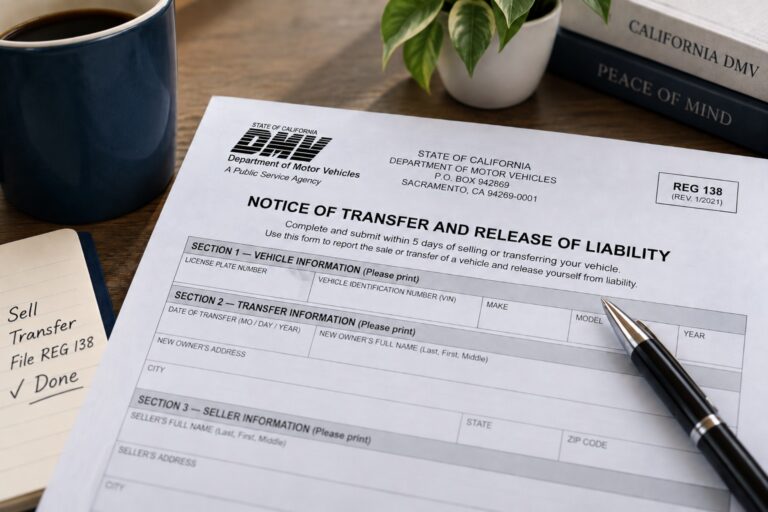
File the Notice of Transfer and Release of Liability
This is one of the most important things a California seller should do after handing over a vehicle.
California DMV requires the seller to submit the Notice of Transfer and Release of Liability, commonly called the NRL, within five calendar days of the sale.
Save the confirmation after submitting it.
There is one important distinction: an NRL does not itself complete the ownership transfer or immediately remove your name from DMV’s vehicle record. The buyer still needs to complete the ownership transfer.
What Should You Do When the Buyer Arrives?
Prepare before pickup instead of trying to sort everything out beside a tow truck.
Before the buyer or driver arrives:
- Remove personal belongings from the vehicle.
- Check the glove box, trunk, under the seats, and center console.
- Remove insurance paperwork and anything containing personal information.
- Photograph the exterior, interior, odometer, and general vehicle condition.
- Have your title or appropriate DMV paperwork ready.
- Keep the written offer accessible.
When the buyer arrives:
- Confirm who they are and which company they represent.
- Make sure the car being inspected matches the condition you already disclosed.
- Confirm the final purchase amount.
- Complete the required ownership paperwork.
- Keep copies or photographs of the signed documents.
- Do not let pressure from a waiting tow truck force you into an unexpected lower offer.
After the vehicle leaves, file the NRL promptly and keep the confirmation with your transaction records.
California license plates also generally stay with the vehicle, so do not automatically remove ordinary plates unless your particular plate type or situation requires different handling.
Your Final Decision: Where Should You Sell It?
If you still are not sure where to start, use the condition of the car.
The car is totaled, non-running, or unsafe:
Start with a professional vehicle buyer or licensed dismantling option that can collect the vehicle.
The car failed smog and needs expensive emissions repairs:
Get an as-is offer before paying for repairs solely to make a private sale possible.
The car runs but needs moderate mechanical work:
Compare an online buyer or professional vehicle buyer against the net amount you would receive after repairing and selling it.
The car needs relatively minor repairs and can satisfy the requirements for a private transfer:
A private buyer may pay more, particularly if the vehicle appeals to mechanics or hobbyists.
You are already purchasing another vehicle:
Get a trade-in figure, but compare it with an independent as-is offer before accepting it.
The car cannot be driven:
Choose a buyer that can arrange pickup rather than risking another trip in an unsafe vehicle.
The car is at a mechanic, tow yard, or has an active loan:
Deal with the payoff, lien, possession, and title situation first and favor a buyer experienced with those transactions.
You Don’t Have to Repair Your Car Before Selling It
The biggest mistake is assuming you only have two choices: spend whatever the mechanic wants or reduce the car to scrap value.
There is usually another number in between.
Find out what the vehicle is worth today, exactly as it sits. Then compare that amount with what you would realistically walk away with after repairing it.
If spending $2,500 creates $4,000 in additional value with relatively little risk, repairing may make sense.
But if that same $2,500 repair could uncover another expensive problem, still leave you fighting a check engine light, or keep you without transportation for weeks, selling the car as-is may be the better financial decision.
That is ultimately the answer to where can I sell my car that needs repairs in California: choose a buyer that can take the vehicle in its current condition without requiring you to put more money into it first.
If you’ve decided the repairs are not worth paying for, Cash Cash Cars buys cars that need repairs throughout the Los Angeles area. You can get an offer based on the vehicle’s current condition, whether it has engine or transmission problems, electrical issues, overheating, failed smog, accident damage, or simply needs more work than you want to pay for.
Before authorizing another expensive repair, compare the cost of fixing the car with what you can get for selling it as-is. In some cases, taking the cash and letting the car go makes more financial sense than putting another dollar into it.