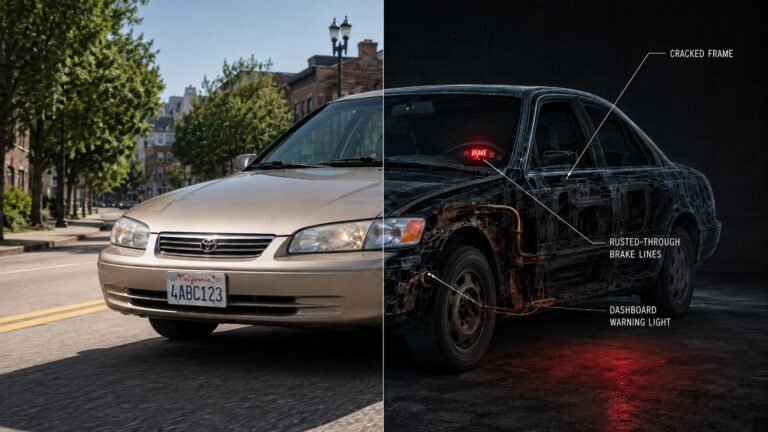
If California Wants $701 to Renew Your Registration, Is the Car Still Worth Keeping?
A $701 California registration renewal can be normal or a warning sign. Here is how LA drivers can separate recurring fees from penalties and decide whether to renew, file PNO, dispute charges, or sell.
A $701 vehicle-registration notice does not automatically mean the car is too expensive to keep. First separate the vehicle's normal recurring fees from late penalties, parking tickets, toll violations, weight charges, or an incomplete smog requirement. Then compare the clean annual cost with the car's value, reliability, use, and realistic replacement cost.
Reddit inspiration: This guide was inspired by a Los Angeles discussion about a $701 tag renewal and an Ask Los Angeles discussion about late DMV penalties.
What this guide helps you decide
Part of the amount may represent the vehicle's normal annual cost. Another part could come from late penalties, parking tickets, toll violations, commercial weight fees, or an incomplete smog requirement.
That's why the first decision is not whether to keep the car. It is whether the $701 represents a recurring ownership cost or a one-time problem.
Start With the Itemized Charges
Do not judge the notice by its total alone. Find the itemized section and separate the charges into two groups.
Charges tied to registration and the vehicle
- Basic registration fee
- Vehicle License Fee, or VLF
- Transportation Improvement Fee
- County and district assessments
- Commercial or weight-related fees
- Applicable emissions or vehicle-specific charges
California currently lists the standard original and renewal registration fee as $73, but that is only one component. The VLF is calculated at 0.65% of the vehicle's purchase price or DMV-determined value. It generally decreases during the vehicle's first 11 renewal years or until the vehicle is transferred.
Because other charges depend on vehicle type, value, location, and use, check the California DMV fee calculator for a vehicle-specific estimate.
Charges created by something that happened
- Registration penalties
- CHP penalties
- Parking citations
- Toll violations
- Owner-responsibility citations
- Other holds or corrective charges
These items can make an ordinary renewal look alarming. Therefore, find out how much of the $701 belongs to the car and how much belongs to a missed deadline or unresolved citation.
Is $701 Normal for This Particular Vehicle?
For a newer or more valuable vehicle, an electric vehicle, or a pickup assessed under commercial-vehicle rules, $701 may be explainable without any error. For an older passenger car of modest value, the same amount deserves closer examination.
That does not automatically mean the DMV calculated it incorrectly. Older citations or penalties may have been added to the renewal.
Registration renewal cannot be completed while unpaid parking or toll violations remain on the vehicle record. The violations must be cleared by the issuing agency or paid with the renewal. The DMV collects the money, but the issuing agency is normally where a citation must be challenged. The DMV explains this in its parking and toll violation guidance.
Compare the Bill With the Car's Value and Usefulness
Suppose the vehicle is worth approximately $35,000, runs reliably, and is driven every day. A $701 renewal represents about 2% of its value. It may be unpleasant, but it is unlikely to justify replacing the car.
Now consider a car worth $2,500. The same bill equals approximately 28% of its market value. That should trigger a closer review, especially if the car also needs repairs or emissions work.
If you drive 10,000 miles per year, a $701 renewal costs roughly seven cents per mile. If the vehicle travels only 1,000 miles, the cost rises to about 70 cents per mile before insurance, maintenance, fuel, or parking is counted. That's why a daily driver and a backup car should not be judged the same way.
Calculate the Complete 12-Month Cost
Registration should not be considered in isolation. Add everything required to keep the vehicle usable for another year.
| Annual expense | Example cost |
|---|---|
| Registration and related charges | $701 |
| Insurance | $1,800 |
| Parking or permits | $200 |
| Repairs or smog work | $2,000 |
| Total for the next year | $4,701 |
Spending $4,701 on a reliable daily driver may still be reasonable if replacing it requires a down payment, monthly loan payments, interest, taxes, and more expensive insurance. However, spending that amount on an unreliable car that is rarely driven is harder to justify.
Because replacement has its own costs, compare the $4,701 with the replacement vehicle's out-the-door cost, not merely its advertised price. Include taxes, DMV charges, financing, insurance changes, a pre-purchase inspection, and immediate maintenance.
Was This Year Unusually Expensive?
Late penalties and individual citations should not recur after they are properly resolved, assuming you remain current afterward. Base registration and other applicable assessments will continue.
The VLF may decline as the vehicle ages. However, not every part of the bill decreases with depreciation. Some fees are fixed, periodically adjusted, or tied to vehicle classification.
So remove confirmed one-time penalties and citations from the current total. Then use the DMV calculator to estimate the normal renewal cost. If $400 of a $701 notice came from a citation and late penalties, selling a dependable car could be an expensive overreaction.
What If the Car Cannot Pass Smog?
A failed smog inspection changes the calculation. Depositing the full renewal fees with the DMV before the deadline can prevent additional late penalties even when the smog requirement remains incomplete.
However, payment alone does not complete registration or produce the new card and sticker. The missing smog certificate still has to be supplied. See the DMV guidance for incomplete applications and deposited fees. Nor should an owner assume payment alone makes the car legal to drive.
For a failed biennial smog inspection, the DMV may issue one Temporary Operating Permit within a two-year period. Renewal fees must be paid, the failed report must be presented, and the permit may be valid for up to 60 days from registration expiration. The current fee is $50, although qualifying CAP participants may receive a waiver. Review the Temporary Operating Permit requirements. A one-day moving permit may also be available for limited movement.
Check repair assistance first
Eligible owners of model-year 1996 or newer vehicles may currently qualify for up to $1,450 toward emissions-related repairs. Eligible 1976–1995 vehicles may qualify for up to $1,100. Income, ownership, registration, inspection, and other requirements apply. Receive approval before authorizing CAP repairs because the program does not reimburse work performed beforehand. See the current BAR repair-assistance requirements.
CAP also offers retirement incentives for qualifying operational vehicles. Current amounts can be $1,350, $1,500, or $2,000 depending on income and smog status. Approval must come before retirement. Check the BAR vehicle-retirement options.
Should You File for Planned Nonoperation?
Planned Nonoperation can make sense when you want to keep the car but will not use it on public roads.
The current PNO filing fee is $28. A PNO may generally be filed up to 60 days before the registration date. To avoid a penalty, it must be filed by midnight on the expiration date. It may still be filed for up to 90 days afterward if the vehicle has not been operated, towed, stored, or parked on a public road, but penalties apply. Confirm the restrictions on the official DMV PNO page.
A PNO vehicle must stay off public roads. In Los Angeles, that normally means a private driveway, garage, or lawful private storage facility.
- Use PNO while saving for repairs.
- Use it during extended travel.
- Use it for a future project car.
- Use it while deciding whether to sell.
- Use it for a backup vehicle you do not currently need.
However, PNO does not erase existing debts or make public-street storage legal.
Do Not Assume a Missing Notice Erases Penalties
Not receiving a renewal notice can be frustrating, but the DMV states that the owner remains responsible for renewing or filing PNO even when no billing notice arrives.
Therefore, “I never received the letter” is not an automatic waiver. Certain statutory waivers exist, but eligibility depends on the facts and supporting evidence. If you believe a charge resulted from a DMV error, qualifying military deployment, an incorrect vehicle record, or another recognized circumstance, ask which waiver provision and documents apply before relying on a general Statement of Facts.
When Should You Keep the Car, and When Should You Sell?
Keeping it may make sense when
- It is reliable and used every day.
- It is paid off.
- You need it to earn income.
- Your household has no practical alternative.
- Replacement would require expensive financing.
- The high notice is mostly a one-time problem.
In much of Los Angeles, a car has practical value that a pricing guide cannot measure. Ask what one month without it would cost in rideshares, rentals, longer travel times, missed work, and lost income. Sometimes a painful registration bill is still cheaper than living without the car.
Selling deserves serious consideration when
- The car is worth little compared with its annual holding cost.
- It is seldom driven.
- It cannot pass smog without expensive or uncertain repairs.
- It has repeated mechanical problems.
- It cannot be stored privately for PNO.
- Its combined costs approach replacement transportation.
For a private sale, California generally requires a qualifying vehicle to have passed a Smog Check within the previous 90 days. Exceptions exist, so review the current BAR change-of-ownership requirements.
If the California title is missing, the DMV generally requires REG 227. Any lienholder must release its interest before transfer. The seller should submit a Notice of Transfer and Release of Liability within five calendar days. Review the DMV title-transfer requirements before handing over the vehicle.
The 10-Step Decision Checklist
- Separate every charge. Divide ordinary registration costs from penalties, citations, weight fees, and other additions.
- Identify tickets and penalties. Record the issuing agency, citation number, amount, and reason for every added charge.
- Investigate valid disputes. Contact the issuing agency about incorrect citations and ask the DMV what evidence a statutory penalty-waiver request requires.
- Estimate the car's value. Use realistic private-party and trade-in figures based on its actual mileage and condition.
- Check the deadline and PNO window. Use the exact expiration date on the registration card, not merely the month on the plate.
- Price any smog or mechanical work. Obtain a diagnosis and check CAP eligibility before authorizing emissions repairs.
- Calculate 12-month ownership cost. Include registration, insurance, parking, maintenance, and expected repairs.
- Calculate the replacement alternative. Include taxes, financing, insurance, inspection, maintenance, and transportation during the changeover.
- Get an as-is offer. Establish what the car is worth today before paying registration charges or repairs solely to make it saleable.
- Choose one path. Renew a dependable car, challenge a demonstrably incorrect charge, file timely PNO for a car kept off public roads, or sell when the complete cost no longer makes sense.
Sources and Reddit Inspiration
- Los Angeles Reddit discussion about a $701 renewal
- Ask Los Angeles discussion about DMV penalties
- California DMV registration fees and penalties
- California DMV Planned Nonoperation guidance
- BAR Consumer Assistance Program repair assistance
- BAR vehicle-retirement program
Related CashCashCars Guides
- Selling a Car With Expired Registration
- Options for a Non-Running Car
- Selling a Car With a Lien
- Cars Needing Repair
Important: DMV and BAR fees, benefits, procedures, and eligibility rules can change. This guide provides general information, not legal advice. Confirm the requirements for your vehicle with the California DMV, BAR, the issuing citation agency, or a qualified professional before acting.