When Is an Old Car No Longer Worth Fixing in Los Angeles?
In This Article
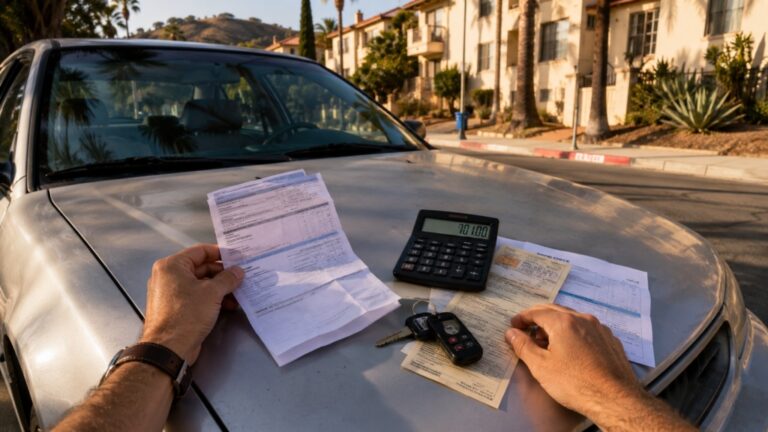
A Los Angeles mechanic hands you a repair estimate for several thousand dollars. Your car is sitting outside the shop, you still need transportation, and now you must decide whether to authorize the work or cut your losses.
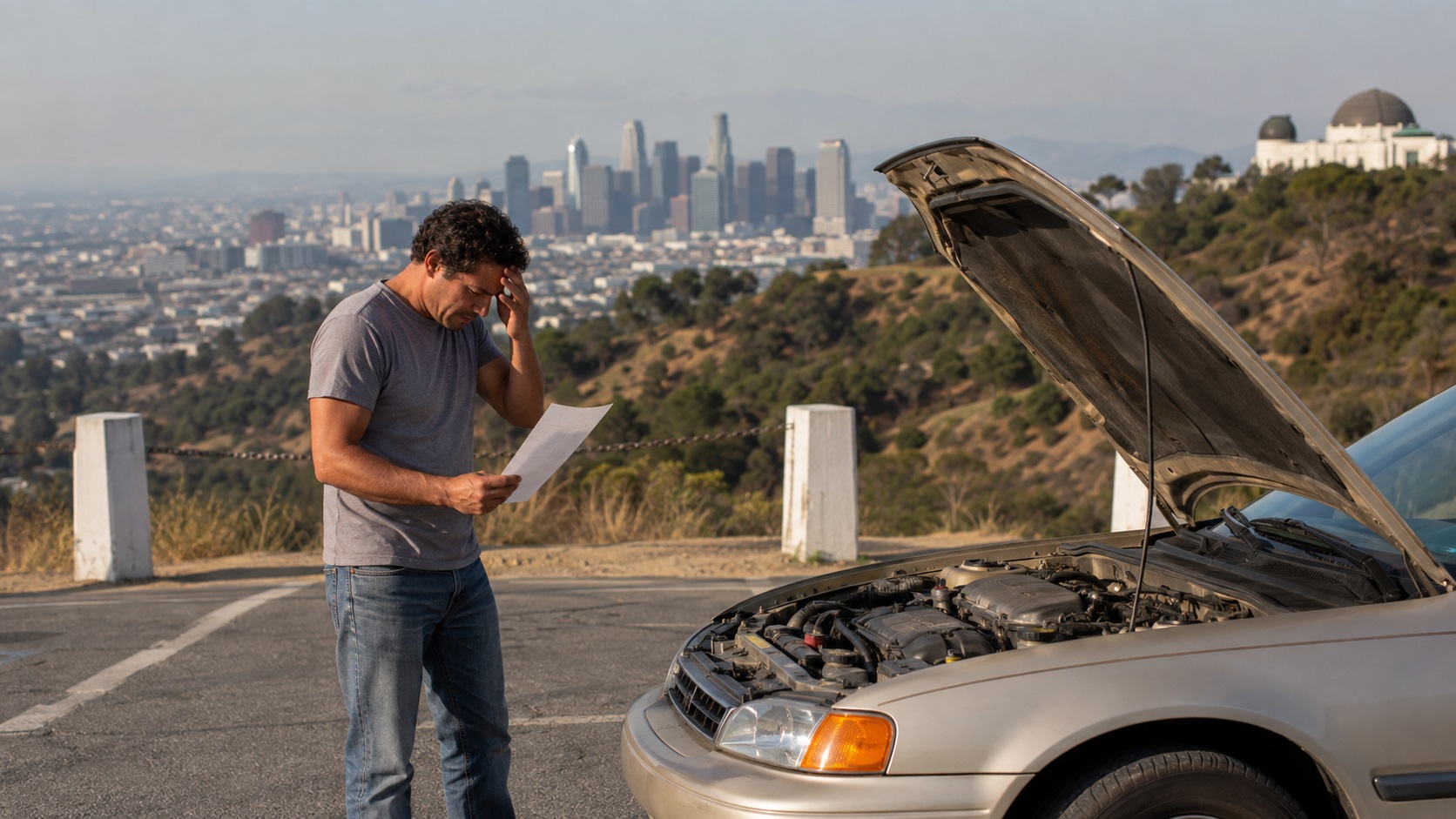
That question appeared repeatedly in several recent Reddit discussions.
- A 2001 Honda Civic needing more than $1,500 in repairs
- A 20-year-old Volvo worth about $2,000 but needing another $3,000
- A 2011 Subaru Outback facing $3,600 to $4,200 in repairs
- A 2003 Nissan 350Z that had been sitting for almost a year
Although their circumstances differ, they are all trying to work out whether the next repair will buy useful life or merely delay an inevitable sale.
Don’t Compare the Repair Bill With the Car’s Broken Value
One of the easiest mistakes is comparing a repair estimate with what the disabled car is worth today.
Suppose your broken car is only worth $1,000 as it sits, but after a $1,500 repair it could realistically be worth $4,000. Comparing $1,500 with $1,000 makes the repair look foolish. However, comparing it with the car’s $4,000 post-repair value produces a very different answer.
Use a pricing resource such as Kelley Blue Book or Edmunds as a starting point, but be honest about the vehicle’s actual condition. A car with faded paint, body damage, a worn interior, and other unresolved problems should not be valued like the cleanest example in Los Angeles.
A useful rule of thumb is that once a repair approaches or exceeds 50% of the vehicle’s realistic post-repair value, it deserves much closer scrutiny. It is a warning line, though, not an automatic verdict.
The Volvo from Reddit presents a fairly clear case. Spending $3,000 to repair a car that may only be worth $2,000 afterward is difficult to justify, especially when it also has engine, electrical, suspension, rust, and windshield problems.
The Civic is different. If $1,500 in work produces a dependable car worth around $4,000, repairing it may still make sense.
Make Sure the Estimate Is Reasonable First
You cannot apply any percentage rule until you know the repair estimate itself is fair.
For an expensive repair, ask for an itemized estimate showing the parts, labor, and additional charges. Then ask the mechanic to separate the work into three categories:
- Repairs needed immediately for safety or drivability
- Maintenance that should be completed soon
- Work that can reasonably wait
Sometimes several recommendations are bundled together, making an older car appear uneconomical to keep. Once the nonurgent items are separated, the decision may look completely different.
A second opinion is especially valuable when the diagnosis is uncertain, the repair involves the engine or transmission, or the shop proposes replacing several components to see whether that solves the problem.
Ask What One More Year Will Cost
A large repair bill can be frightening, but replacing the vehicle may cost considerably more.
Suppose the Subaru owner spends $3,600 and receives another dependable year of driving. Divided over 12 months, that repair costs $300 per month. Finding an equally dependable replacement in Southern California for an equivalent total monthly cost may be difficult.
Therefore, compare these two 12-month totals:
| KEEPING THE CURRENT CAR | REPLACING THE CAR |
|---|---|
| Repair bill Expected maintenance Towing Transportation during repairs |
Down payment and 12 months of payments Tax and DMV costs Insurance increase Inspection and immediate maintenance |
A replacement vehicle’s advertised price is not its complete cost. California vehicle purchases can involve use or sales tax based on the registration address, along with applicable transfer and registration expenses. The state provides an address-based tax-rate lookup, which is more reliable than assuming one rate applies throughout Los Angeles County.
A used replacement should also receive a pre-purchase inspection. Even then, you are exchanging a car whose history you know for one whose hidden problems have not yet appeared.
Don’t Let Yesterday’s Spending Make Today’s Decision
Owners commonly think, “I have already spent $3,000 on this car, so I cannot give up now.”
That is the sunk cost fallacy. Money already spent cannot be recovered, so it should not justify another repair by itself.
However, the repair history still matters because it helps predict the future. Replacing one major component and later encountering a small isolated problem is different from fixing the radiator, fuel pump, wiring, cooling system, and head gasket within a short period. The second pattern is the avalanche factor. You fix one problem, and another appears behind it.
If the honest answer is no, continuing to repair it deserves reconsideration.
Age and Mileage Don’t Decide the Case Alone
A well-maintained 200,000-mile Toyota may be a better repair candidate than a neglected 100,000-mile vehicle.
Service history, model reliability, previous overheating, rust, and the type of driving all matter. Los Angeles stop-and-go traffic can place considerable strain on cooling, braking, and suspension systems even when the odometer does not look unusually high.
Include the Cost of Waiting for the Repair
The mechanic’s invoice is not necessarily the complete repair cost.
If the car remains in the shop for three weeks, you may also face rental charges, rideshare expenses, additional towing, longer public-transit journeys, or lost income. That can be particularly serious for someone who uses the vehicle for delivery or rideshare work.
Before authorizing the work, ask how long it should take and whether parts availability could delay completion.
Safety Comes Before the Calculation
Some conditions should stop the financial debate temporarily.
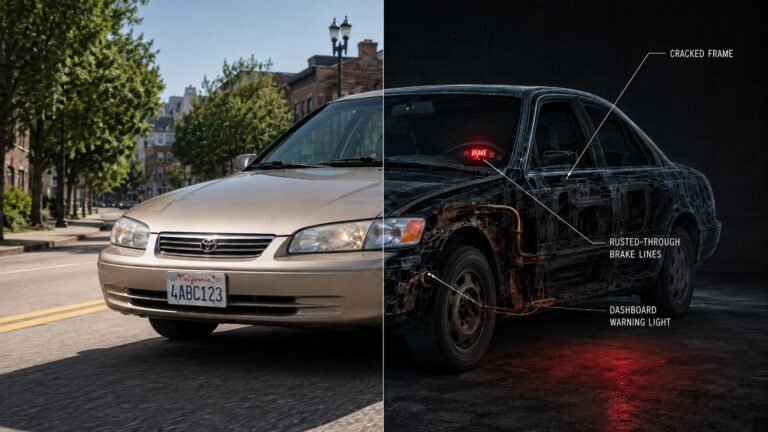
A sinking brake pedal, severely damaged tires, unpredictable steering, smoke from the dashboard, major structural damage, or serious overheating can make a car unsafe. In those circumstances, do not continue driving merely because you have not decided whether to repair or sell.
An unsafe vehicle should not be offered for an ordinary test drive either. Its condition should be disclosed honestly, and it should be transported appropriately if it cannot safely be driven.
A Failed Smog Test Can Change Everything
California emissions problems introduce diagnostic costs, compliant replacement parts, retesting, registration deadlines, and the possibility that one repair will not resolve the failure.
Before spending heavily, eligible owners should check the Bureau of Automotive Repair’s Consumer Assistance Program. It offers qualifying consumers emissions-repair assistance and vehicle-retirement options, subject to current program requirements and available funding.
A California seller generally must provide a valid smog certification when selling a vehicle privately, although exemptions apply in particular situations. Owners should confirm the rules for their vehicle and transaction through the California DMV’s smog guidance.
Registration also deserves attention while a car is sitting. Filing Planned Nonoperation after registration expires can still result in penalties, and a vehicle on PNO cannot be operated or parked where it may receive a citation without registration consequences. Check the current requirements on the DMV’s Planned Nonoperation page.
The Exception Is a Car You Genuinely Love
If the 350Z is essential daily transportation, spending thousands on an uncertain restoration may make little sense. If it is a weekend project that the owner genuinely enjoys, the market value does not have to control the decision.
An enthusiast car, heirloom, or hobby can justify spending beyond its resale value when the owner understands that the expense is personal rather than an investment.
The problem begins when an unreliable project must also get someone to work every day, or when emotional attachment leads to high-interest debt.
Four Numbers Can Usually Settle the Decision
Before approving a major repair, find these four numbers:
- What will the necessary repair actually cost?
- How long will the car be unavailable?
- What will it realistically be worth after repair?
- What could you receive by selling it as-is today?
Get an itemized estimate, obtain a second opinion, estimate the vehicle’s honest post-repair value, calculate the next 12 months of ownership, and request an as-is offer.
If the repair is reasonably priced, resolves an isolated problem, and should return an otherwise dependable vehicle to the road, fixing it may be the smarter choice.
However, if the repair approaches the car’s post-repair value, the diagnosis remains uncertain, other failures are accumulating, and the as-is value gives you a realistic path toward replacement, selling may be the better decision.
Sources and Reddit Inspiration
- Reddit: Options other than junkyards to get rid of my car
- Reddit: When should one stop repairing their car?
- Reddit: What should I do with this car?
- Reddit: Car shop for my 350Z
- California DMV: Smog inspections
- California DMV: Planned Nonoperation
- California BAR: Consumer Assistance Program
- California CDTFA: Sales and use tax rates