Who Can Pick Up My Car for Cash?
Find out who can pick up your car for cash, how free towing works, what paperwork you need, and how to avoid pickup-day scams.
If you’re searching “who can pick up my car for cash,” chances are you’re not casually thinking about selling a vehicle. There’s probably a car sitting somewhere that has become a problem, and you want two things: someone to take it away and money in your hand.
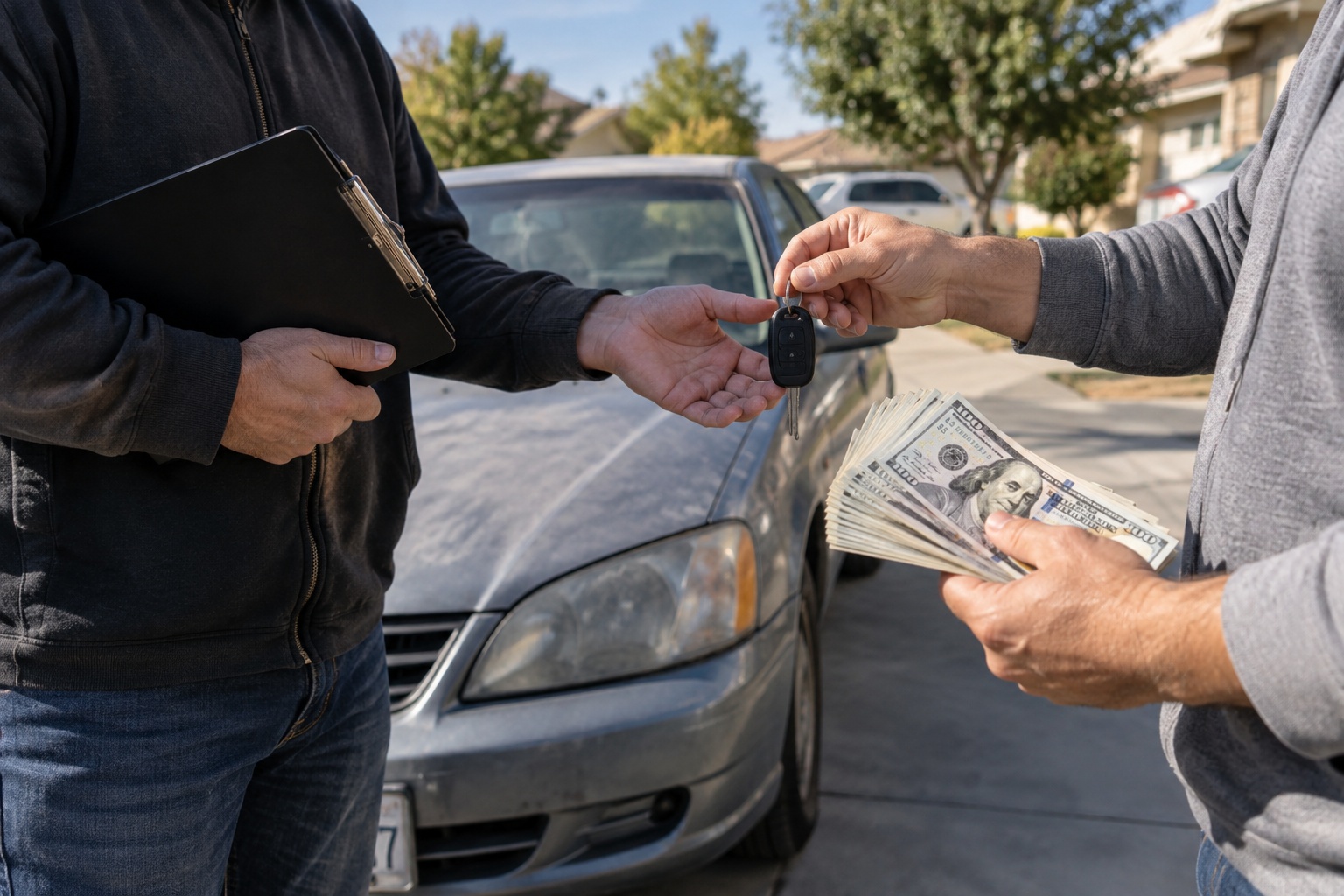
Maybe the engine died. Maybe the car was wrecked. Maybe the registration expired months ago and you don’t want to put another dollar into it. It could be sitting at a mechanic shop while storage charges pile up, or maybe the car runs perfectly well and you simply don’t want to spend the next two weeks dealing with strangers from Marketplace.
In California, several types of buyers may be able to buy and pick up a vehicle. But who you choose matters because a tow truck taking the car away does not, by itself, finish the legal transfer.
Here’s how to choose the right buyer, get paid properly, and make sure the vehicle really leaves your responsibility when it leaves your driveway.
Who Can Pick Up Your Car and Pay You for It?
Your main options are licensed car buyers, licensed vehicle dismantlers, online instant-offer companies, traditional dealerships, and private buyers.
They don’t all work equally well for every vehicle.
Local cash-for-cars buyers
A licensed local car buyer is usually one of the easiest options when speed matters.
These buyers tend to work well for:
- Older cars
- High-mileage vehicles
- Damaged cars
- Cars needing expensive repairs
- Non-running vehicles
- Cars you simply want removed quickly
Instead of making you advertise the vehicle, meet multiple buyers, and arrange transportation yourself, the buyer can evaluate the vehicle and arrange pickup.
If your car doesn’t start or drive, explain that before accepting an offer. A buyer needs to know whether it rolls, steers, has wheels, is blocked, or requires special equipment. You can learn more about the pickup issues involved with a non-running car.
Licensed dismantlers and auto recyclers
A dismantler becomes particularly relevant when the vehicle has reached the end of its useful life.
Think:
- Severe collision damage
- Major mechanical failure
- Missing major components
- Salvage or junk vehicles
- Cars whose repair cost makes little financial sense
- Certain complicated ownership or junking situations
California licensed dismantlers have specific DMV reporting and recordkeeping obligations when acquiring vehicles for dismantling.
That makes them fundamentally different from somebody who simply owns a tow truck and offers cash for cars.
If the vehicle is truly at the end of the road, a company buying junk cars, trucks, SUVs, and minivans may make more sense than trying to turn it back into a normal private-party car.
Instant-offer companies
Online buyers can be convenient if you have reasonably straightforward paperwork and want to compare an offer without advertising the vehicle yourself.
Some platforms focus heavily on running used cars. Others also accept damaged or non-running vehicles and arrange transportation through local towing or buying partners.
The important point is to find out who is actually purchasing your vehicle, not merely what website generated the quote.
Traditional dealerships
A dealership can make sense when the car:
- Still runs well
- Is relatively new
- Has meaningful resale value
- Has a loan that needs to be paid off
- Could be resold rather than dismantled
The disadvantage is convenience. Some dealerships require you to bring the vehicle in rather than picking it up from your location.
If your car doesn’t run, that can defeat the entire purpose of searching for someone who will pick it up.
Private buyers
A private buyer may pay more, particularly for a running car, enthusiast vehicle, desirable older model, or something easily repaired.
But you’re trading convenience for potential price.
You’ll normally have to deal with advertising, messages, appointments, negotiations, paperwork, and possibly helping the buyer arrange a tow.
And California transfer requirements still apply.
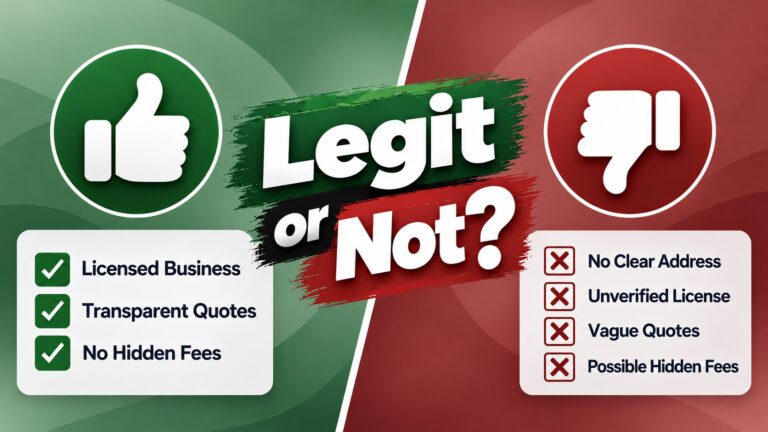
Don’t Confuse the Tow-Truck Driver With the Buyer
This is one of the most important distinctions in the entire transaction.
The person operating the tow truck may simply be transporting the car on behalf of somebody else.
Before the vehicle moves, know:
- Who is actually buying it
- The buyer’s full business or personal information
- What amount you’re being paid
- Whether the driver is authorized to complete the transaction
- What transfer paperwork you’re signing
A professional-looking truck doesn’t automatically tell you who legally acquired the vehicle.
That’s why sellers should be cautious about anonymous cash buyers who want the title signed quickly, want the buyer information left blank, or can’t clearly tell you what licensed business is acquiring the car.
Should Pickup and Towing Be Free?
If a cash-for-cars company advertises free pickup, the towing charge should not mysteriously appear after the truck arrives.
Before agreeing to the sale, ask for the net amount you will actually receive.
Confirm:
- The agreed vehicle price
- Whether towing is included
- Whether there are paperwork charges
- Whether the offer depends on another inspection
- Whether known access problems have already been considered
- Whether any lien, storage, or other legitimate payoff will reduce your payout
A $1,200 verbal quote isn’t necessarily better than a $1,000 firm offer if $300 worth of unexpected charges suddenly appear on pickup day.
Get the important terms in writing by text, email, or another record you can save.
Tell the Buyer Exactly Where the Car Is
Pickup isn’t always as simple as backing a flatbed into a driveway.
Tell the buyer if the vehicle is:
- Inside an underground garage
- Behind a locked gate
- In a narrow alley
- Missing wheels
- Unable to roll
- Parked in a crowded apartment complex
- At a repair facility
- Inside a tow or storage yard
- Blocked by another vehicle
A car that doesn’t roll may need equipment different from a car that simply has a dead battery.
Being accurate upfront also makes it harder for somebody to arrive and suddenly claim the vehicle’s location justifies a lower price.
What If the Driver Tries to Lower the Price?
This is where sellers should be willing to stop the transaction.
If you accurately described the vehicle and its location and the driver suddenly invents towing, loading, or administrative fees, ask for an explanation before allowing the car to be moved.
Don’t let the vehicle get loaded simply because the driver is already there.
The clean sequence is:
- Let the driver verify that the vehicle matches your description.
- Confirm the agreed purchase amount.
- Complete payment and transfer paperwork in the proper sequence.
- Hand over the keys.
- Allow the vehicle to be loaded.
If the terms materially change, you can decline the transaction rather than surrendering the car first and arguing afterward.
Can Someone Pick Up a Car Without a Title?
Sometimes, but “no title” does not describe one legal situation.
You own the car but lost the title
This is the most straightforward version.
California DMV uses the Application for Replacement or Transfer of Title, REG 227, in qualifying situations where the California title has been lost, stolen, damaged, or is otherwise unavailable.
If that’s your situation, tell the buyer before pickup so the required ownership documents can be reviewed.
Cash Cash Cars also has a dedicated guide for situations involving a car without a title.
The car isn’t in your name
That’s different.
A missing piece of paper doesn’t erase the registered owner’s interest in the vehicle. California DMV may require documents completing the chain of ownership, including signatures or bills of sale from the person shown as owner.
Don’t assume that REG 227 magically fixes every ownership problem.
The registered owner has died
California has procedures for qualifying transfers involving a deceased owner, including the Affidavit for Transfer Without Probate, REG 5, when its requirements are met.
The exact documents depend on the estate and ownership situation.
Nobody can establish ownership
If the car was abandoned on your property or you otherwise cannot establish the legal chain of ownership, finding someone willing to hand you cash doesn’t make the sale legitimate.
Lien-sale, abandoned-vehicle, estate, or other legal procedures may need to happen first.
A reputable buyer should be more concerned about proving ownership than getting the vehicle onto a truck as quickly as possible.
Can an Expired or Non-Running Car Still Be Picked Up?
Yes. A vehicle does not have to be capable of being driven away in order to be transferred.
The important distinction is between transferring ownership and operating the vehicle on a public road.
If registration has expired, don’t assume that means you must renew it just to sell the car. Instead, disclose the registration status to the buyer so any DMV fees or transfer issues can be reviewed.
A non-running or unregistered vehicle can be transported rather than driven.
That is one reason pickup service becomes valuable. You don’t have to repair a dead vehicle merely to get it to the buyer.
What About California Smog Requirements?
This is where private sales can become more complicated.
California DMV generally requires a seller in a private-party sale to provide the buyer with a valid smog certification when one is required. There are exemptions depending on the vehicle and transfer.
Writing “as-is” on a bill of sale should not be treated as a substitute for checking California’s smog-transfer requirements.
Selling a vehicle into licensed dealer inventory or to a licensed dismantler can involve a different process. A dismantler acquiring a vehicle to dismantle it, for example, follows dismantler acquisition procedures rather than preparing the car for normal consumer registration.
So if your vehicle:
- Can’t run
- Has a check-engine light
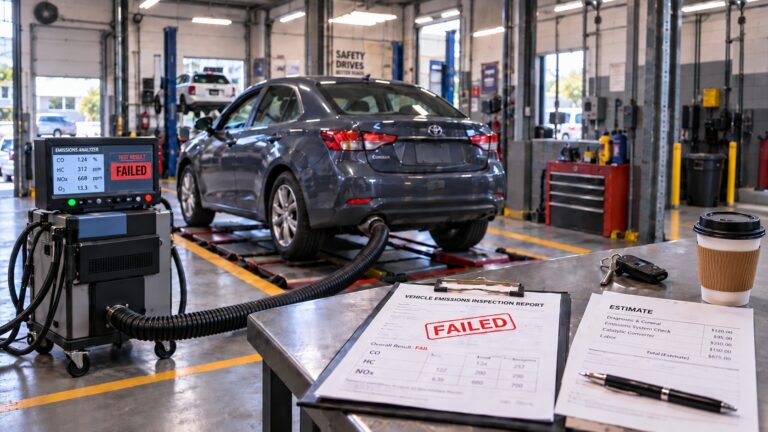
- Recently failed smog
- Has expensive emissions problems
- Is headed for dismantling anyway
it may make more sense to talk to an appropriately licensed commercial buyer instead of assuming a private-party sale will be simpler.
What If the Car Is at a Mechanic Shop or Tow Yard?
You may own the car, but that doesn’t necessarily mean another tow truck can simply take it.
California law allows certain repair, towing, and storage businesses to acquire liens in qualifying circumstances. A facility may therefore have the right to retain possession until legitimate charges are resolved.
First, find out exactly what is owed.
Ask for an itemized amount covering things such as:
- Authorized repair charges
- Towing
- Permitted storage charges
- Other legally allowable charges
If the buyer’s offer is greater than what you owe, one possible transaction structure is for the required amount to be paid to the facility and the remaining proceeds to go to you.
For example:
Vehicle offer: $1,500
Amount required for release: $600
Remaining seller proceeds: $900
But that arrangement should be agreed to by everyone involved before pickup.
If the yard’s charges exceed the vehicle’s value, selling the vehicle may no longer solve the entire financial problem.
Also move quickly. Storage charges can continue accumulating while everyone debates what the car is worth.
California’s Bureau of Automotive Repair specifically regulates and provides consumer guidance concerning automotive repair dealers and storage-fee disputes. Certain administrative, security, loading, pull-out, and gate charges are presumptively unreasonable under specified circumstances, so don’t automatically assume every fee presented by a facility is valid.
Can I Sell a Financed Car for Cash Pickup?
Potentially, but the lien must be dealt with.
If a bank or finance company still holds a legal interest in the car, don’t treat it like a clean-title sale.
Start by getting the lender’s current payoff amount.
If the car is worth more than the payoff
Suppose:
Cash offer: $8,000
Loan payoff: $5,000
A properly structured transaction can pay the lender’s required amount and leave you with the remaining equity.
If you owe more than the vehicle is worth
Suppose:
Cash offer: $4,000
Loan payoff: $6,000
There’s a $2,000 shortage.
That negative equity generally has to be resolved before the lender will release its interest. The buyer cannot make the lien disappear simply by taking possession of the car.
If your vehicle is financed, review the process for selling a car with a lien before scheduling pickup.
Be extremely cautious if someone says:
“Give me the car and I’ll keep making your payments.”
Until the lender’s interest is properly resolved, you can remain exposed to the loan obligation regardless of who physically possesses the vehicle.
Cash Doesn’t Necessarily Mean a Stack of Bills
When people search “who can pick up my car for cash,” what they usually mean is immediate, dependable payment, not necessarily paper currency.
A legitimate transaction may use:
- Cash
- A company-issued check
- Another verified payment method agreed to beforehand
- Direct lender payoff plus payment of your remaining equity
What matters is knowing exactly how you’re getting paid before the truck arrives.
Be particularly careful with personal checks from unknown individuals.
Before You Let the Car Leave
Here’s the practical California pickup checklist.
Before the driver arrives
Remove:
- Personal belongings
- Garage-door opener
- Toll transponder if it belongs to you
- Insurance paperwork
- Personal documents
- Anything stored in the trunk or console
If the vehicle has a connected infotainment system, delete personal data and paired devices where practical.
California plates generally remain with the vehicle, so don’t automatically remove ordinary plates. Personalized and certain special-interest plates have separate DMV retention procedures.
Verify the buyer
Confirm who is purchasing the vehicle and make sure the driver matches the scheduled pickup.
Keep:
- Buyer/company name
- Address
- Buyer information needed for the transfer
- Pickup documentation
- Written offer
- Payment receipt
Check the money
Make sure the payment matches the amount agreed upon after any legitimate, previously disclosed deductions.
Don’t allow the vehicle to be loaded first and negotiate the payout afterward.
Complete the transfer paperwork carefully
Never intentionally leave buyer information blank for somebody to fill in later.
The exact forms depend on the transaction, but a California transfer can involve:
- Certificate of Title
- REG 227 when applicable
- Bill of Sale
- Odometer disclosure when required
- Lien-release documentation
- Other DMV forms depending on the ownership situation
California’s odometer rules have changed over time, so use the current DMV requirement applicable to your vehicle rather than relying on an old “10-year” rule you may find elsewhere.
Keep evidence
Take or retain copies or photographs of useful transaction records such as:
- Completed sale paperwork
- Bill of sale
- Buyer information
- Payment receipt
- Written offer
- Pickup confirmation
- Vehicle being removed
You don’t need to turn pickup day into a crime-scene investigation. You just want enough documentation to show who took the vehicle, when they took it, and what transaction occurred.
File the California Notice of Transfer and Release of Liability
This is the step you should not forget.
California DMV requires the registered owner or person in physical possession who sells or transfers the vehicle to submit the Notice of Transfer and Release of Liability, REG 138, within five calendar days of the transfer.
You can submit the NRL online.
Don’t assume the buyer will do this for you simply because they said they’ll “handle DMV.”
The NRL tells DMV that you transferred the vehicle and provides the buyer and transfer information. Keep your submission confirmation with your sale records.
That’s particularly important if a parking notice, toll issue, registration communication, or other question appears later.
So, Who Should Pick Up Your Car for Cash?
The right answer depends on what’s sitting in front of you.
If the car runs well and is relatively new: compare dealership, instant-offer, and private-party values.
If it runs but it’s old or high-mileage: compare a private sale with a licensed local cash buyer.
If it doesn’t run: look for a buyer that handles non-running vehicles and pickup.
If it’s badly wrecked or truly junk: a licensed dismantler or buyer working with an appropriate dismantling channel may make the most sense.
If there’s a title, lien, tow-yard, registration, or ownership problem: don’t schedule the truck first and figure out the paperwork afterward. Explain the complication before accepting the offer.
And above everything else, remember this:
The car isn’t properly out of your life just because you watched a tow truck disappear down the street.
Know who bought it. Know what you’re being paid. Complete the ownership documents accurately. Keep proof of the transaction. Then file your California Notice of Transfer and Release of Liability within five calendar days.
That’s how you turn “who can pick up my car for cash?” from an urgent problem into a clean sale.