Should You Sell Your Old EV or Hybrid with a Dead Battery Pack, or Keep It?
A dead EV or hybrid battery can cost thousands to replace. Learn how to compare repair costs, vehicle value, towing, and selling the car as-is.
An older Nissan Leaf, Chevy Volt, Toyota Prius, or another early-generation electric or hybrid vehicle runs well for years. Then, a repair changes the entire equation. For example, your 10- or 12-year-old EV has been dependable enough. Then one morning it refuses to move, warning lights appear across the dashboard, and the repair shop eventually tells you something nobody wants to hear: the high-voltage battery pack needs replacement.
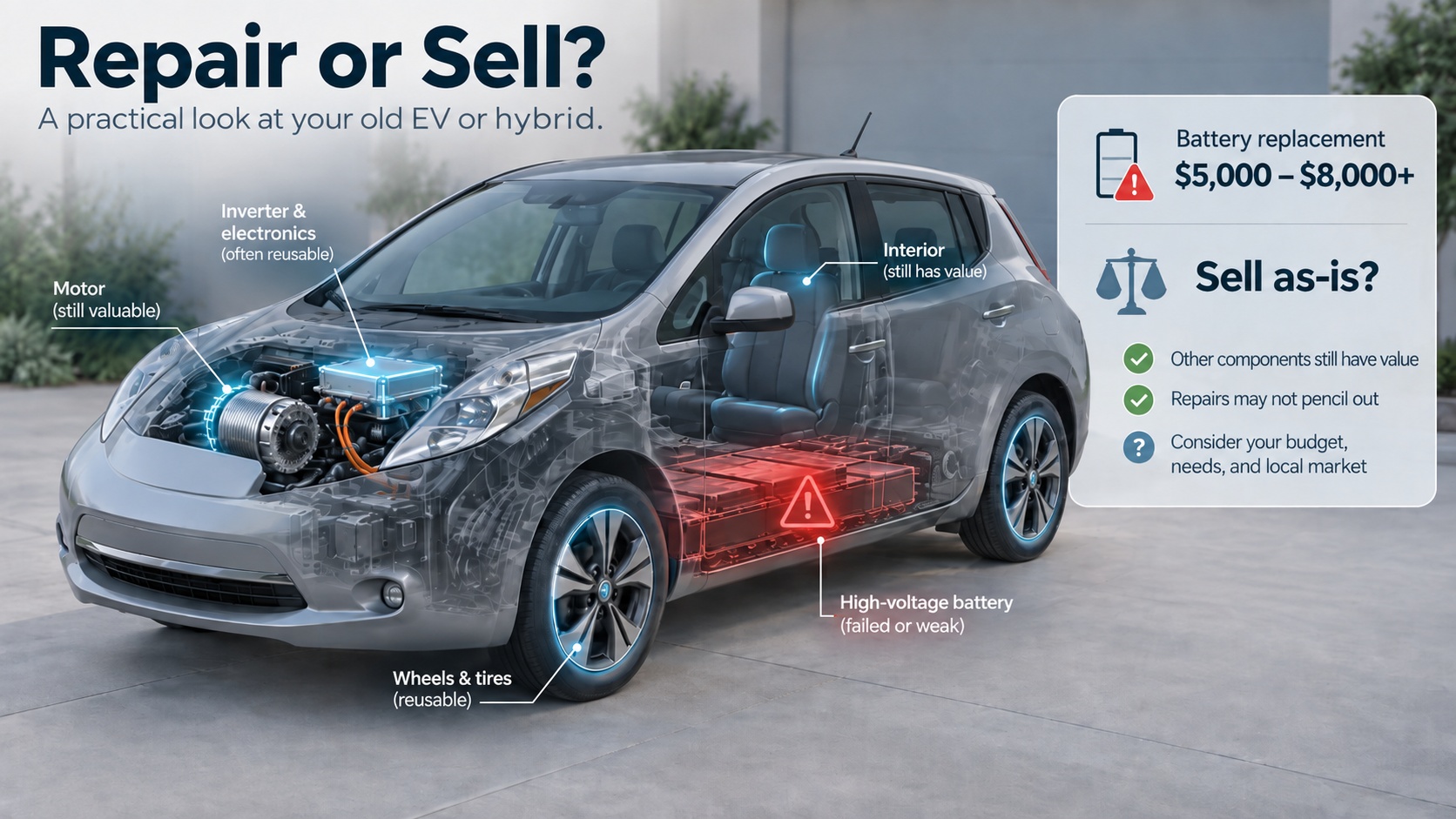
At this point, the problem is no longer simply that the car won’t run. The real issue is that a battery job may cost $5,000 to $8,000, and some original-equipment battery replacements easily run well into five figures after labor, diagnostics, programming, cooling-system service, taxes, and other work. This is when you have to do the math.
At first glance, if the car would be worth about the same amount after the repair, spending thousands of dollars on another battery doesn’t make much financial sense. But that doesn’t mean that the vehicle has suddenly become completely worthless. The body is still there. The electric motor may still be usable. The inverter, onboard charger, electronics, wheels, interior, cameras, sensors, catalytic converter (on some hybrids), and even recoverable battery materials may still hold their value.
So ideally, instead of checking the cost of a new battery, you should start by troubleshooting what failed, the car’s value before repair, and what it will realistically be worth after you spend money on repairs. Only this calculation will tell you whether the expensive battery is the problem or if something else is.
While you’ll need a battery replacement, you still need to know which battery will change. Both electric and hybrid vehicles use a conventional 12-volt auxiliary battery for computers, relays, dashboard systems, and the startup sequence.
So, for example, your Leaf appears completely dead. The dash barely responds. The car refuses to enter READY mode. Several warnings flash when you try to start it. It is natural to assume the high-voltage battery has finally failed. But sometimes the much cheaper 12-volt battery is the actual problem. That is why testing the auxiliary battery is a sensible first step before anyone starts discussing a $7,000 traction battery replacement.
If the vehicle powers on but will not drive, then the next step is usually proper EV diagnostics. An EV-qualified technician or compatible scan tool may find weak or unbalanced modules, a high-voltage isolation fault, battery-management problems, cooling faults, charging-system issues, or even an inverter or control-module failure rather than complete battery-pack death. And this distinction matters financially.
For example, there is a big difference between when the entire traction battery is dead and when the battery pack is functioning, but the inverter has failed. Those two diagnoses can lead to completely different repair costs and completely different offers from buyers. So before approving an expensive repair or calling anyone for a quote, get the diagnosis in writing if possible, as it will give you something concrete to compare instead of pricing the vehicle around an assumption.
If the battery problem has already left the car immobilized, Cash Cash Cars’ staff may guide you to selling a non-running car and explain the broader pickup and paperwork issues involved.
Whether Your Car Insurance Provider Still Covers It?
Once the diagnosis points toward the high-voltage battery, your next instinct should be to start comparing the replacement prices. Here, your first check would be to see whether your insurance still covers the battery. For example, your EV may be nine years old and feel far beyond any normal warranty, but that does not automatically mean your every battery-related claim will be denied.
Battery coverage can depend on the model year, mileage, battery type, emissions certification, manufacturer terms, original state of sale, and the exact failure involved. Many battery-electric vehicles carry battery warranties of about eight years or 100,000 miles, but their actual coverage varies. Some cover defects and failures but don’t guarantee against every reduction in driving range.
Hybrids and plug-in hybrids can be even more complicated because California emissions certification may affect the warranty on certain components. Some qualifying vehicles have longer emissions-related protection, extended to 10 years or 150,000 miles for specified parts. However, this also doesn’t mean every EV in California automatically has a 10-year or 150,000-mile traction-battery warranty, which is why bad assumptions can cost you thousands.
So before approving a battery replacement, run the VIN through the manufacturer or authorized dealer and ask specifically about remaining high-voltage battery coverage, capacity-loss provisions, emissions warranty, recalls, service campaigns, and manufacturer technical programs. A recall or campaign can sometimes create a remedy even after the normal warranty ends, and the useful part is getting the answer in writing. Once the manufacturer confirms the battery isn’t covered, you can stop wondering and start making a real financial decision.
This Is Where the Battery Price Stops Being the Only Number That Matters
Suppose the warranty is gone. Now you will need to call around, and one shop says a replacement pack is $5,500. Another says $7,800. A dealership gives you a number that makes you wonder whether they are replacing the entire car. The mistake at this stage is comparing only the advertised battery price with the value of a running vehicle. You will need to get the complete installed cost.
For example, the battery itself may be $6,000, but then you add diagnostics, labor, taxes, coolant or thermal-management work, software programming, towing, and any other repairs already waiting in line. This will make the real repair cost $7,500 or $8,500.
And even then, you have to decide what kind of battery you are actually buying. A new original-equipment battery generally gives you the strongest warranty, known compatibility, and the best chance of restoring dependable range. It is also normally the most expensive choice.
On the cheaper side, a remanufactured battery may cost less, but you need to know what was actually replaced, how the pack was tested and balanced, what warranty it comes with, and whether labor is covered if the pack fails again. After all, a refurbished or reconditioned pack may replace only weak modules. It can make sense for an inexpensive old hybrid, but the rest of the battery has usually lived through the same years and mileage, and fixing the weakest section today doesn’t guarantee another section will not fail next year. Another option is a used salvage battery, which may be much cheaper, but you are still blind to the donor vehicle’s mileage, battery health, storage history, remaining capacity, or accident history.
So, the cheapest battery on paper can become expensive if you pay installation labor twice. That’s why you should never reduce the repair decision to finding a battery online for $3,000. The real question is what it will cost to put a reliable battery in this vehicle and keep it on the road.
Now Compare The Repair Costs With EV You Will Have Afterward
Imagine you have two cars. The first is a clean, low-mileage hybrid with a good body, good interior, strong suspension, no accident history, and nothing else obviously wrong. The second has 180,000 miles, worn suspension, body damage, tired air conditioning, warning lights, and an onboard charger that has already been acting up. Now put the same $8,000 battery into both cars.
Technically, you are making the same battery repair, but financially you are not making the same decision. No universal rule says a battery must be replaced or rejected at a particular percentage of vehicle value. But once the complete repair approaches roughly half or more of what the vehicle would realistically be worth after repair, the decision deserves much more scrutiny.
Some financial guidelines put that danger area somewhere around 50 to 70 percent, but that is not a law. It is just a warning signal that you may be putting too much money into a depreciating vehicle. That’s why you should include the rest of the car in the decision and look for things like mileage, accident history, brakes, tires, suspension, air conditioning, charging system, inverter, onboard charger, interior condition, warning lights, body condition, and any other repairs likely to come up next.
In other words, do not spend $8,000 fixing the battery and pretend the rest of the vehicle is starting over at zero miles. When you are repairing a low-mileage car you intend to keep for another five years, this can make complete sense. However, putting the same battery into a worn-out vehicle may simply replace one expensive problem with three or more smaller ones. And once the numbers stop making sense, the question changes from “which battery should I buy?” to “what is this car worth as it sits?” And when you consult the dealership, the situation may feel worse. Let’s see why.
In this regard, you take the car to a dealership or ask what they would give you as a trade. The number comes back painfully low. Sometimes almost nothing, and you start to feel the vehicle really is worthless. However, what the dealership tells you is how they decide a vehicle is worth, and your vehicle no longer fits the way dealerships normally make money on it. A conventional dealer wants a car they can inspect, drive, finance, retail, or move through a familiar wholesale channel. And your dead EV or hybrid creates uncertainty. For example, the dealer may subtract the expected battery cost, labor, towing, and auction fees, then deduct another large amount for the risk that the diagnosis turns out worse than expected. By the time you deduct all that from wholesale value, the remaining trade number may be tiny.
A private buyer might pay more, particularly if they repair EVs themselves. But that person will also subtract the battery cost and their own risk. But engaging such a buyer means spending weeks in answering messages from people asking whether the car drives, how bad the battery is, whether they can bring a scanner, whether you will take half your asking price, and whether you can somehow deliver the non-running vehicle to them.
Large online buyers can make the process easier, but automated systems often place anything marked “does not run” or “battery failure” into broad wholesale or salvage categories, due to which you are going to miss the value of what is actually in the car, and this leads to an important conclusion that a dead EV is not the same thing as an empty shell.
The Battery Can Be Dead While the Rest of the Car Still Has Value
A cash-for-car company’s specialist looks at the same vehicle differently. While a dealership may see things like “Old EV. Dead battery. Expensive repair,” a buyer familiar with damaged EVs will see motor, inverter, converter, charger, control modules, cameras, sensors, wheels, glass, interior parts, body panels, suspension pieces, and a complete battery pack with recoverable materials. The same difference in perspective can change the offer.
For example, electric motors contain copper windings and specialized magnetic materials. Inverters and converters are expensive power-electronics assemblies. Onboard chargers, displays, computers, sensors, cameras, wheels, and body components may remain perfectly usable even though the car will not move. A hybrid may still have a valuable catalytic converter if it is present and intact. And even a failed battery pack contains materials that may be recoverable depending on its chemistry, including lithium, nickel, cobalt, manganese, iron, phosphate, graphite, copper, aluminum, or nickel-metal-hydride materials in older hybrids.
However, this does not mean you should calculate the commodity price of every ounce of metal and expect a buyer to hand you that amount. Removal, transport, testing, storage, recycling, processing, damaged cells, and unusable material all have costs. It explains why a car with a failed battery can still be worth something meaningful.
Cash Cash Cars buys old and unwanted vehicles across Los Angeles, including dead EVs and hybrids, so the quote can account for the vehicle’s remaining condition and component value rather than treating the dead battery as if it erased the entire car.
“Dead Battery” and “Damaged Battery” Are Two Very Different Problems
Up to this point, we have been talking about a battery that has failed electrically or degraded so badly that the vehicle can no longer operate normally. Now change the situation.
The car was in a collision. The battery enclosure was hit. Or the vehicle was flooded. Or there was a previous battery fire. Now you are no longer dealing only with value. You are dealing with safety because a battery can be discharged, degraded, or electronically disabled without being physically compromised, but a battery that has been crushed, punctured, overheated, flooded, or burned is a completely different situation.
Even when the car appears dead, the high-voltage system can still retain dangerous stored energy. So when you are trading your car for cash, this is not the time to open the battery casing, pull modules, cut orange high-voltage cables, or attempt a backyard repair. High-voltage direct current can definitely cause fatal shock. A physically damaged lithium-ion battery can also enter thermal runaway, where heat spreads from one cell to another and can lead to intense fire, hazardous gases, and even reignition after the battery appears stable.
Although the vehicle inspectors at Cash Cash Cars are well trained, the towing staff still checks safety while towing, and the most important thing they ask vehicle inspectors before towing EVs is whether the battery has failed or is physically hazardous. Because the answer changes what happens next. Sometimes You Need a Tow Truck. Sometimes You Need 911.
For example, when the vehicle simply will not run, and there is no smoke, no chemical smell, no leaking, and no obvious battery damage, etc. In this situation, you can shut the car down, place it in Park, set the parking brake, keep the key away, and arrange appropriate EV-capable towing.
However, if you hear hissing, see smoke under the vehicle, feel the pack area is unusually hot, smell a strong chemical odor, or the car was recently flooded or hit hard near the battery, that is not a normal pickup situation. In that situation, Cash Cash Cars advises calling 911, moving away from the vehicle, keeping others clear, avoiding fumes, and telling dispatch the vehicle is an EV or hybrid.
Let’s not forget that a regular tow company should not be your first call during an active battery fire or hazardous battery event. This distinction is important because people often use the phrase “dead battery” to describe both situations. Financially, both cars may not run, but operationally, they differ completely.
Once It Is Safe to Move, the Type of Tow Matters
Assuming the vehicle is stable, towing still needs some planning. A flatbed is generally the safest and most flexible choice for a non-running EV or hybrid, although the manufacturer’s towing instructions should take priority because drivetrains differ.
However, the dispatcher wants to hear more than “My EV is dead.” You need to describe whether the vehicle is battery-electric, hybrid, or plug-in hybrid, whether the battery has simply failed or was physically damaged, whether the car powers on, whether it shifts into Neutral, whether the steering and brakes work, whether the wheels are locked, whether the keys are available, and exactly where the vehicle is sitting.
For example, a dead Leaf on a wide suburban driveway is one pickup. The same Leaf with locked wheels on level B3 of a low-clearance parking garage is another. Similarly, gates, steep slopes, underground structures, missing keys, inaccessible wheels, and tight driveways can change the equipment needed. If the buyer discovers those facts only after the truck arrives, surprise extraction fees and price arguments will begin.
Cash Cash Cars has an advantage here because our service includes towing with qualifying vehicle purchases across our service areas. So, when requesting a quote, you will also need to describe the access situation and battery condition at the same time instead of treating towing as an afterthought.
Selling the Complete Vehicle Is Usually Easier Than Trying to Dispose of the Battery Yourself
Once people hear that failed batteries contain recoverable materials, another idea may flash across your mind about removing the battery and selling or recycling it separately. This approach usually makes things more complicated for most vehicle owners. After all, a loose traction battery is not ordinary scrap. Don’t put it in household trash, leave it beside a dumpster, or drop it at a regular metal recycler without confirming the facility is legally equipped to accept it. Once you remove the pack, chemistry, condition, packaging, storage, and transportation rules become much more important. Damaged or defective lithium batteries can face even stricter requirements.
A qualified automobile dismantler may be able to accept the complete vehicle with the battery installed, remove usable components, and route the pack into an appropriate reuse or recycling channel. But this is normally far simpler for the owner. You sell the vehicle, the qualified buyer handles the high-voltage component correctly, and you keep documentation showing where the car went.
Once the Physical Problem Is Under Control, the DMV Problem Still Remains
At this point, you may have confirmed the diagnosis, decided not to repair the car, found a buyer, and arranged the right tow. But the battery problem does not replace California ownership rules. The title still has to transfer correctly.
For example, if the California title lists two owners joined by AND, both generally need to sign. If it says OR, one owner can generally sign. If there is a recorded lien, the lien has to be released before the buyer receives clean ownership. If the paper title is missing, REG 227 may be available, depending on the situation. But an unresolved loan or electronic lien can still require the lender to act first. REG 262 may also be needed for odometer disclosure or reassignment when the title is missing or cannot accommodate the required information.
So even after spending most of the article on battery chemistry, warranty, and towing, the ownership rules still apply to every vehicle sale. A broken car still needs clean ownership paperwork. A dead battery does not make the DMV disappear. Battery-electric vehicles and hybrids also differ on smog, and this is another area where people sometimes group EVs and hybrids together too casually. A battery-electric vehicle does not require a California Smog Check because it has no tailpipe emissions, but a conventional hybrid or plug-in hybrid is different.
Depending on the transaction and applicable exemption, you may be required to provide a valid smog certificate in a private-party sale. This distinction matters if the hybrid’s battery has failed.
For example, you own an old Prius that needs a traction battery and also cannot pass smog. Selling it privately may mean solving both problems before the transfer. However, at this point, spending money on a battery only to discover that emissions repairs are also required can change the calculation again. A properly documented sale to a licensed dealer or dismantler may follow different rules. So before accepting an offer, establish who the buyer actually is.
Are they a private individual, or a licensed dealer, or a dismantler, or a recycler? This label matters because different transaction rules may apply.
The Highest Quote Is Not Automatically the Best Offer (Sounds Strange?)
Suppose one buyer says $3,800. Another says $3,400. At first glance, the first buyer wins. But then you read the terms and are shocked to learn that the $3,800 quote excludes towing, includes a battery-processing fee, doesn’t apply if the wheels are locked, or requires payment after the vehicle leaves, etc. On the other hand, the $3,400 buyer includes towing, confirms the battery condition in advance, and pays before taking the car. Now the smaller headline number may actually be the cleaner offer.
This is why every buyer should receive the same information regarding the year, make, model, mileage, VIN, battery diagnosis, warning lights, title status, lien status, accident history, missing components, keys, photos, and exact pickup location. You should also ask for the offer in writing, and the written terms should explain the payment amount, towing, possible access charges, conditions that can change the quote, any battery-handling fees, and when payment occurs.
A high verbal quote is easy to make, but the real offer is what remains after the truck is standing beside the car. So be cautious when a buyer suddenly introduces a hazardous-battery fee, towing fee, extraction charge, or dramatic price reduction that was never mentioned during the quote. And don’t release the signed title and vehicle just because someone shows you a screenshot saying a payment is “pending.” Payment should be verified before ownership and possession leave your control.
Close the DMV Side of the Transaction
Once the car is gone, the process still needs one important final step. California sellers should submit the Notice of Transfer and Release of Liability within five calendar days. You will need information such as the plate number, last five VIN digits, mileage, transfer date, and buyer’s legal name and address. You should save the confirmation. The NRL does not transfer title by itself, but it records when and to whom you reported transferring the vehicle. For an old EV or hybrid that may later be dismantled, transported, stored, or moved between facilities, that record is especially worth keeping.
That’s why you should keep the signed paperwork, written offer, payment record, pickup details, and NRL confirmation together. So that later, if someone questions it, you can show what the vehicle was, who the buyer was, what the amount was, what date it left, and the date you notified the DMV. Keeping a record of this information on time is much easier than reconstructing the transaction months later.
Before Selling, Check Whether a Retirement Program Is Better
This is another option worth checking before the vehicle changes hands because California and Southern California offer vehicle-retirement and replacement programs, including the Bureau of Automotive Repair’s Consumer Assistance Program and South Coast AQMD’s Replace Your Ride. For some owners, these programs can provide more value than a normal sale. But eligibility is not automatic.
Requirements can include income limits, residency, registration history, minimum ownership periods, model-year rules, approved dealers or dismantlers, inspection requirements, prior approval, and sometimes the vehicle’s ability to move under its own power. This last point matters most for the situation we discuss in this article.
A vehicle with a completely dead traction battery may fail an operability requirement. A dead battery-electric vehicle also produces no tailpipe emissions, so some programs aimed at removing high-polluting vehicles may not fit the situation particularly well. Still, if you think you may qualify, look into it before selling or recycling the car. Some programs require approval before transfer.
So, before anything else, look at these options too, because once the vehicle is gone, the opportunity may disappear with it.
Should You Replace the Battery or Sell the Car As-Is?
By this point, the decision should be much clearer than it was when the first warning light appeared. Repairing can make sense when the car is otherwise in excellent condition, the battery replacement is reliable, meaningful warranty coverage exists, the remaining vehicle has good service life, and the complete repair cost stays comfortably below the car’s realistic post-repair value.
Selling as-is starts making more sense when the battery job approaches the vehicle’s value, mileage is already high, other expensive repairs are waiting, warranty protection is gone, a used battery feels too risky, storage is becoming a problem, or the dealership’s trade-in offer does not reflect the remaining value of the vehicle.
Donation is another possibility, but not every charity accepts a non-running EV or hybrid.
Waiting for battery prices to fall is also technically an option, but even so, the car keeps aging while you wait. Meanwhile, registration, parking restrictions, storage, deterioration, and depreciation continue. So “doing nothing” also costs money.
A Dead Battery Should Be a Financial Decision That Cannot Be Taken In Panic Mode
A failed battery pack can push an old EV or hybrid over a financial cliff very quickly. One day you own a useful vehicle. The next day, somebody asks you to spend $8,000 just to make it move again. That is exactly when it is easy to make a rushed decision. You may accept the dealership’s almost-zero trade offer because you assume nobody else wants the car. Or you may spend thousands repairing it because you assume a dead battery makes the vehicle worthless unless it runs again.
Neither assumption is automatically correct. The better approach is to work through the problem in order. First, confirm what actually failed. Then check the warranty, recalls, and manufacturer coverage. If you are paying for the repair yourself, calculate the total installed cost, not just the battery price. Compare that number with the realistic value of the whole vehicle after repair. Then compare both of those numbers with written as-is offers.
And while doing that, remember that a dead traction battery does not erase the value of the motor, inverter, charger, electronics, body, wheels, interior, hybrid catalytic converter where applicable, and recoverable battery materials.
That is the difference between seeing the vehicle as an expensive broken car and seeing it as an asset with several possible exits.
Cash Cash Cars buys damaged, non-running, dead-battery EVs and hybrids across Southern California and can arrange towing when the vehicle is ready to move. If the repair numbers no longer make sense, call 818-822-1863 and explain the year, model, battery diagnosis, title status, and where the vehicle is located.
Sometimes the smartest battery replacement is the one you decide not to buy.