Can You Sell a Car With a Lien on It?
Selling a car with a lien in California is possible. Learn how to clear the lien, handle negative equity, and complete the DMV transfer safely.
In This Article
A California-focused guide to lender payoffs, negative equity, title releases, repair and towing liens, private sales, and DMV transfer requirements.
Can you legally sell a car with a lien on it in California, and what has to happen before the buyer can receive clear ownership?
Yes, you can sell a car with a lien on it in California. However, you cannot treat it like an ordinary sale in which you sign the title, collect the money, and hand the buyer the keys.
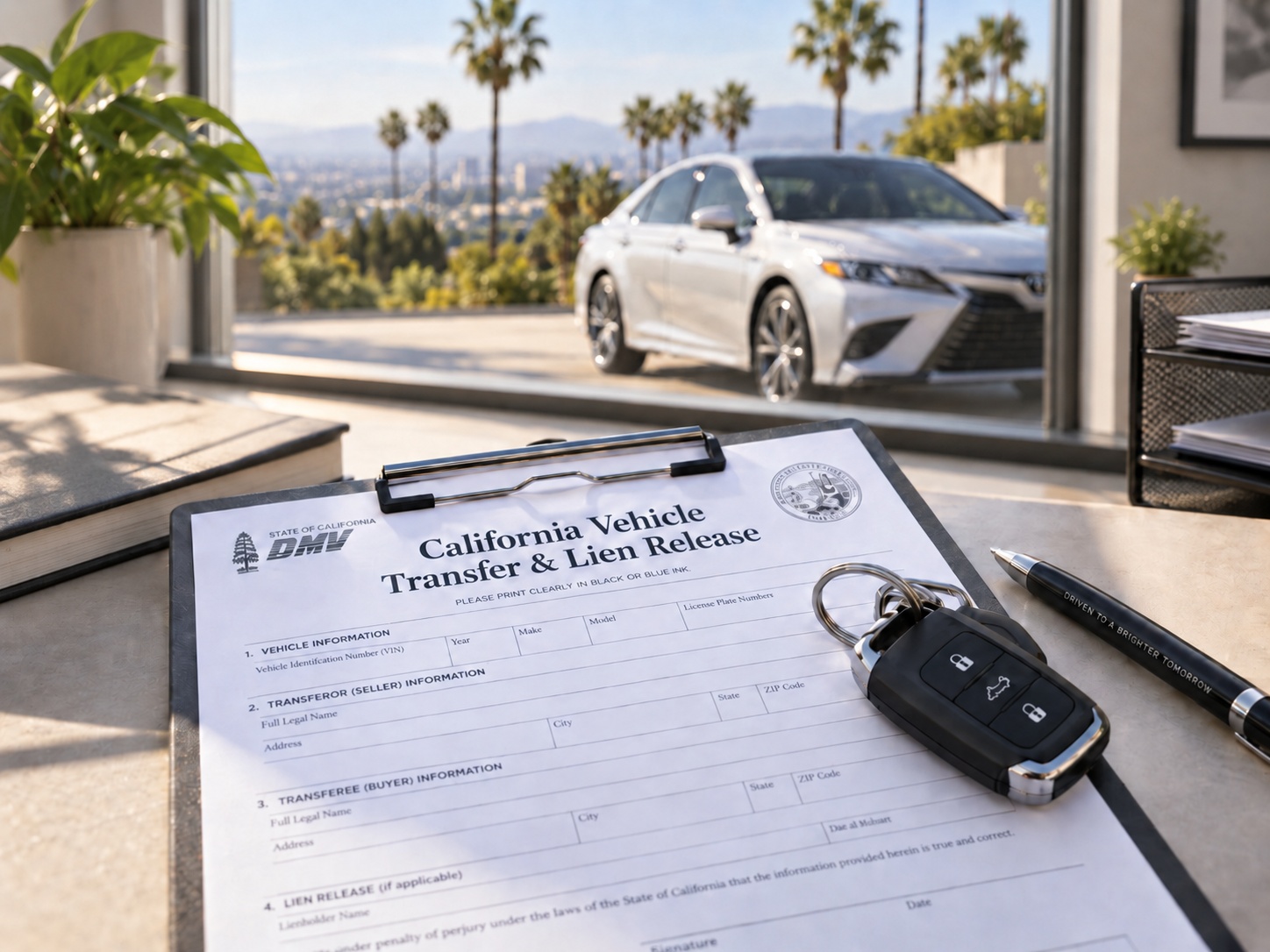
Because the lienholder has a legal interest in the vehicle, the lien must be properly paid, released, or otherwise resolved as part of the transaction. This applies whether the lien comes from an auto loan, an unpaid repair bill, towing and storage charges, or another enforceable claim against the vehicle.
So, if you are asking, “Can I sell my car with a lien on it?” the short answer is yes. The more important question is how you will satisfy the lien and provide the buyer with a valid path to ownership.
A Signed Title Does Not Automatically Clear a Lien
The biggest misunderstanding is that signing a title or preparing a bill of sale automatically makes the buyer the legal owner.
That may sound logical. However, if you still owe money on an auto loan, your lender remains the vehicle’s legal owner or lienholder of record. Hence, you cannot erase its interest simply by signing an agreement with someone else.
The same problem arises when a seller tells a buyer, “You can take the car and continue making my monthly payments.” Auto loans generally cannot be transferred that way. The buyer would need financing approved in the buyer’s own name unless the lender expressly allows another arrangement. Until the existing loan is paid and the lien is released, the original borrower remains responsible for it.
Selling a lien-affected car is not automatically illegal. The danger comes from concealing the lien, misrepresenting the title as clear, or taking the buyer’s money without a workable plan to release the lien.
Disclosing a lien does not remove it. The payoff and release must be built into the sale.
Start With an Official Payoff Quote
Before advertising the car or accepting a deposit, contact the lienholder and ask for its current payoff instructions.
Do not rely only on the balance displayed in a banking app. That figure may not include interest accruing through the proposed payment date or other amounts needed to close the account.
Ask the lender:
- What is the exact payoff amount?
- Through what date is the quote valid?
- Does the lender provide a 10-day payoff quote or use another period?
- Which payment methods will it accept?
- Can the buyer or buyer’s lender pay it directly?
- Does it hold a paper title, or is the lien recorded electronically?
- What will it do after receiving cleared funds?
- How long does its lien-release process normally take?
California operates an Electronic Lien and Title system. When an electronic lien is satisfied, the lienholder sends a satisfaction notice to the DMV, after which the title may be issued to the registered owner or a new lienholder. However, processing the payment and receiving a paper title are not necessarily simultaneous events. That is why sellers should not promise a title-delivery date that the lender has not confirmed. See the California DMV Electronic Lien and Title Program for the official process.
What Happens When the Car Is Worth More Than the Loan?
If the buyer’s price exceeds the payoff, you have positive equity.
Suppose the lender’s payoff is $12,000 and the buyer agrees to pay $16,000. The transaction can be structured so that:
- The lender receives the $12,000 needed to satisfy the loan.
- You receive the remaining $4,000, subject to any transaction expenses.
- The lender releases its interest.
- The ownership transfer is completed using the documents required for that vehicle.
The buyer should not simply give you the entire $16,000 and trust you to pay the lender later. A coordinated payment made at the lender’s branch, through the buyer’s financing institution, or through a reputable vehicle escrow service gives both parties better protection.
Can You Sell a Car With a Lien When You Owe More Than It Is Worth?
Yes, but negative equity must be covered.
Suppose your payoff is $20,000, while the best available offer is $15,000. The missing $5,000 does not disappear when you sell the vehicle. The lender generally expects the full payoff before releasing its lien.
Pay the Shortfall Yourself
You can combine the buyer’s $15,000 with $5,000 of your own money. Once the lender receives the complete $20,000 payoff, it can begin the lien-release process. This is usually the cleanest option for a private sale.
Replace the Shortfall With an Unsecured Loan
If approved, you may use a personal loan to cover the difference. This separates the remaining debt from the vehicle, allowing the auto lien to be satisfied. However, the debt still exists. Hence, interest rates, origination fees, and monthly payments should be considered before choosing this route.
Roll the Negative Equity Into Another Vehicle Loan
A dealership may be able to pay the existing loan and include the shortfall in financing for your replacement vehicle.
This can make the immediate transaction easier, but it may also leave you borrowing more than the next car is worth from the beginning. So the convenience should be weighed against the increased principal, interest, and risk of remaining underwater.
What you should not do is hand over the car while promising to cover the shortage later. The buyer may be unable to complete the title transfer, while you remain responsible for a loan secured by a vehicle you no longer possess.
The difference between positive and negative equity determines where the money goes at closing:
| Positive Equity | Negative Equity |
|---|---|
| The offer is higher than the payoff. The lender is paid first, and the remaining amount can go to the seller. | The payoff is higher than the offer. The seller must normally cover the shortfall before the lender will release its lien. |
| Example: a $16,000 offer minus a $12,000 payoff leaves about $4,000 for the seller, subject to transaction expenses. | Example: a $15,000 offer against a $20,000 payoff leaves a $5,000 deficit that still has to be resolved. |
Handing over the vehicle while promising to pay the shortfall later leaves the buyer without a clean transfer and the seller responsible for a loan secured by a car they no longer possess.
The Safest Structure for a California Private Sale
A private buyer has good reason to be cautious. Therefore, the sale should be organized as a three-party transaction between the seller, buyer, and lienholder.
1. Verify the Parties and the Vehicle
Compare the seller’s government-issued identification with the registration and ownership records. Both parties should also verify the VIN displayed on the actual vehicle rather than relying on a number sent by text or included in an advertisement.
If the seller is not the registered owner, stop until the person’s legal authority to sell the vehicle is established.
2. Confirm the Payoff Directly
The seller should obtain a current written payoff quote. Ideally, the seller and buyer should then contact the lender together, with the seller authorizing the lender to discuss the transaction.
The buyer should confirm the payoff amount, accepted payment method, lien-release procedure, and title-delivery instructions.
3. Pay the Lienholder as Part of the Closing
If the lender has a local branch, the parties may be able to complete the financial side of the sale there. The buyer pays the agreed amount toward the loan, while the seller contributes any negative-equity shortfall.
If there is no accessible branch, the parties can follow the lender’s remote payoff instructions or consider a reputable escrow provider experienced in lien-affected vehicle sales. Do not hand the seller unrestricted cash based only on a promise that the lender will be paid afterward.
4. Complete the Correct Transfer Documents
The exact paperwork depends on the title’s status, the vehicle’s age, and whether the lien is recorded electronically.
A California Bill of Sale, REG 135, can document the parties, price, vehicle, and sale date, but it does not by itself release a lien. Similarly, REG 227 can be used in certain replacement-title, paperless-title, and transfer situations, but it is not a universal substitute for every title or lien release.
California’s rules are especially strict for newer vehicles. The DMV states that, for a California-titled vehicle two model years old or newer, a separate REG 166 or other standalone lien release is not accepted in place of the required title procedure. Therefore, confirm the document requirements for the specific vehicle rather than downloading a form and assuming it will work. The DMV explains these requirements in its basic transfer guidance.
5. Report the Sale on Time
The seller must submit a Notice of Transfer and Release of Liability, commonly called the NRL, within five calendar days after the sale or transfer. Keep the submission confirmation with the bill of sale and payoff records.
The NRL reports the transfer, but it does not complete the buyer’s title application. The buyer must also submit the ownership transfer and applicable fees. California requires a change of ownership or lienholder to be reported to the DMV within ten days. The official deadlines and transfer information are available through the California DMV title-transfer page.
What If the Loan Was Paid but the Lien Still Appears?
Paying the debt and correcting the DMV record are related, but they are not always completed at the same time.
Start by gathering:
- The final loan statement showing a zero balance
- The lender’s payoff confirmation
- Bank records showing the final payment
- Your payment history
- Emails or letters exchanged with the lender
- The current title and registration documents
If the lender is still operating, contact its title or lien-release department. Ask it to submit the electronic release or provide the document required for your vehicle. If telephone requests go nowhere, make a written request and preserve proof of delivery.
If the original lender failed or was acquired, identify the successor institution. A successor bank may now be responsible for releasing the old lien.
California also has a diligent-effort procedure for some unavailable legal owners. Depending on the circumstances, this can involve sending a certified letter to the lienholder’s last known address and preserving the returned, unopened letter or proof that no response was received. Additional statements, supporting evidence, or a bond may be required. Newer vehicles and ELT lienholders have special rules, so review the DMV’s unavailable legal-owner procedures before attempting a sale.
Until the record and release documents are in order, do not advertise the car as having a clear title.
Mechanic’s Liens Are Different From Auto Loans
A repair shop may have a possessory lien when authorized work has been completed and the customer has not paid the lawful charges. This means the shop may retain possession of the vehicle and, after following California’s procedures, pursue a lien sale.
However, a repair facility does not receive unlimited authority to perform any work it wants and then demand payment. California repair dealers must follow rules governing estimates, customer authorization, invoices, and storage charges. The Bureau of Automotive Repair confirms that a repair dealer may conduct a lien sale for unpaid authorized parts and labor when the applicable requirements have been met. Its requirements are explained in the BAR documentation and authorization guide.
If you dispute a repair lien:
- Request the written estimate, authorization records, itemized invoice, and storage policy.
- Preserve text messages, emails, photographs, and payment records.
- Ask when repairs were completed and when storage charges began.
- Consider paying under protest if that is the practical way to stop mounting storage fees, but obtain legal advice before relying on that strategy.
- File a complaint with the California Bureau of Automotive Repair if the dispute involves unauthorized or improper automotive repairs.
Do not try to remove the vehicle secretly or forcibly. Ownership of the car does not necessarily defeat a facility’s valid right to retain possession while its lien is unresolved.
Towing and Storage Liens Can Become Expensive Quickly
A towing or storage facility may pursue a lien sale to recover eligible towing and storage charges. Because storage charges can continue accumulating, ignoring the notices can turn a manageable bill into a much larger problem.
A Notice of Pending Lien Sale is not junk mail. It tells registered owners, legal owners, and other interested parties that a sale process has begun. California provides a Declaration of Opposition process, but deadlines and procedures matter. If the DMV receives a valid opposition, the sale cannot simply proceed unless the lienholder satisfies one of the permitted next steps, such as obtaining a court judgment.
The California DMV lien-sale page explains the process for vehicle owners and lienholders.
If law enforcement ordered the tow, you may also have a right to request a post-storage hearing to challenge the legal basis for the tow. Contact the agency that ordered it immediately because the deadline can be short.
Does a Court Judgment Automatically Become a DMV Lien?
Not necessarily.
A judgment against the owner and a lender listed as the legal owner on a California title are not the same thing. A creditor may need to take additional enforcement steps before it can seize and sell a particular vehicle, such as obtaining a writ of execution and arranging a sheriff’s levy.
However, that does not mean a general judgment can safely be ignored. A judgment creditor may acquire rights against personal property, and tax liens, bankruptcy orders, family-law orders, and accident-related judgments can raise additional issues. A debtor may also be entitled to protect some vehicle equity through California’s exemption laws.
Before selling, determine:
- Whether the DMV record identifies a legal owner or lienholder
- Whether a sheriff has levied the particular vehicle
- Whether a court order restricts its transfer
- Whether a state or federal tax lien may attach to the vehicle
- Whether the owner is in bankruptcy
- How much equity remains after the auto lender’s senior claim
- Whether a current California vehicle exemption applies
Because selling property after a levy, court restriction, or bankruptcy filing can have serious consequences, obtain legal advice when any of these conditions exists.
Can Cash Cash Cars Buy a Vehicle With a Lien?
Cash Cash Cars may be able to buy a lien-affected vehicle when the ownership can be verified and there is a legitimate, documentable path to paying and releasing the lien.
That can include:
- A vehicle with an outstanding auto loan
- A vehicle with positive or negative equity
- A vehicle being held by a repair shop
- A vehicle stored at a tow yard
- A paid-off vehicle whose lien release needs to be documented
The first step is to provide accurate information about the vehicle and the claim against it. Cash Cash Cars will generally need the VIN, year, make, model, mileage, condition, registration information, lienholder’s identity, and current payoff or invoice.
If the purchase price exceeds the lien, the remaining amount can be paid to the seller after the agreed obligations are satisfied. If the lien exceeds the offer, the seller must normally provide the shortfall unless the lienholder agrees to another lawful resolution.
Cash Cash Cars may coordinate with a lender, repair facility, tow yard, or storage facility when appropriate. However, it cannot override a court order, erase a disputed claim, purchase a vehicle from someone who cannot establish the right to sell it, or complete a transaction after a valid lien sale has already transferred ownership.
For a closer look at this process, read how to sell a car with a lien through Cash Cash Cars.
What Should You Have Ready Before Requesting an Offer?
- Government-issued identification
- Current registration or other ownership evidence
- The VIN
- Vehicle mileage and condition
- The lender’s current payoff quote
- The payoff quote’s expiration date
- The lender’s payment instructions
- Repair-shop or tow-yard invoices
- Any Notice of Pending Lien Sale
- Proof of previous payments
- Court, bankruptcy, tax, or levy documents affecting the vehicle
Cash Cash Cars can review the transaction and explain what information is still needed. However, the exact timeline will depend on the lienholder, title status, documentation, and DMV processing.
Frequently Asked Questions
Can I sell my car with a lien on it if the buyer knows about the loan?
Yes, but disclosure alone does not clear the lender’s interest. The payoff and lien release should be built into the transaction so the buyer has a valid path to title.
Can you sell a car with a lien through a dealership?
Usually, yes. A dealership can obtain the payoff and pay the lender as part of a purchase or trade-in. If you have negative equity, you must pay the difference or, if approved, include it in financing for another vehicle.
Can you sell a car with a lien on it privately?
Yes. The safer approach is to verify the payoff directly with the lender and direct the required funds to the lender during the closing. The seller should contribute any shortfall before relinquishing the vehicle.
Can u sell a car with a lien on it without paying the full balance?
Only if the lienholder formally agrees to accept less, authorizes a transfer that keeps its interest protected, or another legally valid arrangement applies. A private agreement between buyer and seller does not force the lienholder to release its claim.
Can I use a bill of sale while waiting for the lien release?
A bill of sale helps document the transaction, but it does not replace the lienholder’s release or complete the California title transfer. The parties should not rely on it as proof of clear ownership.
The Answer Comes Down to Coordination
If you want to sell a lien-affected vehicle in California, take these steps in order:
- Identify the lien. Confirm whether it comes from a lender, repair shop, towing or storage facility, court enforcement action, tax claim, or another source.
- Get the current amount and instructions. Obtain the official payoff quote or itemized claim and learn exactly how the lienholder will release its interest.
- Compare the payoff with the vehicle’s value. Determine whether the sale leaves positive equity or a shortfall you must cover.
- Coordinate the closing. Direct the required funds to the lienholder rather than relying on a promise to pay it afterward.
- Complete the California paperwork. Use the documents required for the vehicle and title status, submit the NRL within five calendar days, and keep proof of the transaction.
Because a lien-affected sale involves more than the seller and buyer, nobody should have to rely only on trust. The lienholder should receive the required payment, the buyer should receive a documented path to ownership, and the seller should leave with evidence that the vehicle and related obligations were properly transferred.
Official California Sources
- California DMV Electronic Lien and Title Program
- California DMV Basic Transfer Requirements
- California DMV Title Transfers and Changes
- California DMV Unavailable Legal Owners
- California DMV Lien Sales for Vehicles
- California Bureau of Automotive Repair Documentation and Authorization Requirements
- California Bureau of Automotive Repair Complaint Process